
Understanding Leash Reactivity in Dogs
Leash reactivity in dogs is one of the most common — and most misunderstood — behavior challenges pet owners face. If your dog transforms from calm companion to barking, lunging chaos the moment another dog or person appears on a walk, you are not alone.
Here's a quick summary of what you need to know:
- What it is: Leash reactivity is when a dog overreacts to triggers (other dogs, people, bikes, etc.) while on leash — barking, lunging, growling, or pulling
- Why it happens: The leash prevents your dog from either fleeing or approaching, creating fear or frustration that explodes as reactive behavior
- What it looks like: Stiff body, hard stare, hackles up, then barking and lunging at the trigger
- What helps: Staying below your dog's reaction threshold, counter-conditioning with high-value treats, and consistent rewards-based training
- What makes it worse: Punishment, tight leashes, head-on approaches, and forcing greetings
One moment your dog is trotting happily beside you. Then another dog rounds the corner — and suddenly you're holding on for dear life. That "Dr. Jekyll and Mr. Hyde" moment is jarring, embarrassing, and exhausting. But it is treatable.
I'm Allen Daniels, co-founder of Paws University in Kailua-Kona, Hawaii County, and I've spent over 25 years applying operant conditioning principles — first with marine mammals, then with dogs — to address behavioral challenges exactly like leash reactivity in dogs. The same trust-based, reward-driven methods that work with 500-pound dolphins work remarkably well with your reactive pup.
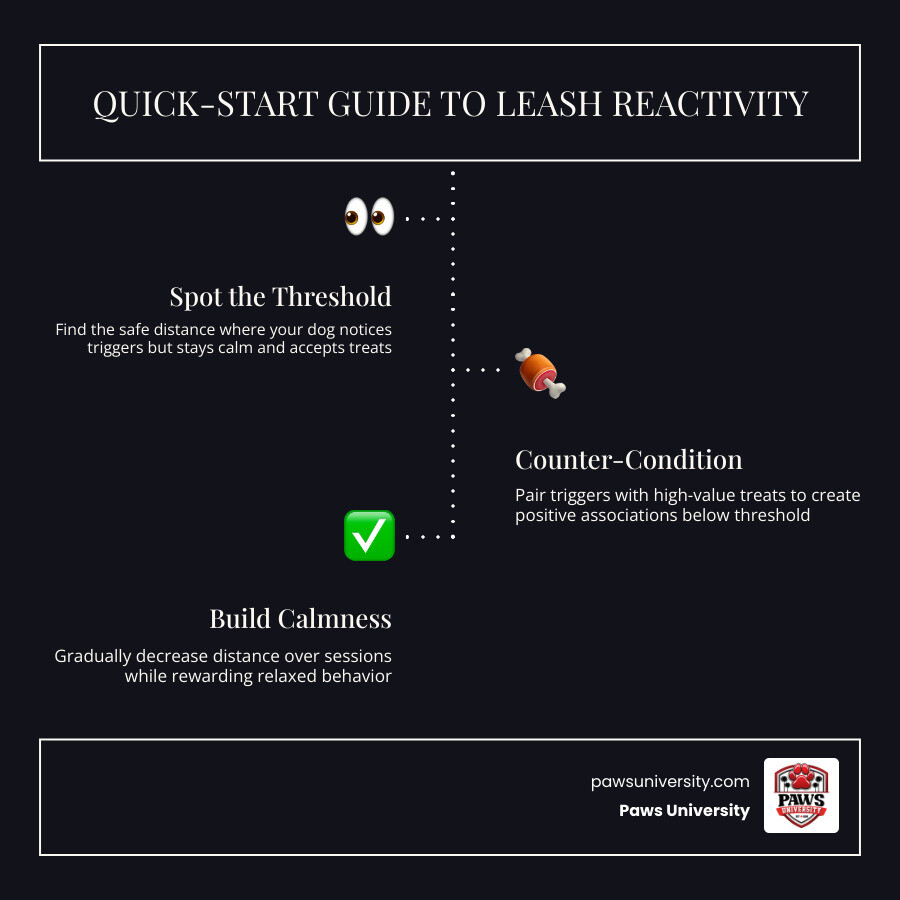
When we talk about leash reactivity in dogs, we aren't necessarily talking about "aggression." Instead, we are describing a dog’s intense response to something in their environment. This behavior is often a result of big emotions that the dog doesn't know how to handle while tethered to a human.
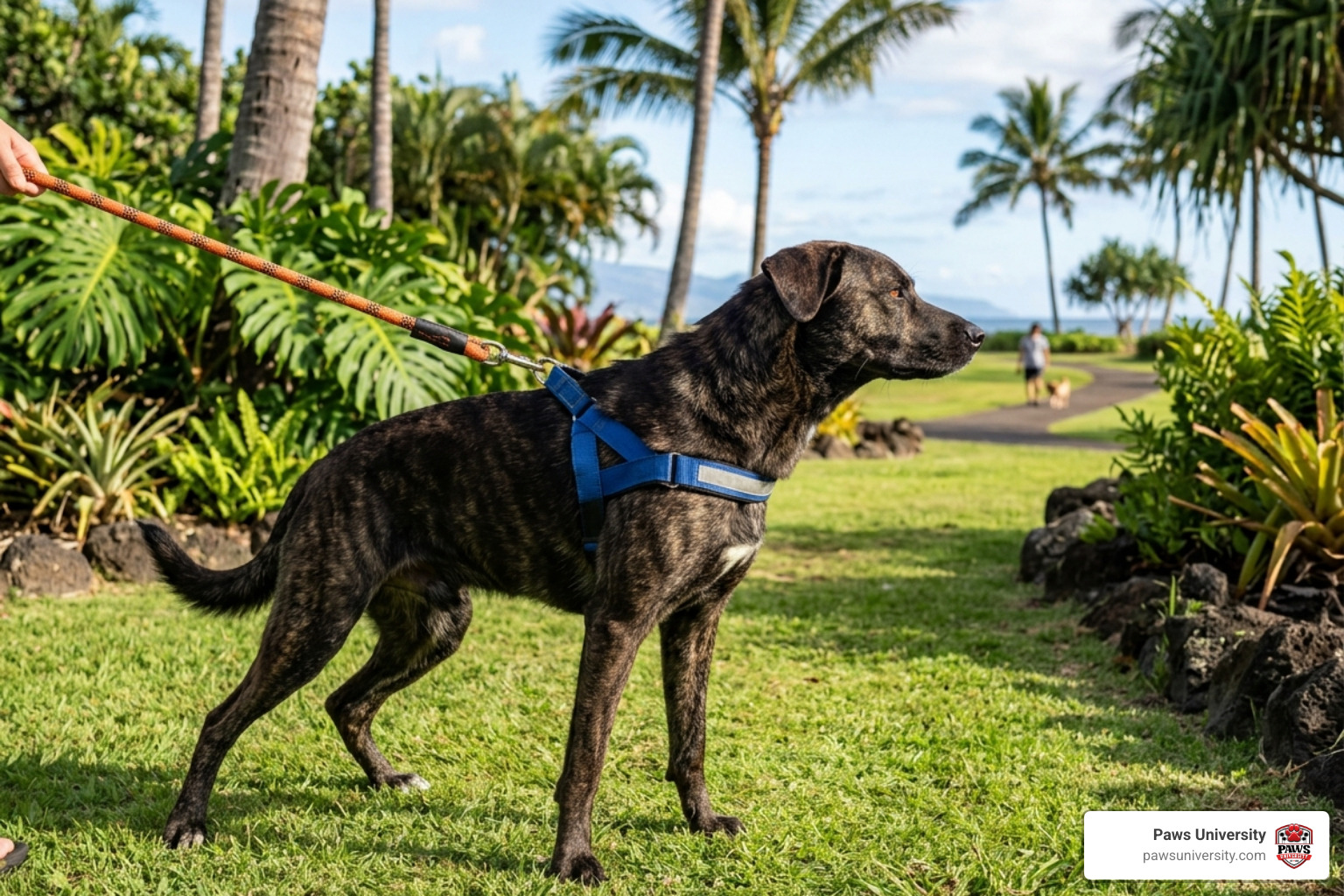
There are three primary emotional drivers behind these outbursts:
- Fear-Based Reactivity: The dog feels threatened by the "trigger" (the other dog or person) and wants to create distance. Because the leash prevents them from running away, they resort to a "the best defense is a good offense" strategy—barking and lunging to scare the scary thing away.
- Frustration-Based Reactivity: This often happens to "social butterflies." The dog desperately wants to greet the other dog, but the leash holds them back. This barrier frustration builds up until it explodes into a tantrum that looks a lot like aggression.
- Barrier Frustration: Similar to frustration, this occurs when a dog feels restricted by a physical boundary, like a fence or a leash, which prevents them from investigating a stimulus.
According to research on Leash Reactivity (Confinement) in Dogs | PetMD, this behavior is frequently a "confinement" issue. When a dog feels trapped, their natural "flight" option is taken off the table, leaving "fight" as their only perceived way to stay safe or get what they want. If you've noticed your dog acting out, you might also be wondering how to stop your dog growling at other dogs in these high-stress moments.
The Role of the Leash
The leash is a vital safety tool, but it fundamentally changes how dogs interact. In a natural, off-leash setting, dogs rarely approach each other head-on; they move in curves and arcs, sniffing the ground and showing "soft" body language.
When we walk dogs on a 6-foot lead, we often force them into direct, "rude" head-on approaches. Furthermore, as owners, we often tighten the leash the moment we see another dog. This tension travels straight down the line. To the dog, a tight leash signals that we are stressed, which confirms their suspicion that the approaching dog is a threat. This creates a feedback loop of anxiety between the handler and the dog, as noted by Veterinary Partner - VIN.
Common Signs and Body Language
Early detection is the secret to managing leash reactivity in dogs. Before the first bark happens, your dog is likely screaming for help with their body language. Watch for these "pre-reaction" signals:
- The Hard Stare: Locking eyes with the trigger and refusing to look away.
- Stiff Posture: The body becomes rigid, and the tail may be held high and vibrating (which is not a happy wag).
- Hackles Up: The hair along the spine (piloerection) stands up.
- Lip Licking or Yawning: These are "calming signals" indicating the dog is already feeling internal pressure.
- Whining: Often the precursor to a full-blown bark in frustrated greeters.
Understanding these cues is a major part of managing dog aggression and preventing a full-scale meltdown on the sidewalk.
Identifying Triggers and Threshold Distances
To help your dog, you must become an expert on what sets them off and exactly how close they can get before losing control. This is known as the "threshold."
One concept to keep in mind is trigger stacking. Imagine your dog has a "stress bucket." A loud truck goes by (a little water in the bucket), then a neighbor yells (more water), then a bird flushes out of a bush (even more water). By the time you see another dog, the bucket is already overflowing. On "stacked" days, your dog's threshold will be much larger than usual.
Determining Your Dog's Threshold
The threshold is the "invisible line" where your dog transitions from being aware of a trigger to reacting to it.
| Behavior Under-Threshold | Behavior Over-Threshold |
|---|---|
| Can look at the trigger and then look away | Locks eyes and cannot look away |
| Will enthusiastically take a high-value treat | Refuses treats or "snaps" at them blindly |
| Can follow simple cues (Sit, Touch) | Appears "deaf" to your voice |
| Body is relaxed or only slightly alert | Body is rigid, lunging, or barking |
Finding this distance—whether it's 20 feet or 100 yards—is crucial. As Pet InfoRx points out, training must happen under the threshold. If your dog is already barking, they are no longer in a "learning" state of mind; they are in "survival" mode.
Common Triggers for Leash Reactivity in Dogs
Every dog is an individual, but most reactive pups share a common list of "enemies":
- Unfamiliar Dogs: Especially those that are also staring or pulling.
- Fast-Moving Objects: Bicycles, skateboards, or joggers.
- Novelty: People wearing large hats, carrying umbrellas, or wearing bulky backpacks.
- Specific Environments: Narrow trails or vet clinic parking lots where space is limited.
Experts emphasize that identifying these specific triggers allows you to plan your walks like a "defensive driver," avoiding situations that set your dog up for failure.
Management Strategies for Stress-Free Walks
Management isn't training—it's damage control. It's about preventing your dog from "practicing" the reactive behavior while you work on the underlying issues.
If you see a trigger approaching and realize you can't maintain a safe distance, don't feel bad about turning around! Knowing how to stop your dog from growling at you or others often starts with simply removing the pressure of the situation.
Immediate Handling Techniques
When you find yourself in a "tight spot" on a Hawaii County trail, use these emergency tools:
- The Emergency U-Turn: Practice this when no triggers are around. Give a cheerful cue like "Let's go!", pivot 180 degrees, and jog a few steps away, rewarding your dog for following.
- Visual Barriers: Use parked cars, bushes, or even your own body to block your dog's line of sight to the trigger.
- The "Find It" Game: Toss a handful of treats on the ground. This forces the dog to put their nose down (a natural calming behavior) and focus on the floor rather than the approaching "threat."
These strategies, recommended by ASPCA Pro, keep the situation from escalating into a dangerous confrontation.
Alternative Exercise and Enrichment
If your neighborhood is a "minefield" of triggers, it's okay to skip the traditional walk while you are in the early stages of training. Constant "blow-ups" keep your dog's cortisol levels high for days.
Instead, try:
- Sniffaris: Take your dog to a quiet, open area on a long line and let them sniff to their heart's content.
- Indoor Games: Use nose work or hide-and-seek to burn mental energy.
- Tropical Garden Exploration: Utilize your own yard or our expansive seven-acre outdoor campus in Hawaii County for premium play and training sessions in a warm, tropical environment.
Experts note that reducing the frequency of reactive events is the first step toward a calmer dog.
Training Techniques for Leash Reactivity in Dogs
To truly "fix" the behavior, we have to change how the dog feels about the trigger. This is called counter-conditioning. We want the dog to see another dog and think, "Oh boy, here comes the chicken!" instead of "Oh no, here comes trouble!"
Popular Training Games: LAT and Open Bar
Two of the most effective rewards-based games for leash reactivity in dogs are:
- Look at That (LAT): When your dog notices the trigger at a safe distance, you say "Yes!" (or click) and give a high-value treat. Eventually, the dog will see the trigger and immediately look at you for their reward. This teaches them to "check in" rather than "lock on."
- Open Bar/Closed Bar: The "bar" opens (continuous high-value treats) the moment the trigger appears. When the trigger disappears, the "bar" closes (no more treats). This creates a very clear association: Trigger = Awesome Snacks.
By using these methods, you are addressing the emotional root of the problem. If you are struggling with specific sounds or warnings, learning how to stop your dog growling at other dogs through these games is a game-changer.
Why to Avoid Punishment and Aversives
It is tempting to "correct" a barking dog with a leash pop or a shout, but this is incredibly dangerous for reactive dogs. Punishment may suppress the barking, but it increases the dog's underlying anxiety.
Experts warn that punishing a dog for growling is like taking the batteries out of a smoke detector. You haven't put out the fire; you've just removed the warning. This can lead to "silent bites," where a dog skips the warning signs and goes straight to a physical reaction because they've been taught that communicating their discomfort is "wrong."
Essential Equipment and Safety Tools
The right gear can make a world of difference in your confidence and your dog's comfort.
- Front-Clip Harnesses: These are the gold standard for reactive dogs. When the dog pulls, the harness gently redirects their momentum back toward you, giving you more control without causing pain.
- Fixed-Length Leashes: Use a sturdy 4-to-6-foot leash. Never use retractable leashes for a reactive dog; they offer zero control and can snap or cause "rope burn" during a lunging episode.
- Head Halters: For very strong pullers, a head halter can help redirect the dog's gaze, but it requires careful acclimation so the dog doesn't find it stressful.
If you're dealing with redirected behavior, you might need to learn how to stop your dog from growling at you when you try to move them away from a trigger.
Safety and Muzzle Training
Muzzles are not a sign of a "bad dog"—they are a sign of a responsible owner. A comfortable basket muzzle allows a dog to pant, drink, and take treats while ensuring everyone stays safe. This is especially important given the leash laws in Hawaii, which require dogs to be under control in public areas. Conditioning your dog to love their muzzle (by putting treats inside it) can lower your stress levels significantly during walks.
Frequently Asked Questions about Leash Reactivity in Dogs
How long does it take to see improvement?
Progress is rarely a straight line. Most owners see a noticeable difference within 6 to 12 weeks of consistent, rewards-based training. However, severe cases or dogs with a long history of reactivity may take six months or longer. Success is measured by your dog's ability to recover more quickly after a reaction and a shrinking "threshold distance."
Is my dog aggressive or just reactive?
Most leash reactivity in dogs is driven by fear or frustration, not a desire to cause harm. A great way to tell is to observe your dog off-leash in a controlled environment like a supervised daycare. Many "leash-reactive" dogs are perfectly social and friendly when the restriction of the leash is removed.
When should I seek professional help?
You should reach out to a professional if:
- The reactivity is escalating despite your efforts.
- You feel physically unable to control your dog.
- The dog has successfully bitten a person or another animal.
- You find yourself avoiding walks entirely due to anxiety.
Conclusion
Managing leash reactivity in dogs is a journey that requires patience, empathy, and the right environment. At Paws University, we’ve been West Hawaii’s premier facility since 2002, offering a sprawling seven-acre outdoor campus in Hawaii County designed for the well-being of your pet. Our supervised play and premium training programs are rooted in the same rewards-based philosophy used by world-class animal trainers, conducted in our beautiful tropical setting.
If you’re ready to trade the stressful lunging for peaceful strolls under the Kona sun, we are here to help. Our team understands the unique challenges of the island environment and is dedicated to helping you and your dog thrive together.