Is Overnight Dog Training the Right Choice? What Busy Owners Need to Know
Overnight training for dogs -- also called board and train -- is one of the most effective ways to address problem behaviors fast, especially when your schedule leaves little time for daily training sessions.
Here's how it works at a glance:
| What | Details |
|---|---|
| What it is | Your dog stays with professional trainers full-time, receiving multiple training sessions each day |
| Who it's for | Busy owners, puppies, dogs with behavioral issues like barking, reactivity, or destructive habits |
| What's taught | Basic obedience, leash manners, recall, house manners, socialization |
| How long | Typically 1 to 4 weeks depending on the dog and goals |
| What you get back | A dog with new skills -- plus a hands-on handoff session so you know how to maintain them |
The core idea is simple: immersion works. A dog receiving consistent, rewards-based instruction throughout the day -- in a structured, distraction-rich environment -- learns faster than one trained in short bursts at home between busy schedules.
For Hawaii County pet parents dealing with separation anxiety, mild reactive behavior, or a dog that just won't listen, this kind of intensive program can feel like a genuine turning point.
I'm Allen Daniels, co-founder of Paws University and a professional animal trainer since the early 1990s, where I developed my expertise in rewards-based Operant Conditioning training marine mammals before applying those same science-backed methods to overnight training for dogs. Over 25+ years training hundreds of dogs on our seven-acre Kailua-Kona campus, I've seen how the right immersive environment transforms even the most challenging behaviors into reliable, lasting skills.
Understanding the Board and Train Model
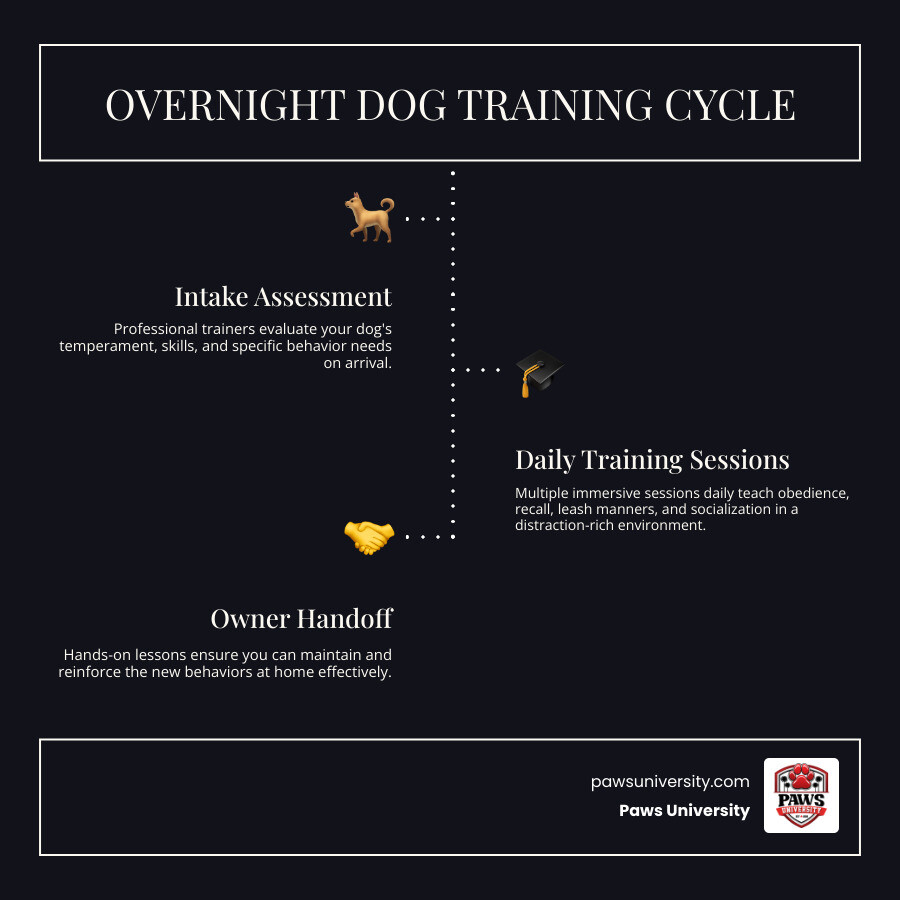
When we talk about the board and train model, we are describing a "boarding school" experience for your canine companion. Instead of you struggling to find thirty minutes after a long work day to practice "sit" and "stay," your dog enters a world where every interaction is a learning opportunity. At our premium campus in Hawaii County, we utilize our spacious environment to provide a setting that is both stimulating and educational.
The beauty of the overnight training for dogs model lies in 24/7 consistency. In a home environment, a dog might get mixed signals -- one family member lets them jump on the couch, while another scolds them for it. In a professional Training program, the rules never change. This clarity reduces stress for the dog and allows them to map out "correct" behaviors much faster. Our professional trainers monitor every group and individual session, ensuring that the rewards-based philosophy is applied at every turn. You can explore more about our approach in our Category Dog Training section.

Core Skills Taught During overnight training for dogs
What exactly does a dog learn when they stay overnight? While programs are often customized, there are several foundational "pillars" of behavior that almost every dog benefits from:
- Leash Manners: We focus on teaching dogs to walk calmly by your side without pulling, making your sunset walks along the Kona coast much more enjoyable.
- Reliable Recall: Coming when called is a safety essential. We use positive reinforcement to make "come" the most rewarding word your dog hears.
- Basic Obedience: This includes the "Big Three" -- Sit, Down, and Stay -- performed reliably even when there are distractions nearby.
- House Manners: We address several common nuisances like jumping and demand behavior.
Transitioning Skills to the Home Environment
A common concern among owners is: "Will my dog only listen to the trainer?" This is why the "go-home" lesson is perhaps the most important part of the entire program. We don't just hand you a leash and say goodbye. We spend significant time educating the owner on how to use the same cues, hand signals, and reward structures we used during the stay.
Success is a team effort. Once the dog has the "software" installed, we teach you how to run the program. This transition often includes Private Training sessions where you practice with your dog under our supervision. We provide follow-up support because we know that real life happens, and we want to ensure those new skills stick for the long haul.
Benefits of Intensive Professional Instruction
The primary benefit of intensive instruction is the sheer volume of "reps" a dog gets. In a standard one-hour weekly class, a dog might get 20 minutes of actual focused work. In an overnight program, they might engage in 3 to 5 sessions a day, spaced out to maximize retention. This frequency allows for rapid progress that would normally take months to achieve at home.
Distraction management is another huge plus. On our tropical campus, we can carefully control the level of "noise" -- starting in a quiet area and gradually moving to areas with more activity, other dogs, or interesting island scents. This builds a dog's "focus muscle," teaching them to listen even when the world is exciting.
Why Busy Owners Choose overnight training for dogs
Let's be honest: life in Hawaii County is beautiful, but it's also busy. Between work, family, and enjoying the island, many owners find it difficult to maintain the rigid consistency required to fix a behavioral issue.
- Time-Saving: You outsource the heavy lifting of the "acquisition phase" (the part where the dog learns what the command actually means) to professionals.
- Expertise: Professional trainers can read subtle body language cues that an owner might miss. This is especially helpful for behavior modification, such as learning How to Stop Your Dog from Growling at You.
- Early Intervention: As we like to say, The Early Bird Gets the Best Behaved Dog. Starting a puppy in an overnight program prevents bad habits from ever taking root.
Long-term Success and Reliability
The goal of overnight training for dogs isn't just a "quick fix." It's about classical conditioning and habit formation. When a dog performs a behavior correctly hundreds of times in a row and is rewarded for it, that behavior becomes a "default."
We also work toward "environmental neutrality." This means the dog learns that a sit is a sit, whether they are in a training yard, a parking lot, or your living room. By exposing them to different areas of our seven-acre campus, we help generalize their training so it holds up in the real world.
Selecting a Reputable Rewards-Based Program
Not all training programs are created equal. When researching overnight training for dogs, it is crucial to look for a facility that uses rewards-based methods. This means using things the dog loves -- treats, praise, play, and affection -- to encourage good choices. We firmly believe that training should build a bond of trust and respect, not fear.
A reputable program should be transparent about their facility standards. In Hawaii County's warm climate, look for premium amenities like temperature-controlled lodging, large outdoor play areas, and a staff-to-dog ratio that ensures your pet isn't just sitting in a kennel all day.
Preparing Your Pet for a Successful Stay
To ensure your dog has the best experience possible, a little preparation goes a long way.
- Vaccination Requirements: For the health of all our guests, up-to-date vaccinations (including Rabies and Distemper/Parvo) are mandatory.
- Temperament Assessment: Most reputable programs require a "Meet & Greet" or evaluation. This helps us understand your dog's personality and ensure they are a good fit for a group environment.
- Packing Essentials: We usually recommend bringing your dog's regular food to avoid tummy upsets. You might also bring a familiar blanket or toy to help them settle in, though we provide premium bedding.
- Information Gathering: Check out our Kona Dog Training Guide From Puppies to Pros for more tips on getting your dog ready for the "university" life.
Frequently Asked Questions about overnight training for dogs
How long do these programs typically last?
Durations vary based on your goals. A 1-week "refresher" or "puppy kindergarten" is great for basic manners. However, for comprehensive obedience or addressing specific behavior issues, most programs last between 2 to 4 weeks. This gives the dog enough time to move past the initial "learning" phase and into the "fluency" phase.
Is my puppy old enough for an overnight program?
Puppies can often start as early as 8 to 12 weeks, provided they have their initial round of vaccinations. Early socialization and "foundation" training (like crate and potty routines) are incredibly effective at this age. We tailor our puppy programs to be gentle, fun, and focused on building confidence.
What training methods are used during the stay?
We use a strictly rewards-based approach. This means we capture and reward the behaviors we want to see more of. We do not use "balanced" training tools like e-collars or prong collars that rely on discomfort. Instead, we use science-backed methods like clicker training or marker words to communicate clearly with your dog.
Conclusion
Professional overnight training for dogs is a significant commitment to your dog's future and your own peace of mind. By choosing an immersive, rewards-based program, you give your dog the benefit of professional expertise and a structured environment that simply can't be replicated in a busy home.
At Paws University, we take pride in being Hawaii County's premier facility. Since 2002, our seven-acre campus has provided a safe, fun, and educational space for island dogs to grow. Whether you have a "tiny terror" of a puppy or an older dog who needs to brush up on their manners, our premium care and expert instruction are here to help. Ready to see the difference immersion can make? Visit our Training page to learn more about joining our pack.