Science-Backed Dog Training Fundamentals
Modern canine behavioral science demonstrates that dogs learn best when we engage their natural desire to earn positive outcomes. When a dog performs a desired behavior and receives an immediate, high-value reward, dopamine pathways in their brain light up. This neurochemical release reinforces the neural connection between the cue, the physical action, and the positive outcome, making the dog eager to repeat the action.
The key to unlocking this enthusiasm lies in precise reward timing. Dogs live entirely in the immediate moment. If more than one or two seconds elapse between the correct action and the reinforcement, your dog may associate the treat with something completely different, such as shifting their weight, blinking, or looking away.
To bridge the gap between action and reward, professional handlers use marker cues—either a handheld mechanical clicker or a crisp verbal marker like "yes!" The marker pinpoints the exact micro-second your dog does what you want, acting as a clear promise that a reward is coming.
For everyday practice, tailor your rewards to the difficulty of the task:
- Low-Distraction Tasks (Living room sit): Standard kibble or basic crunchy biscuits.
- Moderate Challenges (Front-yard focus): Soft training treats, freeze-dried liver, or small bites of cooked chicken.
- High-Distraction Milestones (Public parks, greeting guests): Premium high-value jackpots such as real roast meat, string cheese, or a high-energy tug toy for play-driven dogs.
To explore foundational handling techniques in greater depth, review our guide to dog obedience training.
Understanding Learning Theory in Dog Training
Every interaction you share with your dog involves learning theory. Dogs process the world primarily through two learning pathways:
- Classical Conditioning (Associative Learning): This is involuntary, emotional learning. When your dog hears the rustle of the treat bag or sees their leash, their emotional state changes immediately because they associate that stimulus with something positive.
- Operant Conditioning (Consequence-Based Learning): This involves voluntary behavioral choices. The dog realizes: "When I sit calmly at the door, the door opens. When I jump on the door, nothing happens."
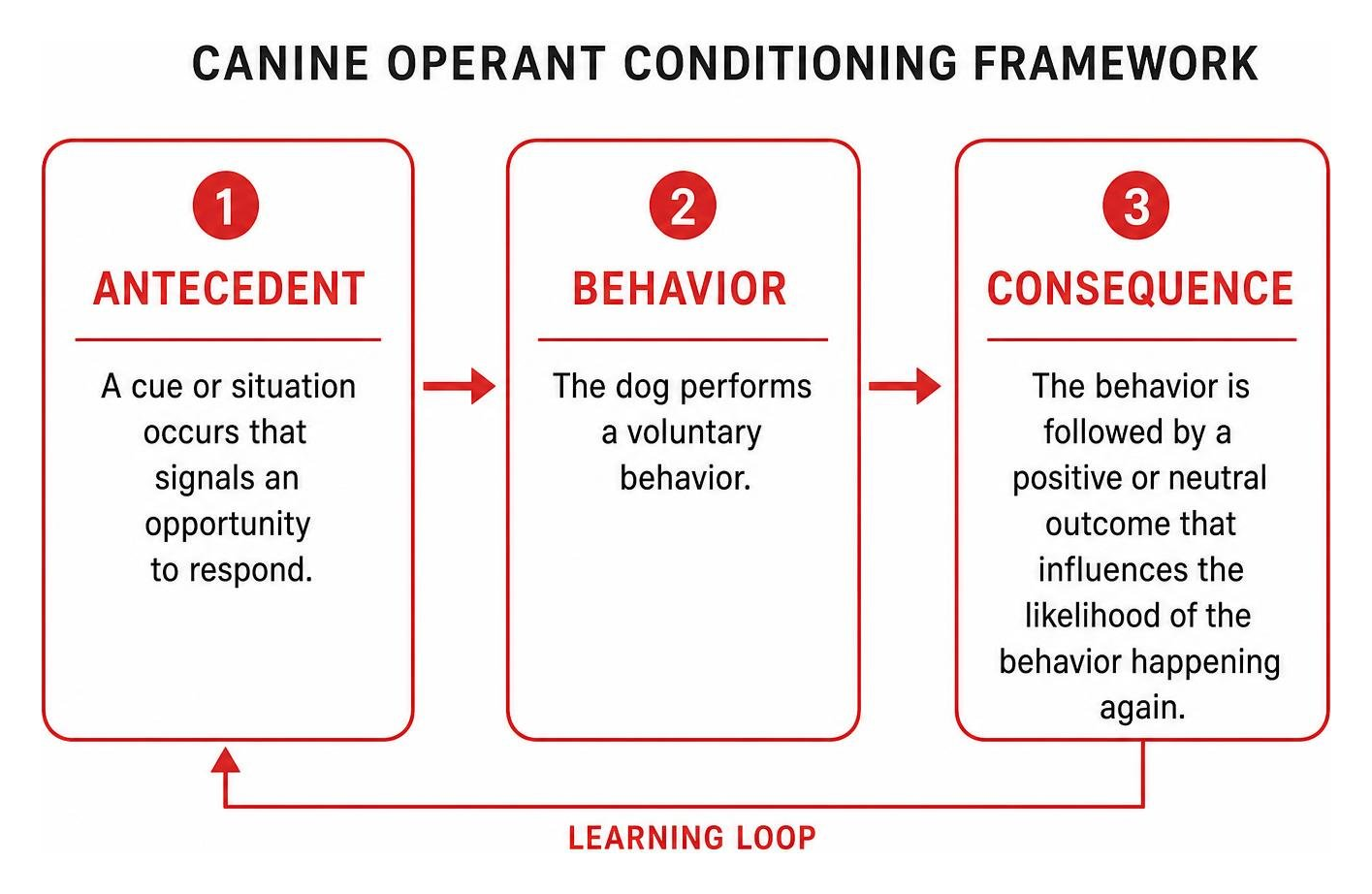
By setting up proactive antecedent management—arranging the environment so your dog cannot rehearse unwanted habits—you make the right choice the easiest choice. Over time, consistent rewards lead to habituation, allowing your dog to stay calm and neutral even around exciting or unfamiliar stimuli.
The Risks of Aversive and Punishment Methods
While old-school training relied heavily on intimidation, leash corrections, and physical force, contemporary science has revealed the severe downsides of punishment-based techniques. A comprehensive 2017 meta-review examining 17 peer-reviewed studies concluded that aversive training methods significantly jeopardize both the physical and mental well-being of dogs.
Furthermore, a landmark 2009 study led by Dr. Meghan Herron demonstrated that confrontational interventions—including shock collars, physical corrections, and yelling—frequently trigger defensive aggression and worsen existing behavioral issues. When a dog is punished for expressing fear or overstimulation, the root emotion is never addressed; instead, the outward warning signals (such as a growl) are suppressed, creating an unpredictable animal.
For an extensive look at humane handling across our island, explore dedicated Hawaii dog positive reinforcement trainers.
Core Skills and Essential Obedience Cues
Building a well-mannered companion starts with a small set of foundational skills: Name Attention, Sit, Down, Stay, and Leave It.
The most reliable way to teach these cues without force is through luring and shaping:
- Lure the Motion: Hold a high-value treat right at your dog's nose, slowly guiding their head upward and back to drop their hips into a natural sit, or downward between their paws to guide a down.
- Mark and Reward: The instant their body achieves the position, mark with "yes!" and deliver the treat.
- Fade the Food Prompt: Within 5 to 10 repetitions, make the exact same hand motion without food in your fingers. Reward from your opposite hand or treat pouch once they complete the motion.
- Attach the Verbal Cue: Say the cue word (e.g., "Sit") one second before presenting your hand gesture.
- Proof the Behavior: Gradually introduce the "3 Ds"—Duration, Distance, and Distraction—adjusting only one variable at a time so your dog continues to succeed.
For early developmental guidance, follow our step-by-step approach to puppy obedience training.
Loose-Leash Walking and Foundation Heel
Walking politely on a leash is an acquired skill, not an innate canine instinct. Dogs naturally walk faster than humans and follow their powerful sense of smell, which contains up to 300 million olfactory receptors.
To teach loose-leash walking, implement the "Be a Tree" technique:
- The instant you feel the leash tighten, stop walking immediately.
- Do not pull back or jerk the line. Simply anchor yourself and wait.
- The moment your dog turns, looks back, or eases the tension, mark with "yes!" and take several steps forward together, rewarding generously at your hip seam.
- Use directional changes (turning 180 degrees) whenever your dog begins to forge ahead, making you the most engaging element of the walk.
- Pair these exercises with a comfortable, non-restrictive front-clip harness to gently redirect forward momentum without putting pressure on the sensitive trachea.
To master structured daily outings, explore our comprehensive plan for loose leash walking.
Reliable Recall and Emergency Response
A reliable recall is the single most important safety behavior your dog will ever learn. An effective recall must always be paired with positive outcomes—never call your dog to you to administer medication, trim nails, or abruptly end their playtime at the park.

Avoid cue poisoning, which occurs when an owner repeats "Come! Come! Come!" while the dog ignores them. If your dog does not respond to the first cue, repeating it merely teaches them that the word is meaningless background noise.
- Set Up a Long Line: Use a 15- to 30-foot biothane long line in an open, grassy space to give your dog freedom while preventing self-reinforcing runaways.
- Make Coming Fun: Call your dog in an upbeat tone, turn, and run backward a few steps to trigger their natural chase drive in your direction.
- Deliver High-Value Jackpots: When your dog reaches you, deliver multiple treats in succession alongside genuine, warm praise.
- Proof with Distractions: Build up to 60+ successful repetitions on a long line across varying environments before testing off-leash freedom in open spaces.
Structured Formats and Learning Progression
Every dog has a unique learning style, temperament, and developmental background. Choosing the right educational environment ensures steady progress while keeping learning fun and stress-free.
| Training Format | Best Suited For | Key Focus Areas | Typical Setting |
|---|---|---|---|
| Puppy Socialization | Puppies 8 to 16 weeks | Novel surface exposure, gentle play styles, bite inhibition | Controlled, sanitized indoor/outdoor spaces |
| Group Manners Classes | Dogs 4+ months needing public manners | Impulse control, focus around other dogs, loose-leash walking | Structured group lawn or training pavilion |
| Private One-on-One | Specific habit modification or focused goals | Tailored problem solving, handling sensitivity, personalized skills | Private field or direct home environment |
| Daycare & Train / Camp | Busy families seeking accelerated progress | Supervised social play, daytime manners immersion, regular handler updates | Multi-acre outdoor canine campus |
To find the ideal fit for your household routine, explore structured local dog training classes.
Structuring Effective Dog Training Sessions
Dogs learn far more effectively through short, frequent training intervals rather than exhausting marathon sessions. A puppy or young adult dog can quickly experience mental fatigue if drilled continuously for an hour.
- Keep active learning sessions between 5 to 10 minutes, scheduled two to three times daily.
- Always end each session on a successful, happy repetition to keep motivation high.
- Practice skills in different rooms, on the patio, and in open yards to help your dog generalize cues across varied environments.
For additional insight into structured classes, discover how Kona pet training classes cultivate essential manners.
Puppy Socialization and Developmental Milestones
The developmental period between 8 and 16 weeks of age is the most critical window in a dog's life. During this phase, the brain is uniquely receptive to novel experiences. Positive, low-stress exposure to different textures (sand, grass, concrete), sounds (traffic, household appliances), and friendly people builds a resilient, confident adult dog.
Ensure your puppy learns gentle bite inhibition by redirecting sharp puppy teeth toward appropriate chew toys, and never isolate a puppy during this vital window. For comprehensive developmental protocols, consult our guide to teaching puppy obedience basics.
Managing Everyday Behavioral Challenges
Most unwanted canine behaviors stem from normal instincts performed in inappropriate contexts, excess energy, or underlying anxiety. Managing the environment and offering clear alternative behaviors resolves issues far faster than scolding.

- Excessive Barking: Identify the trigger. If your dog barks out of boredom, increase daily physical exercise and mental enrichment (such as scent puzzles or stuffed frozen toys). If they bark at passing foot traffic, block visual access to the window and reward a quiet "settle" cue on their mat.
- Jumping on Guests: Remove the payoff. Dogs jump to get attention and eye contact. Have guests turn their backs and completely ignore an excited dog until all four paws are firmly on the floor, then calmly reward with praise and affection.
- Leash Reactivity: If your dog barks or lunges at other dogs on walks, they are often experiencing frustration or fear. Work below their reaction threshold—the distance at which they notice a trigger but can still focus on you. Pair the sight of another dog with premium treats to change their emotional response from stress to anticipation.
For dogs struggling with deeper stress-related habits, learn effective techniques for high anxiety dog training.
Frequently Asked Questions About Canine Behavior
What is the most effective age to start obedience training?
You should start training the very day you bring your dog home. Puppies as young as 8 weeks can readily learn basic cues like sit, come, and gentle crate resting through gentle, treat-based games.
Older dogs can also learn new behaviors throughout their entire lives. While senior dogs may learn cues 20% to 30% slower than adolescent dogs, they frequently possess longer attention spans and lower impulsivity, making them wonderful training companions.
How long does it take to train basic obedience cues?
With daily 10-minute practice sessions, most dogs achieve reliable foundational obedience (name response, sit, down, wait at doors) within 2 to 4 weeks.
Loose-leash walking in distracting outdoor environments generally requires 6 to 12 weeks of consistent reinforcement, while a dependable, distraction-proof off-leash recall typically takes 8 to 16 weeks of systematic practice on a long line.
How do I stop unwanted pulling and excessive barking?
Stop rewarding the unwanted behavior and proactively teach an incompatible alternative:
- For pulling: Stop moving the second the leash goes taut; reward only when the leash is loose and your dog is walking by your side.
- For barking: Identify whether the cause is demand, alert, or anxiety. Remove the payoff (e.g., do not open the back door while your dog is barking to go out), and teach a reliable "quiet" or "place" cue using high-value rewards.
Conclusion
Effective dog training is not about exerting dominance or demanding perfection; it is about establishing clear, two-way communication built on trust, consistency, and positive reinforcement. By rewarding the behaviors you want to see, managing your dog's surroundings thoughtfully, and keeping daily sessions short and fun, you set your dog up for a lifetime of confidence and good manners.
At Paws University, we have spent over two decades helping families across Hawaii County build lasting, joyful partnerships with their dogs. Nestled on our seven-acre outdoor campus in West Hawaii, our experienced team provides comprehensive day care, premium boarding, and science-backed training programs tailored to your dog's unique personality.
Ready to transform your dog's manners and deepen your bond? Take the next step today and enroll in structured dog training with our dedicated team.