The Anatolian Shepherd Training Tips That Actually Work With This Breed
The most important Anatolian shepherd training tips start with one simple truth: this breed is not stubborn — it's independent. And that changes everything about how you train them.
Here are the five core steps to training an Anatolian Shepherd successfully:
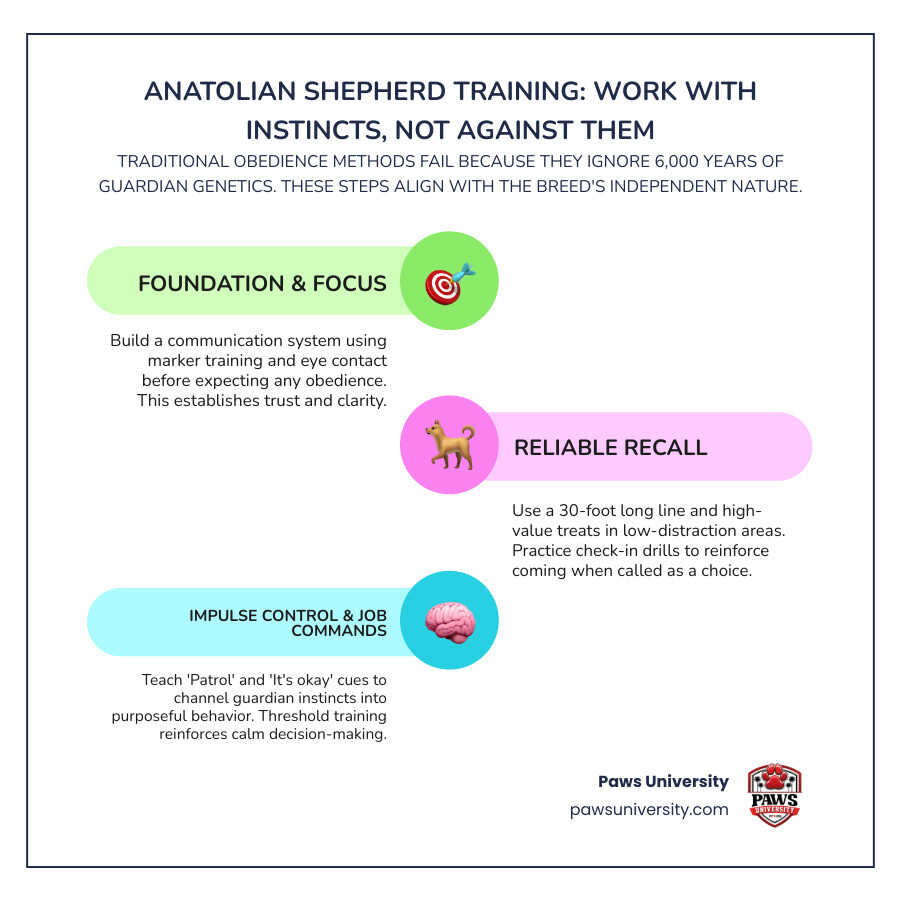
- Establish foundation marker work and focus — build a communication system before anything else
- Build a reliable recall — using a long line and high-value rewards in low-distraction environments
- Master essential commands — tied to real-world tasks, not arbitrary tricks
- Implement structured socialization and boundary training — teach calm neutrality, not forced friendliness
- Teach impulse control and job commands — channel guardian instincts into purposeful behavior
Anatolian Shepherds were bred for over 6,000 years to patrol remote terrain and make life-or-death decisions without human direction. They protected flocks from wolves and bears — alone. That history is wired into every dog of this breed today.
So when your Anatolian hears "come" and simply looks at you before deciding whether to comply, that's not defiance. That's a guardian brain doing exactly what it was designed to do.
The good news? These dogs are absolutely trainable — they just require a different approach than most breeds.
I'm Allen Daniels, co-founder of Paws University in Hawaii County, and over 25+ years of applying rewards-based operant conditioning to hundreds of dogs, I've seen why cookie-cutter obedience methods fall flat with independent guardian breeds — and what Anatolian shepherd training tips actually move the needle. The step-by-step framework in this guide is built around working with this breed's instincts, not against them.
Why Traditional Methods Fail: The Mindset Shift
Traditional dog training often relies on instant obedience, heavy repetition, and sometimes physical pressure or dominance. If you try these methods with an Anatolian Shepherd, you will hit a wall.
Anatolian Shepherds are highly intelligent, but they fall into Coren’s trainability tier 5 ("Fair Working Dogs"). This means they typically require 40 to 80 repetitions to understand a new command, and their first-command obedience rate in casual settings is around 30%.
This is not because they are unintelligent. Rather, they are independent decision-makers. They act like "CEOs making executive security decisions" rather than eager-to-please employees. If a command doesn't make sense to them in the moment, they will ignore it.
Furthermore, these massive dogs—with adult males standing 27 to 29 inches tall and weighing up to 150 pounds—cannot be physically forced into submission. Attempting to use physical corrections, shock collars, or prong collars will only destroy their trust, make them shut down, or trigger defensive aggression.
To succeed, you must adopt a rewards-based training mindset. Training an Anatolian is a negotiation and a partnership. You are teaching them that cooperating with you is highly rewarding and makes logical sense. By framing yourself as a calm, consistent leader, you establish a solid foundation of mutual respect. For more on setting up basic expectations, read our Beginners Guide To Dog Manners Training.
Step-by-Step Anatolian Shepherd Training Tips
Because Anatolian Shepherds are easily bored by repetitive tasks, we must make our training sessions highly efficient.
We recommend keeping training sessions short and highly focused. Implementing 15-minute precision-reward training sessions per day is 30% more effective than longer, inconsistent sessions. These short bursts of micro-learning keep your dog engaged and prevent them from tuning you out.
Here is your 5-step training blueprint designed to build a reliable, cooperative partner.
Step 1: Establish Foundation Marker Work and Focus
Before you can teach complex behaviors, you must establish a clear communication system. This is done through marker training. A marker is a distinct sound (a clicker or a sharp, enthusiastic "Yes!") that tells your dog the exact millisecond they did something right, immediately followed by a high-value reward.
- Charge the Marker: In a quiet room, say "Yes!" and immediately hand your puppy a tiny piece of boiled chicken or cheese. Repeat this 10 to 15 times until your dog's ears perk up at the sound of the word.
- The 5-Pace Check-In: Walk slowly around your yard. Every five paces, pause. The moment your Anatolian turns their head to make eye contact with you, mark ("Yes!") and reward.
This simple game teaches your dog that paying attention to you is highly profitable, establishing a strong default focus even in outdoor environments. To learn more about how to structure these early steps, refer to the Anatolian Shepherd Dog - RayDogs guide.
Step 2: Build a Reliable Recall (Anatolian Shepherd Training Tips)
Building a reliable recall is one of the greatest challenges with this breed. Because their natural instinct is to patrol and investigate, they will easily ignore a basic "Come!" if they spot something interesting on the horizon.
To build a reliable recall:
- Never Call for Negative Experiences: If you call your dog to you only to put them in a crate, give them a bath, or trim their nails, you will ruin their recall. For negative tasks, quietly walk over and fetch your dog.
- Use a 30-Foot Long Line: Never practice off-leash in an unsecured area. Attach a 30-foot biothane long line to a back-clip harness. Allow your dog to wander, then call their name followed by "Come!" in a cheerful voice.
- Use High-Value Jackpots: When they turn and run to you, reward them with a "jackpot"—multiple small pieces of real meat or cheese delivered one after the other.
- Do Not Pull Them: Use the long line only to prevent them from wandering further away if they ignore you. Wait for them to make the choice to return, then reward generously.
For more detailed strategies on overcoming their independent nature during recall, explore Anatolian Shepherd Training Tips - .
Step 3: Master Essential Commands (Anatolian Shepherd Training Tips)
Anatolians do not care for arbitrary tricks. They need to understand the practical context of a command. To make training relevant, tie basic obedience directly to real-world boundaries and daily routines.
- Sit Before Doors: Do not let your dog rush through doorways or gates. Require a "Sit" and eye contact before opening any door. This establishes you as the coordinator of access to the outdoors.
- "Leave It": This is a non-negotiable safety command. Start by covering a treat in your hand. When your dog stops sniffing your hand, mark and reward with a different treat from your other hand. Gradually transition to dropping treats on the floor, and eventually, applying it to moving objects or other animals.
- "Drop It": Because Anatolians can develop resource guarding tendencies, teach them that giving up an item always results in getting something better. Trade a low-value toy for a high-value piece of freeze-dried liver.
- "Place": Teach your dog to go to a specific mat or cot and stay there until released. This is incredibly useful when guests arrive, or when you need your dog to remain calm in a designated spot.
To master these behaviors step-by-step, check out The Ultimate Guide To Dog Obedience Training.
Step 4: Implement Structured Socialization and Boundary Training
Socialization for an Anatolian Shepherd is widely misunderstood. It does not mean forcing your dog to play with every dog they meet or allowing strangers to crowd and pet them. In fact, forcing interactions often backfires, creating a defensive, reactive adult dog.
Instead, socialization must focus on neutrality. Your goal is to teach your dog to remain calm, relaxed, and completely indifferent to new sights, sounds, people, and animals.
- The Socialization Window: The critical window closes around 16 weeks of age, which directly overlaps with their first fear period (weeks 8 to 11). Keep all exposures positive, low-stress, and paired with high-value treats.
- Boundary Walking: If you live on acreage or a farm, walk the physical perimeter of your property daily with your dog on a leash. Use the cue "Boundary" to teach them exactly where their patrol zone ends, preventing them from expanding their territory onto neighboring lands.
To dive deeper into safe exposure techniques, read our comprehensive resource: How To Socialize A Dog The Ultimate Guide.
Step 5: Teach Impulse Control and Job Commands
Anatolians are working dogs at heart. If you do not give them a job, they will invent one—which usually involves guarding your property from the mail carrier, the neighbors, or blowing leaves. Channel their protective instincts into structured, acceptable behaviors.
- The "Patrol" Cue: Teach your dog to walk the yard on cue. Walk the fence line together, saying "Patrol." When they complete a lap and check back in with you, mark and reward. This satisfies their natural desire to guard while keeping them under your guidance.
- The "It's Okay" Cue: When your dog alerts to a sound or a visitor, acknowledge it once ("Thank you") and then use a calm, low-toned "It's okay" cue. This signals to your dog that you have assessed the situation, you are in control, and they can stand down.
- Threshold Training: Practice "Wait" at every gate, car door, and entryway. Your dog must wait for your release cue ("Okay!") before moving forward.
For advanced handlers looking to unlock their dog's full cognitive potential, check out Advanced Training Techniques For Anatolian Shepherd: Unleashing Their Potential - Just Big Dogs .
Managing Developmental Stages and Common Challenges
Training an Anatolian Shepherd is a long-term commitment. Because they are a giant breed, they mature very slowly. Understanding what to expect at each developmental milestone is key to staying patient and consistent.
Developmental Stages
- Puppyhood (8 Weeks to 8 Months): During this stage, focus entirely on relationship building, gentle handling, house training (which can realistically take 6 to 12 months for this breed), and positive socialization. Protect their developing joints by avoiding high-impact activities or overexertion. Their growth plates do not fully close until around 24 months of age.
- Adolescence (8 to 24 Months): This is the notorious "teenage phase." Your once-attentive puppy may suddenly develop selective hearing, ignore commands, and test boundaries. They will also experience a second fear period around 14 to 17 months. Remain calm, go back to basics, and never use force.
- Adulthood (2 to 3 Years): Anatolians reach full mental maturity around 20 to 24 months, but they may not fully settle into their adult guardian roles until closer to 3 years. By this stage, their protective instincts are fully online, and they should be calm, stoic, and highly observant.
| Stage | Age Range | Typical Behaviors | Training Focus |
|---|---|---|---|
| Puppy | 2 - 8 Months | High curiosity, rapid physical growth, teething, easily overwhelmed. | House training, basic focus, gentle socialization, handling. |
| Adolescent | 8 - 24 Months | Boundary testing, selective hearing, fear periods, high energy. | Recall proofing, impulse control, consistency, low-impact exercise. |
| Adult | 24+ Months | Calm, stoic, protective instincts fully active, highly observant. | Maintaining boundaries, job reinforcement, mental stimulation. |
Common Training Challenges
- Selective Hearing: If your dog suddenly ignores a command, do not repeat yourself. This only teaches them that they can ignore the first request. Instead, increase the value of your reward, simplify the environment by reducing distractions, and ensure the command has a clear, practical purpose.
- Resource Guarding: Because they are natural guardians, they can become protective of food, toys, or sleeping spots. Never use physical force to take an item away, as this will escalate the behavior. Instead, practice trading up with exceptionally high-value treats.
- Multi-Pet Coexistence: Anatolians can coexist beautifully with other household pets, including smaller animals and cats, if they are raised with them from puppyhood. They will view these household animals as part of their "flock." However, this tolerance rarely extends to strange animals outside the family. Always supervise early interactions closely and use the "Leave It" command to manage their prey drive.
- Leash Pulling and Reactivity: Walking a 150-pound dog that pulls is incredibly dangerous. Use a front-clip harness to help redirect their momentum, paired with a standard 6-foot leather or biothane leash. Avoid retractable leashes entirely. If your dog begins showing reactivity on walks, consult our In Depth Guide To Leash Reactivity Correction for step-by-step guidance.
- Anxiety and Stress: If your puppy is showing signs of environmental stress or extreme fearfulness during their developmental phases, check out The Ultimate Guide To High Anxiety Dog Training for specialized support.
Frequently Asked Questions About Anatolian Shepherd Training
What is the biggest training mistake owners make with Anatolian Shepherds?
The single biggest mistake is treating an Anatolian Shepherd like a typical companion breed, such as a Golden Retriever or Labrador. Owners often expect instant, enthusiastic obedience and try to achieve it through endless repetitions or harsh physical corrections.
This approach completely ignores the breed's 6,000-year history of independent decision-making. Harsh corrections will destroy your relationship, causing the dog to shut down or defend itself. Successful owners understand that training an Anatolian is a partnership built on mutual respect, clear boundaries, and high-value, rewards-based motivation.
Can an Anatolian Shepherd ever be trusted off-leash?
As a general rule: No. Regardless of how reliable their recall is in a fenced yard, an Anatolian Shepherd should never be trusted off-leash in an unfenced, public area.
Their deep-seated guardian instincts will always prioritize a perceived threat or a desire to patrol over your verbal commands. If they spot a strange dog, a wild animal, or a person they deem suspicious, they will make an independent executive decision to investigate or neutralize the situation. Statistics show that 67% of reported livestock-guardian dog losses involve dogs under 18 months of age due to premature off-leash freedom. Always use a secure 6-foot fence at home and a sturdy leash when out in public.
How do I handle my Anatolian Shepherd's natural protectiveness around guests?
Because Anatolians are naturally wary of strangers, visitors to your home must be managed carefully.
First, teach your dog the "It's Okay" cue to signal that you have accepted the visitor and that no threat is present. Always introduce guests in a neutral space if possible, or have your dog on a "Place" cot when guests enter the home. Instruct your visitors to completely ignore the dog—no direct eye contact, no reaching out to pet them, and no loud, sudden movements. Allow your Anatolian to observe from a safe distance. Once they see that you are relaxed and that the stranger is not a threat, they will typically settle down and ignore the guest. For more help with managing defensive behaviors, read How To Train Dog Aggression In 7 Simple Steps.
Conclusion
Training an Anatolian Shepherd is one of the most challenging—yet deeply rewarding—journeys a dog owner can take. By abandoning outdated dominance theories and embracing a rewards-based approach that respects their independent heritage, you can raise a calm, loyal, and incredibly reliable guardian.
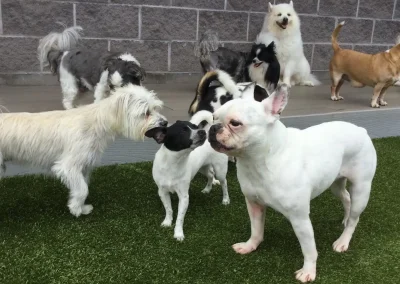
If you live in Hawaii County and are looking for professional support, Paws University is here to help. Located on a premium, spacious seven-acre campus in Hawaii County, we have been the island's premier pet care and training facility since 2002. We were the first in the state to offer structured Doggie Daycare, where supervised play in our beautiful outdoor facilities helps reduce behavioral issues, build social confidence, and burn energy in a safe, tropical setting.
Whether you need help navigating the challenging adolescent phase, building a reliable recall, or structuring early socialization, our experienced trainers use positive, rewards-based methods tailored to your dog's unique personality.
Ready to build an unbreakable partnership with your independent guardian? Explore Paws University's premium training programs today and let us help you set your Anatolian Shepherd up for a lifetime of success.