What It Really Means to Socialize a Dog (And Why It Changes Everything)
How to socialize a dog is one of the most important skills any dog owner can learn — and one of the most misunderstood. Here's a quick answer if you need it fast:
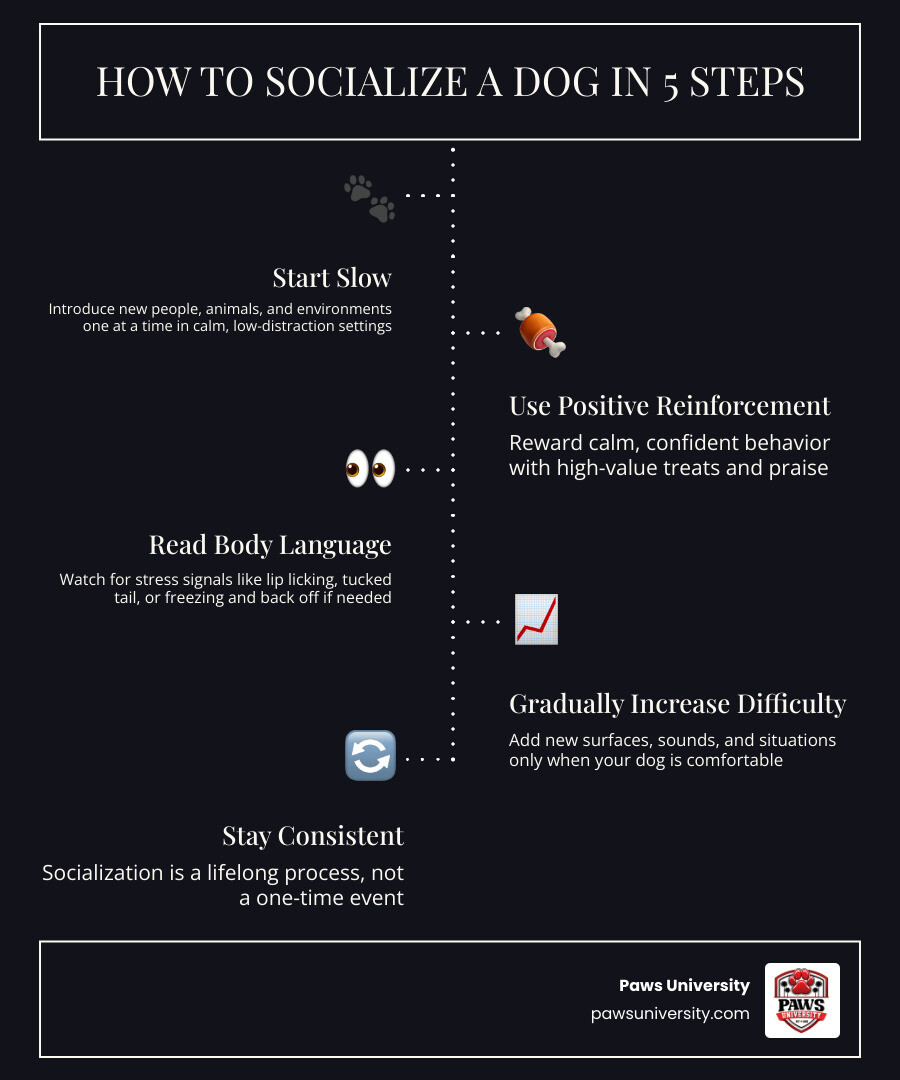
How to socialize a dog in 5 steps:
- Start slow — introduce new people, animals, and environments one at a time in calm, low-distraction settings
- Use positive reinforcement — reward calm, confident behavior with high-value treats and praise
- Read body language — watch for stress signals (lip licking, tucked tail, freezing) and back off if needed
- Gradually increase difficulty — add new surfaces, sounds, and situations only when your dog is comfortable
- Stay consistent — socialization is a lifelong process, not a one-time event
Most people think socialization means taking a dog to the dog park and letting them figure it out. It doesn't. True socialization is about building positive, controlled experiences that teach your dog the world is safe — not overwhelming them until they either shut down or lash out.
Here's why it matters so much: behavioral issues — not infectious disease — are the leading cause of death in dogs under three years old. Most of those issues trace back to missed or mishandled socialization early in life.
The good news? Whether you have a puppy or an adult rescue dog, there is a clear, science-backed path forward.
I'm Allen Daniels, co-founder of Paws University in Kailua-Kona, and I've spent over 25 years applying operant conditioning principles — first with marine mammals, then with hundreds of dogs — to understand exactly how to socialize a dog at every age and background. The strategies in this guide are the same ones we use daily on our seven-acre campus here in West Hawaiʻi, and they work.
How to socialize a dog definitions:
Understanding Dog Socialization and Its Benefits
To truly understand how to socialize a dog, we must first clarify what socialization actually is. According to the American Veterinary Medical Association, socialization is the intentional process of preparing a dog to enjoy interactions and feel comfortable with other animals, people, places, and activities. It is not just about making your dog "friendly." It is about giving them the emotional toolkit to navigate a human-dominated world with ease.
Proper socialization has profound effects on both the mental and physical health of your dog. When a dog is well-socialized, their baseline stress levels are significantly lower. They do not view every novel sound, unfamiliar person, or strange environment as a direct threat. This reduction in chronic stress preserves their physical health, supporting a stronger immune system and a longer, happier life.
From a behavioral development standpoint, socialization is the foundation of confidence. It prevents your dog from developing fear-based behaviors, such as defensive aggression or severe separation anxiety. Instead of reacting with panic, a well-socialized dog remains calm and adaptable, whether they are visiting the vet, walking past a noisy construction site, or lounging with you at an outdoor cafe on the sunny Kona coast.
Why Learning How to Socialize a Dog Matters
When a dog does not receive proper socialization, the consequences can be heartbreaking. Unsocialized dogs often live in a state of perpetual hyper-vigilance. What looks like "bad behavior" — such as lunging on the leash, excessive barking, growling, or snapping — is almost always a desperate attempt to keep scary things at a distance.
Without early and positive exposure, dogs are highly prone to developing deep-seated phobias. Common everyday triggers like thunder, vacuum cleaners, skateboarders, or even people wearing hats can cause absolute panic. This fear-based reactivity makes simple activities like daily walks incredibly stressful for both the dog and the owner. In fact, behavioral problems caused by a lack of socialization are among the leading reasons pets are surrendered to shelters. Understanding how to socialize a dog properly is the most effective way to prevent these issues before they start. If you suspect your dog is already struggling, reviewing our Signs of a Poorly Socialized Dog: Essential Guide can help you identify where their confidence is lacking.
The Science of Canine Behavior and Neutrality
To understand the science of dog socialization, we must look at how a dog's brain develops. During early puppyhood, the brain has an incredible amount of neuroplasticity. This means the brain is highly malleable, easily forming neural pathways that determine what is "safe" and what is "dangerous." Positive experiences during this phase build emotional resilience, allowing the dog's brain to bounce back quickly after a startling event.
A common misconception is that socialization means your dog must eagerly greet every person and dog they encounter. In reality, the ultimate goal of socialization is neutrality.
We do not want our dogs to view every distraction as an invitation to play or a reason to panic. Instead, we want them to observe a distraction, recognize that it is non-threatening, disengage, and focus back on us. Teaching your dog to remain neutral around triggers is the true secret to a calm, well-behaved companion. You can learn more about how to cultivate this mindset in our guide on how to turn your lone wolf into a social star.
The Critical Puppy Socialization Window
When it comes to training, timing is everything. For puppies, the most critical developmental stage for socialization is a fleeting window that opens around 3 weeks of age and begins to close between 14 and 16 weeks.
During this brief period, a puppy's brain is uniquely primed to accept new experiences without fear. According to the American Veterinary Society of Animal Behavior (AVSAB), this is the developmental phase where puppies are most receptive to forming positive associations.

If a puppy is not exposed to a wide variety of people, environments, sounds, and surfaces before this window closes, they can become permanently suspicious of anything unfamiliar. In fact, puppies that miss out on these crucial experiences between 3 and 20 weeks of age may never fully learn to be comfortable around novel stimuli, leaving them at a much higher risk for long-term anxiety and aggression.
This creates a common dilemma for pet owners: how do you safely socialize a puppy before they are fully vaccinated?
Historically, owners were told to keep their puppies strictly indoors until they received their final round of shots at 16 weeks. However, we now know that the risk of behavioral death (due to severe, unmanageable behavior issues later in life) is far higher than the risk of contracting infectious diseases in controlled settings.
To balance these needs, you can safely jumpstart your puppy's training by following the guidelines in Puppy Socialization: When & How to Socialize a Puppy | Purina US . Focus on low-risk exposures:
- Drive-thrus or sitting in the back of your car in a busy parking lot to observe the world.
- Carrying your puppy in a sling or backpack through outdoor shopping areas.
- Visiting the homes of fully vaccinated, friendly adult dogs.
- Walking on clean, non-soil surfaces where unvaccinated dogs do not frequent.
To ensure you don't miss a single step during this vital time, we recommend using A Bomb-Proof Dog Starts with This Socialization Checklist to systematically introduce your puppy to the world.
How to Socialize a Dog: Step-by-Step Guide
Whether you are working with an eager young puppy or a hesitant adult rescue, the fundamental process of how to socialize a dog remains the same. It requires a systematic, step-by-step approach rooted in rewards-based training.
We must always remember that exposure alone is not socialization. If you expose a fearful dog to a trigger without actively managing their emotional state, you risk "sensitizing" them, making them even more afraid. We must ensure every exposure is positive, controlled, and paired with high-value rewards.
Step 1: Start Slow in Controlled Environments
The golden rule of socialization is to keep your dog under threshold. A dog's threshold is the point at which they become too aroused, fearful, or excited to think clearly or take treats. If your dog is barking, lunging, or freezing, they are over threshold and cannot learn.
To prevent this, always start in highly controlled, low-stimulation environments. This could be your living room, your backyard, or a quiet, grassy spot far away from a walking path. Maintain a safe distance from any potential triggers. If your dog can look at another dog or person without reacting, you are at a safe starting distance.
A fantastic foundational tool for this stage is The Do Nothing Exercise and Other Socialization Secrets, which teaches your dog that they do not need to react to everything in their environment; they can simply relax and do nothing in your presence.
Step 2: Use Positive Reinforcement and Rewards
Rewards-based training is the only safe way to build true confidence. When your dog observes a novel stimulus — whether it is a bicycle, a trash can, or another animal — immediately mark that calm observation and reward them with a high-value treat (like small pieces of boiled chicken or freeze-dried liver) and warm verbal praise.
By consistently pairing the trigger with something wonderful, you change your dog's underlying emotional response. Instead of thinking, "Oh no, a stranger is walking toward me," they begin to think, "Wow, a stranger! That means I get chicken!"
Be careful not to use treats to lure your dog into situations they are uncomfortable with. Luring can mask their true fear, and once the treat is gone, they may suddenly find themselves too close to a trigger and panic. Instead, reward them for voluntarily stepping forward or simply looking at the trigger from a comfortable distance.
Step 3: Gradually Increase Difficulty and Distractions
Once your dog is completely relaxed at their initial starting distance, you can begin to gradually increase the difficulty of your sessions. This is done by manipulating three variables: distance, duration, and distraction.
Slowly decrease the distance between your dog and the trigger, always watching their body language. Introduce novel sounds (like recorded fireworks played at a very low volume initially), unfamiliar surfaces (like gravel, wet grass, sand, or wooden decks), and diverse environments.
For comprehensive, step-by-step instructions on structured exposure methods, you can consult How to Socialize a Dog Properly: Full Training Guide or review Dog Socialization Training: A Beginner’s Step-by-Step Guide . Always move at your dog's individual pace; if they show any signs of hesitation, take a step back and make the exercise easier.
Socializing Adult Dogs and Rescue Pets
It is a common myth that you cannot socialize an adult dog. While it is true that the puppy socialization window is the easiest time to build confidence, adult dogs and rescue pets can absolutely learn to navigate the world calmly. However, the goal and the method change slightly.
With an adult dog, we are often working on rehabilitation, counter-conditioning, and desensitization rather than pure, blank-slate socialization.
How to Socialize a Dog of Adult Age or Rescue Background
When working with an adult rescue dog, patience is your greatest asset. Many rescue dogs come with unknown histories, meaning they may have missed early socialization altogether or experienced past trauma. For these dogs, building a strong foundation of trust and routine at home is the essential first step.
You must establish yourself as a calm, consistent leader so your dog feels safe in your care. When you go on outings, start very small. A quiet park or a walk around a peaceful neighborhood is much better than a busy street.
If your dog displays fear-based reactivity (such as growling or cowering), do not force them to "face their fears." This will only cause flooding and worsen their anxiety. Instead, use systematic desensitization: keep them at a distance where they feel safe and reward their calm behavior.
For deeper insights into helping an older or fearful dog build confidence, check out How to Help a Poorly Socialized Dog - Whole Dog Journal and How Do I Socialize A Fearful Dog: These Strategies Build Dog Confidence! - The Online Dog Trainer .
Reading Stress Signals and Body Language
To safely socialize an adult dog, you must become an expert in reading canine body language. Dogs are constantly communicating their emotional state, but their earliest signals are often incredibly subtle. If we ignore these subtle warnings, the dog is forced to escalate to more obvious behaviors like growling or biting.
Nine out of ten dog fights are entirely predictable because the stress signals leading up to them were ignored. Watch for these red flag signals that indicate your dog is overwhelmed:
- Lip licking or yawning when not eating or tired
- Whale eye (showing the whites of their eyes)
- Tucked tail or a stiff, slow tail wag
- Cowering or freezing in place
- Heavy panting when it is not hot
- Hyper-vigilance (refusing to look at you or take treats)
If you notice any of these signs, immediately increase the distance between your dog and the trigger. Do not punish the fear; simply guide them away calmly and try again later at a much easier level.
Common Mistakes to Avoid in Dog Socialization
Even the most well-meaning dog owners can make critical mistakes when trying to socialize their pets. Knowing what not to do is just as important as knowing what to do.
- Flooding: This is the mistake of throwing a fearful dog directly into an overwhelming situation (like a busy pet store or a chaotic dog park) in the hopes that they will "get used to it." Flooding is highly traumatic and almost always results in increased fear, shut-down behavior, or aggression.
- Forcing Interactions: Never force your dog to greet another dog or person. If your dog is backing away, hiding behind your legs, or growling, respect their boundaries. Forcing them to interact teaches them that you will not protect them, destroying their trust in you.
- Skipping Rewards: Exposure without positive reinforcement is just habituation at best, and sensitizing at worst. Always carry high-value rewards to actively build those positive emotional associations.
- Over-Arousal: Allowing your dog to get wild, hyper-excited, and frantic around other dogs is not good socialization. High arousal can quickly turn into frustration or aggression. Focus on calm, polite, and neutral behaviors instead.
- Stopping Too Early: Socialization is not a task you complete and cross off your list when your puppy turns six months old. It is a lifelong maintenance plan. Dogs can regress if they do not continue to have positive experiences throughout their adult lives.
For more tips on troubleshooting common training hurdles, explore our resources under the Category: Dog Socialization archive.
Frequently Asked Questions about Dog Socialization
Can you socialize an adult dog who is fearful?
Yes, you can. While it takes more time, structure, and patience than socializing a puppy, fearful adult dogs can make incredible progress. The key is to focus on slow pacing, counter-conditioning, and desensitization. Never force them into situations they aren't ready for, and always use rewards-based training to build their confidence at a distance they find comfortable.
Why are dog parks not recommended for socialization?
Dog parks are highly uncontrolled environments. You cannot guarantee the behavior, health, or vaccination status of the other dogs present. High levels of arousal in a confined space can easily escalate into bullying or full-blown fights. A single negative experience at a dog park can traumatize a sensitive dog and undo months of positive training. Controlled, supervised playgroups or organized pack walks are much safer alternatives.
When should I seek professional help for my dog's behavior?
You should seek professional help if your dog displays severe anxiety, extreme fear (such as shutting down or refusing to move), or any form of aggression (growling, snapping, lunging, or biting) toward people or other animals. A certified professional dog trainer or veterinary behaviorist can design a customized, safe, and effective training plan tailored to your dog's specific needs.
Conclusion
Learning how to socialize a dog is a journey that requires time, patience, and a deep commitment to understanding your dog's unique emotional needs. By focusing on gradual exposure, positive reinforcement, and achieving neutrality, you can help your canine companion develop the confidence they need to thrive.
If you are looking for a safe, structured, and professional environment to support your dog's socialization, we are here to help. Paws University is West Hawaiʻi's premier pet care facility, operating since 2002 on a beautiful, seven-acre tropical campus in Hawaii County. We specialize in supervised play and professional training programs designed to reduce behavioral issues and build lifelong social skills.
Whether you need premium daycare, boarding, or expert training support, we invite you to explore our Premium Dog Training Services and let us help you turn your companion into a confident, well-adjusted social star.