It's Not Too Late: How to Socialize an Adult Dog with Other Dogs
Learning how to socialize an adult dog with other dogs is absolutely possible — and here's the short version of how to do it:
- Start with parallel walks — walk your dog near (not next to) another calm dog on a loose leash, keeping enough distance that your dog stays relaxed.
- Use high-value treats to build a positive association every time another dog appears.
- Keep sessions short — 10 to 15 minutes is enough early on. Always end on a calm, successful moment.
- Introduce brief, controlled greetings only once your dog is consistently relaxed on parallel walks.
- Move to supervised off-leash play in a fenced, controlled environment — not a public dog park.
- Go at your dog's pace. Never force an interaction. If your dog is stressed, increase distance and try again.
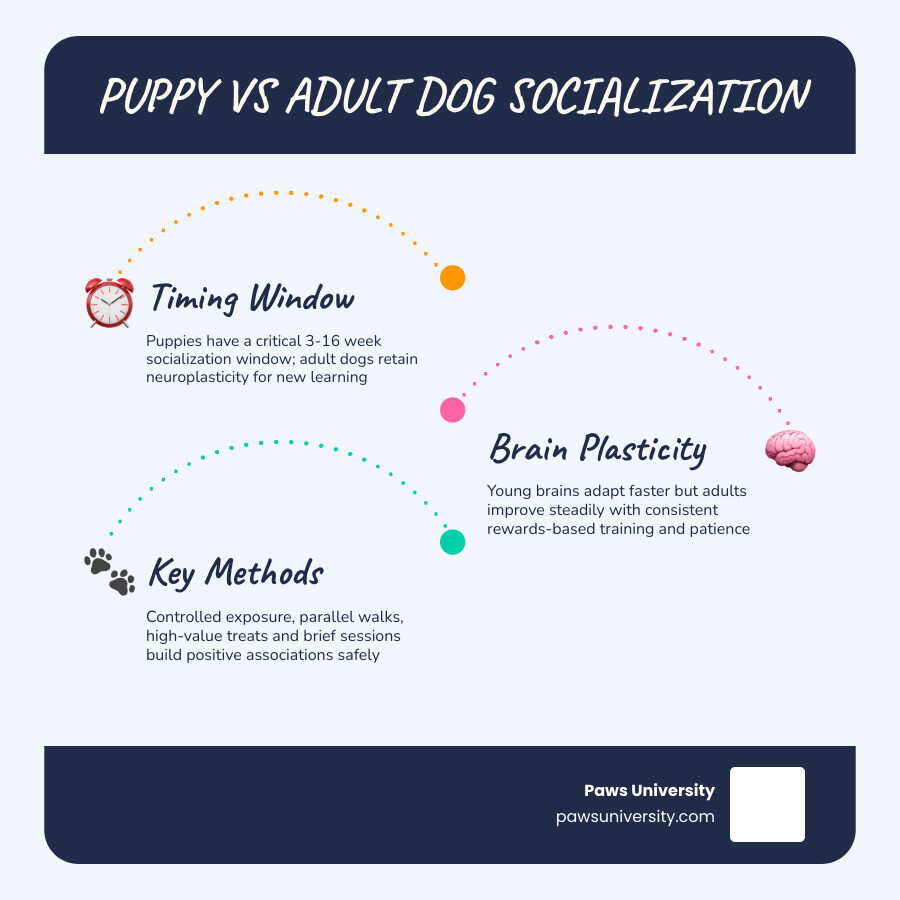
The critical socialization window in puppies closes around 14 to 16 weeks of age — so if you've adopted an adult dog or your puppy missed that window, it's natural to wonder if it's too late. It isn't.
Adult dogs can still form new, positive associations with other dogs. The process is slower and requires more patience than it would with a puppy. But meaningful improvement is realistic with consistent, rewards-based work.
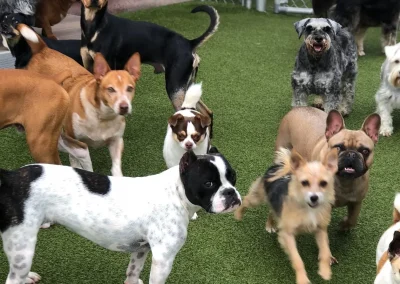
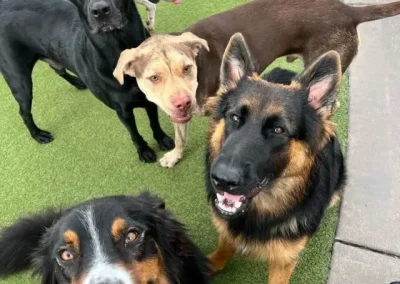
Many dogs in West Hawaiʻi arrive at Paws University having had little or no positive exposure to other dogs — whether they're rescues, former street dogs, or simply dogs whose early months didn't include proper socialization. The results we see every day confirm the same thing the research does: the window may be harder to open as an adult, but it is never fully closed.
I'm Allen Daniels, co-founder of Paws University and a professional animal trainer with over 25 years of experience applying operant conditioning — the same science used in marine mammal training — to how to socialize an adult dog with other dogs safely and effectively. In this guide, I'll walk you through exactly what works, what to avoid, and how to know when to ask for help.
Related content about how to socialize an adult dog with other dogs:
The Core Principles of How to Socialize an Adult Dog with Other Dogs
When we talk about adult dog socialization, we are shifting our focus from preventative exposure to active behavior modification. While a puppy's brain is a sponge waiting for its first impressions, an adult dog already has established opinions about the world. Socializing a mature canine means gently reshaping those opinions using rewards-based training and positive reinforcement.

To do this safely, we rely on two primary scientifically proven concepts: desensitization (gradually exposing your dog to another dog at a distance where they do not react) and counter-conditioning (changing their emotional response to other dogs from fear or excitement to calm anticipation of a reward).
Every interaction must be built on consent and safety. We must never force a dog to interact if they are showing signs of discomfort. For a deeper understanding of how these training mechanics work, read through How to Socialize a Dog: The Ultimate Guide. Additionally, the step-by-step framework outlined by the Introducing Dogs to Each Other | Best Friends Animal Society emphasizes that control, patience, and neutral territory are the foundational pillars of any successful introduction.
How to Socialize an Adult Dog with Other Dogs: Puppy vs. Adult Differences
To understand why adult dog training requires a different approach, we have to look at developmental biology. Puppies possess a critical socialization window that starts around 3 weeks of age and closes between 14 and 16 weeks. During this brief period, their brains are hardwired to accept new sights, sounds, and species as normal and safe.
Once this window closes, the brain's plasticity shifts. New experiences are no longer accepted automatically; instead, they are met with natural caution or fear. Furthermore, as dogs transition from adolescence to social maturity—which typically occurs between 1 and 3 years of age—their social preferences change.
While a puppy might want to play with every dog they see, socially mature adult dogs become more selective. They may prefer a smaller, trusted circle of friends and have less tolerance for rude or high-energy behaviors from unfamiliar dogs. This is completely normal! Socialization for an adult dog does not mean turning them into a social butterfly who loves every dog they meet. Often, the goal is simply neutrality—teaching them to remain calm, relaxed, and focused on you in the presence of other dogs. For more details on early development, see our Step-by-Step Guide to Puppy Socialization Methods.
Identifying Signs of Poor Socialization in Mature Dogs
How do you know if your adult dog missed out on early socialization? Dogs communicate their discomfort through clear, albeit sometimes subtle, body language. Common signs of poor socialization or underlying fear and anxiety include:
- Leash Reactivity: Barking, lunging, growling, or pulling wildly toward other dogs while on a leash. This is often a defense mechanism born out of feeling trapped by the leash.
- Hyper-Vigilance: Constantly scanning the environment, unable to focus on you, with a stiff posture and a hard stare directed at other dogs.
- Avoidance and Flight: Tucking the tail, pinning the ears back, lip licking, yawning, or physically trying to hide behind you or flee the area.
- Over-Excitement: Appearing friendly but displaying frantic, pushy behaviors that ignore natural canine boundaries, which can easily trigger a defensive reaction from other dogs.
If you recognize these behaviors in your dog, don't worry. They are simply expressing that they feel overwhelmed. You can read more about identifying these behavioral gaps in our Signs of Poorly Socialized Dog Essential Guide.
Why Flooding Fails and Controlled Exposure Works
One of the most common mistakes well-meaning dog owners make is attempting to "force" socialization. This often looks like taking a fearful or reactive dog to a busy public dog park and letting them loose, hoping they will "figure it out."
In the behavioral sciences, this is known as flooding—exposing an animal to an intense, overwhelming level of their trigger without escape, in the hopes that they will eventually stop reacting.
Flooding is highly detrimental. Instead of teaching your dog that other dogs are safe, it triggers a severe "fight or flight" response. The dog's brain is flooded with cortisol and adrenaline, making learning impossible. This extreme stress can cause severe trauma, deepen their fear, and even lead to defensive aggression.
To safely modify behavior, we must use controlled, gradual exposure. This means working with your dog below their "stress threshold"—the precise distance at which they notice another dog but remain calm enough to take treats and listen to your cues. Over time, as your dog builds confidence, this threshold distance naturally shrinks. You can learn more about managing these thresholds in The Do Nothing Exercise and Other Socialization Secrets.
The Danger of Overwhelming Your Dog
When a dog crosses their threshold, their sympathetic nervous system takes over. Once they are barking, lunging, or shaking, they are no longer in a state of mind to process information or learn new associations.
To prevent this, you should build a customized trigger hierarchy for your dog. Rank their triggers from least intense to most intense. For example, your dog's hierarchy might look like this:
- Hearing a dog bark in the distance (Least intense)
- Seeing a calm dog walking 100 feet away
- Seeing a calm dog walking 50 feet away
- A dog walking directly past them on the opposite side of the street
- An energetic dog approaching them directly (Most intense)
By identifying these levels, you can systematically design training sessions that keep your dog safe, comfortable, and successful. For formal guidance on these behavioral principles, refer to the Desensitization and Counterconditioning | ASPCA guide.
The Power of Positive Reinforcement and High-Value Treats
At the heart of rewards-based training is Pavlovian association. We want to teach your dog a simple equation: Other Dogs = Amazing Things for Me.
To do this, you must use high-value treats that your dog only gets during socialization training. Think boiled chicken, small pieces of hot dog, freeze-dried liver, or fresh fish.
The timing of your delivery is critical. The moment your dog spots another dog at a safe distance, mark the behavior (with a clicker or a cheerful "Yes!") and immediately deliver the high-value treat. If they look away from the other dog and back to you, reward them again.
By consistently pairing the sight of another dog with premium rewards, you will notice their physical response begin to shift. Instead of tensing up, they will begin to look at another dog and then immediately look at you in happy anticipation of a treat.
A Step-by-Step Guide on How to Socialize an Adult Dog with Other Dogs
Socializing a mature dog requires a structured, step-by-step approach. Never rush from one step to the next; only progress when your dog is completely relaxed and successful at the current level.
Before starting, ensure you have the right equipment. Use a standard flat collar or a well-fitted, non-restrictive harness paired with a fixed 6-foot leash. Avoid retractable leashes, which maintain constant tension and make controlled handling difficult. For additional strategies on shifting your dog's social perspective, read How to Turn Your Lone Wolf into a Social Star.
Step 1: Parallel Walks on Neutral Ground
The safest way to introduce two adult dogs is through a parallel walk on neutral territory, such as a quiet public park. Neutral ground prevents either dog from feeling territorial.
Begin by walking in the same direction as the helper dog, but separated by a wide distance—perhaps 50 to 100 feet apart, depending on your dog's threshold. Keep both dogs on a loose leash.
Parallel walking allows the dogs to observe each other's movement, exchange scent information carried on the wind, and get used to each other's presence without the pressure of a face-to-face confrontation.
As both dogs settle into a rhythm and display relaxed body language (loose shoulders, soft eyes, swinging tails), you can slowly decrease the lateral distance between them. For a vet-approved breakdown of how to manage these walks safely, consult How to Introduce Your Dog to Other Dogs on Walks: A Vet-Approved Guide – Dogster .
Step 2: Controlled, Brief Greetings
Once your dogs can walk calmly side-by-side without tension, you can transition to a brief, controlled greeting.
Avoid head-on approaches, which dogs naturally view as confrontational. Instead, guide the dogs to approach each other in loose, natural arcs, allowing them to sniff each other's rear ends and flanks.
Apply the three-second rule: limit the initial sniff to three seconds, then calmly call your dog away using a cheerful voice and a high-value treat.
This short duration prevents tension from building and ensures the interaction ends on a highly positive note. If either dog tenses up, freezes, or stares intensely, immediately step back and increase the distance. For expert-vetted tips on managing these physical mechanics, review the Expert Tips on How to Introduce Dogs | Preventive Vet resource.
Step 3: Supervised Off-Leash Play in a Fenced Area
If the on-leash greetings are consistently relaxed, you may progress to off-leash play in a secure, fenced area. On-leash interactions can sometimes cause frustration or defensive behavior because the dogs feel restricted. Off-leash movement allows them to use their natural body language to communicate.
To maintain safety, have both dogs wear light "drag lines"—long, lightweight leashes with the handles cut off so they don't catch on obstacles. This gives you a safe way to step on a line and separate the dogs if play becomes too intense, without having to grab their collars.
Watch for healthy play signals, such as play bows (lowering the front half of the body while keeping the rear up), bouncy movements, and taking natural, self-imposed breaks. If play becomes too frantic, step in calmly, redirect both dogs to a quiet activity, and let their excitement levels settle before allowing them to play again.
Managing Fear, Anxiety, and Reactivity During Training
Working with a dog who is fearful or reactive requires an immense amount of patience. It is common to experience setbacks—progress is rarely a straight line. If your dog has a bad day or reacts negatively, do not punish them. Punishing a fearful reaction only confirms to your dog that other dogs cause bad things to happen, which will worsen their behavior. Simply increase the distance, give them a chance to decompress, and set up your next session at a much easier level.
To help you decide on the best path forward for your dog's specific needs, we've put together a quick comparison of the most common training and socialization options:
| Training Option | Best Suited For | Key Benefits | Things to Keep in Mind |
|---|---|---|---|
| Do-It-Yourself (DIY) Training | Dogs with very mild shyness or minor focus issues. | Builds a direct, strong bond between you and your dog. | Requires highly consistent execution and a reliable network of calm helper dogs. |
| Private Professional Training | Dogs with moderate to severe reactivity, fear, or anxiety. | Highly customized plans; direct, expert coaching tailored to your dog's exact thresholds. | Requires a commitment to practicing the homework between professional sessions. |
| Premium Supervised Daycare | Social or mildly selective dogs needing structured, safe social outlets. | Fully screened playgroups; professional supervision on a spacious campus; prevents behavior issues. | Not suitable for highly reactive or aggressive dogs; requires a baseline temperament evaluation. |
If your dog struggles with anxiety or exhibits physical signs of fear, you can find helpful advice and soothing techniques in our guide, Stop the Shakes with These Proven Anxious Dog Solutions.
Handling Setbacks and Red Flag Behaviors
During socialization, you must remain highly attuned to warning signs that indicate your dog has reached their limit. Red flag behaviors include:
- Low Growling or Snarling: This is a dog's polite way of saying, "I need space right now." Never punish a growl; if you do, you may train them to bite without warning.
- Resource Guarding: Showing aggression over toys, treats, or even your attention. Always remove toys and food from the environment before introducing dogs.
- Stiff, Stationary Freezing: A dog that tenses their muscles and freezes is often preparing to react defensively.
If you observe any of these behaviors, calmly and quietly step in, redirect your dog's attention, and walk away. Give your dog ample time to decompress—sometimes up to 24 to 72 hours—as stress hormones like cortisol take time to leave their system.
When to Seek Professional Help
There is no shame in admitting that a behavior issue is beyond your current comfort level. In fact, seeking professional help early is the most responsible choice you can make for your dog's safety and well-being. You should contact a professional force-free trainer or a certified veterinary behaviorist if:
- Your dog displays unprovoked aggression or attempts to bite other dogs.
- Your dog's reactivity is so severe that you cannot find a safe threshold distance in public.
- You feel anxious, overwhelmed, or fearful during training sessions, as your dog will easily sense your stress.
- Your self-led training efforts have stalled, and you aren't seeing progress.
Working with a certified professional ensures you have a custom behavior modification plan designed specifically for your dog's needs. For more details on finding professional resources, you can read the guide on How To Socialize An Adult Dog - Guide Dog Foundation .
Frequently Asked Questions about Adult Dog Socialization
Is it too late to socialize my 3-year-old rescue dog?
Not at all! While the critical puppy socialization window has closed, adult dogs possess neuroplasticity—their brains are fully capable of learning new behaviors and forming positive associations throughout their entire lives.
With a rescue dog, it is highly recommended to follow the "Rule of Threes" for decompression: allow three days to settle in, three weeks to learn your household routine, and three months to build true trust and feel secure before introducing major training triggers.
With patience, consistency, and realistic expectations, your rescue dog can make incredible progress. For a deeper look at this topic, read through the community insights on How to socialize an adult dog set in his ways and has passed his ... as well as the practical tips found in How to Socialize an Adult Dog: A Realistic Guide - Zoom Room .
Should I take my reactive adult dog to a public dog park?
We strongly advise against taking a reactive or poorly socialized adult dog to a public dog park. Public parks are uncontrolled, unpredictable environments. You cannot guarantee that the other dogs present will be polite, and many owners do not monitor their dogs' behavior closely.
For a reactive dog, a public dog park is a recipe for flooding, which can easily lead to fights, injuries, and severe behavioral setbacks. Instead, opt for structured, controlled alternatives—such as parallel walks with trusted friends, private training sessions, or premium supervised dog daycare facilities that screen all participants for temperament.
How long does it take to see progress in an older dog?
The timeline for socializing an adult dog is highly individual and depends on several factors, including their genetics, past experiences, and the consistency of your training.
Some dogs show noticeable improvement within 4 to 8 weeks of consistent, daily work. For others with deep-seated trauma or severe fear, the journey can take 6 to 12 months or longer.
Progress is rarely linear. Celebrate the small victories—like your dog choosing to look at you instead of barking at a dog across the street—and focus on your dog's individual growth rather than comparing them to others.
Conclusion
Socializing an adult dog is a journey of patience, empathy, and trust. While it requires a more structured and deliberate approach than puppy training, witnessing a once-fearful dog blossom into a confident, relaxed companion is one of the most rewarding experiences a pet parent can have.
At Paws University, located on our beautiful, spacious seven-acre campus in West Hawaiʻi, we have been helping dogs and their owners thrive since 2002. As the premier pet care facility in Hawaii County, we specialize in offering premium pet daycare, boarding, and training services. Our supervised playgroups are designed to reduce behavior issues by matching dogs of similar sizes, play styles, and temperaments in a safe, tropical outdoor setting.
If you are ready to take the next step in your dog's socialization journey, our experienced team is here to support you with professional guidance and rewards-based training methods. Contact us today to learn More info about premium training services and discover how we can help your dog live their happiest, most confident life.