What Leash Reactivity Is and How to Correct It Fast
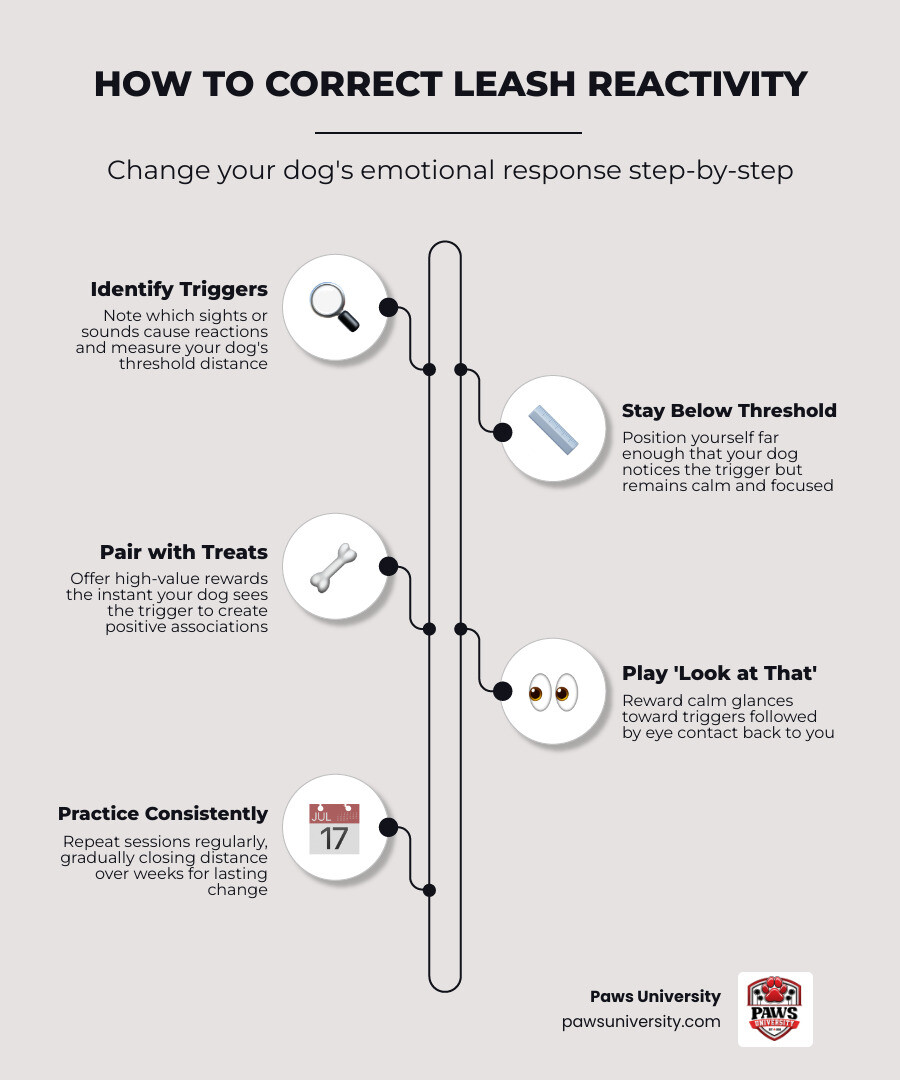
How to correct leash reactivity starts with understanding what's driving the behavior — then systematically changing your dog's emotional response to triggers using distance, rewards, and consistency.
Quick answer — the core steps:
- Identify your dog's triggers (other dogs, people, bikes, etc.) and the distance at which they react
- Stay below threshold — keep enough distance so your dog notices the trigger but stays calm
- Pair the trigger with high-value treats the moment your dog sees it (counter-conditioning)
- Use the "Look at That" game to teach your dog to glance at triggers and look back at you
- Build emergency skills like U-turns and name response for real-world moments
- Avoid punishment — it worsens fear and anxiety rather than resolving them
- Be consistent — progress takes weeks to months, not days
If your dog transforms into a barking, lunging chaos tornado the moment another dog appears on your walk, you are not alone. Research suggests around 66% of dogs show some signs of reactivity, and roughly 30% of dog owners deal with leash reactivity regularly. It is one of the most common — and most misunderstood — behavioral challenges dog owners face.
The good news? It is very treatable. Almost all dogs improve significantly with the right approach.
Leash reactivity is not aggression. It is not your dog being "bad." It is usually rooted in fear, frustration, or a lack of early socialization — and the leash itself often makes things worse by removing your dog's ability to simply walk away from something that frightens them.
I'm Allen Daniels, co-founder of Paws University in Kailua-Kona, and I've spent over 25 years applying the same operant conditioning principles I developed training marine mammals to help hundreds of dogs — including many with reactivity — build genuine calm and confidence. In this guide, I'll walk you through exactly how to correct leash reactivity using a rewards-based, science-backed approach that works for real dogs in real environments.
Discover more about how to correct leash reactivity:
- dog training for aggressive dogs near me
- how do i stop my dog from growling at me
- how do i stop my dog growling at other dogs
Understanding the Root Causes of Leash Reactivity
Before we talk training, we need to answer one important question: why is your dog reacting at all?
Leash reactivity usually looks like barking, lunging, growling, whining, freezing, staring, pulling hard toward or away from something, or even redirecting onto the leash. The behavior can be aimed at dogs, people, scooters, bikes, cars, cats, or anything else your dog finds intense.
Most reactive dogs fall into one of these buckets:
- Fear-based reactivity: your dog wants space and is trying to make the scary thing go away
- Frustration-based reactivity: your dog wants to get to the trigger and explodes because the leash prevents access
- Socialization gaps: your dog never learned how to calmly process the world, especially during early development
- Trigger history: one or more bad experiences can create strong negative associations
This is why leash reactivity is different from true aggression. Reactivity is often an over-the-top response to a specific trigger, while aggression involves a more direct intent to harm. Many leash-reactive dogs are social or neutral when off leash because they can move naturally, create distance, or greet in a less pressured way.
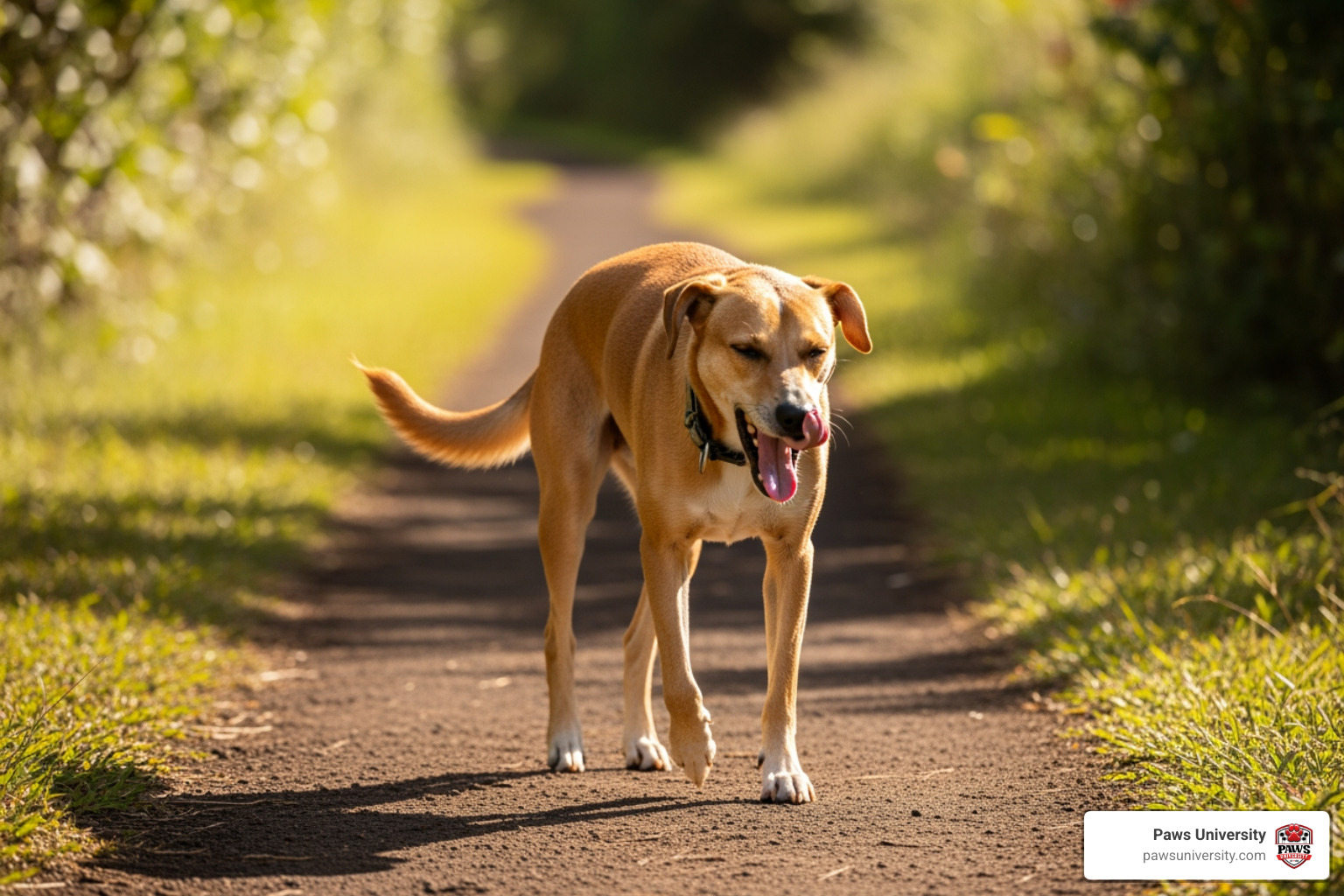
We also have to consider trigger stacking. Think of stress like water filling a bucket. A noisy morning, poor sleep, a surprise delivery truck, another barking dog behind a fence, and then a close leash encounter can add up fast. Your dog may handle one dog at 30 feet on a calm day, then react at 60 feet later because the stress bucket is already full.
For more on dog-to-dog communication and growling, see How Do I Stop My Dog Growling at Other Dogs. You can also read a solid overview here: Leash Reactive Dog: Causes, Training & Tips That Work.
The Role of the Leash in Reactivity
The leash is not the villain, but it definitely adds drama.
Off leash, dogs usually approach in curves, pause, sniff, and use a lot of subtle body language. On leash, they are often pulled into direct, head-on greetings. In dog language, that can feel pushy or threatening.
The leash also changes your dog's options:
- A fearful dog cannot choose flight
- A social but frustrated dog cannot go say hello
- A tight leash can increase physical tension
- Your own stress can travel down the leash like bad Wi-Fi, but for emotions
That last point matters more than people realize. When we spot a trigger and brace, shorten the leash, or hold our breath, our dogs often notice immediately. To them, that tension can confirm, "Yep, something is wrong here."
Identifying Triggers to Learn How to Correct Leash Reactivity
If you want to know how to correct leash reactivity, start by becoming a detective.
Write down:
- What your dog reacts to
- Whether the reaction is worse with dogs, people, wheels, or motion
- The distance where your dog first notices the trigger
- The distance where your dog goes over threshold
- Time of day, location, and environment
- Whether your dog had other stressors earlier that day
Threshold distance is the key concept here. It means the distance at which your dog can notice a trigger but still think, eat, and respond. Once your dog is barking, lunging, or unable to take food, they are over threshold. Learning is much harder there.
Watch for early body language, not just the big explosion:
- Hard staring
- Closed mouth
- Ears forward or pinned back
- Lip licking
- Yawning
- Weight shift forward
- Tail high and stiff, or low and tucked
- Slowing down or freezing
- Ignoring treats
A helpful overview of triggers and thresholds is available in Dog Leash Reactivity | Pet InfoRx.
How to Correct Leash Reactivity Using Management and Thresholds
Management comes first. Always.
That does not mean we are giving up on training. It means we stop letting the reactive behavior rehearse while we build new habits. Every time a dog barks and lunges and the trigger goes away, the dog may learn, "That worked." We want fewer practice reps of that pattern, not more.
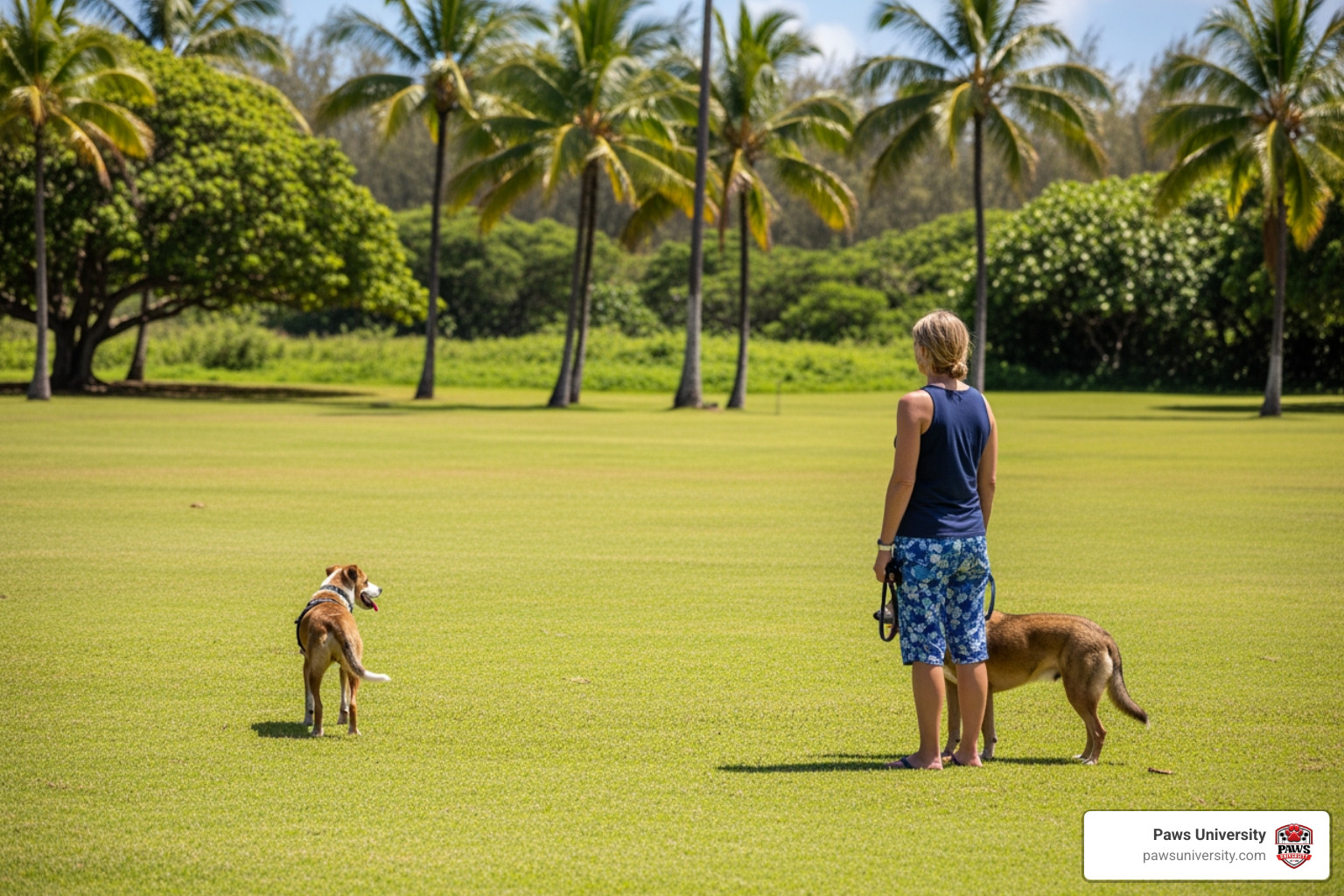
Good management looks like this:
- Walk at quieter times
- Choose wide paths and open spaces
- Cross the street early
- Use visual barriers like parked cars, hedges, or corners
- Avoid narrow trails when traffic is high
- Skip on-leash greetings with unknown dogs
- End walks early if your dog is already fried
This is also where we remind owners of a hard truth: just because your dog wants to meet another dog does not mean the greeting is a good idea. Head-on leash greetings are one of the fastest ways to create frustration, tension, and bad habits.
For more help with foundational management, see Stop the Barking with This Leash Reactivity Guide and Managing a leash-reactive dog - Animal Humane Society.
Establishing a Safe Training Distance
Your safe training distance is where your dog can:
- Notice the trigger
- Stay loose in the body
- Take treats easily
- Turn back to you
- Recover quickly
If your dog cannot eat, cannot respond to their name, or is vibrating like a furry tuning fork, you are too close.
Start farther away than you think you need. Then work there until your dog is consistently successful. Success means calm observation, eating happily, and disengaging without a meltdown.
A simple progress journal can help:
| Trigger | First notice distance | Reactivity distance | Notes |
|---|---|---|---|
| Dog walking by | 60 ft | 35 ft | Worse after busy morning |
| Person with hat | 40 ft | 15 ft | Improved with treats |
| Bike | 80 ft | 50 ft | Motion increases intensity |
If you need more basics on reading and reducing behavior issues, visit Reducing Dog Behavior Issues Without Pulling Your Hair Out.
Using Positive Reinforcement to Learn How to Correct Leash Reactivity
Now we change the emotional meaning of the trigger.
Counter-conditioning means we pair the sight of the trigger with something your dog loves, usually very high-value treats. Desensitization means we expose your dog at a low enough intensity that they can stay under threshold.
The sequence is simple:
- Dog sees trigger
- We mark or calmly acknowledge it
- We deliver excellent treats
- Trigger disappears, treats stop
Over time, your dog starts to think, "A dog appears, chicken happens." That is a much better internal monologue.
Use rewards your dog truly cares about:
- Chicken
- Turkey
- Cheese
- Roast beef
- Soft training treats with strong smell
This is not the moment for boring kibble unless your dog thinks kibble is a life event.
Step-by-Step Training: The 'Look at That' Game and CC&D
One of our favorite tools for how to correct leash reactivity is the Look at That game, often shortened to LAT. It teaches your dog that noticing a trigger is not a problem. In fact, noticing calmly is what earns reinforcement.
Basic LAT steps:
- Stand at a safe distance from the trigger
- The moment your dog looks at the trigger, mark with a clicker or "yes"
- Give a high-value treat
- Repeat each time your dog calmly notices the trigger
- Over repetitions, many dogs begin to look at the trigger, then back at you
That final part is gold. It means your dog is learning an alternative behavior: observe, then check in.
Counter-conditioning and desensitization work best when sessions are short, controlled, and successful. Five good minutes beats twenty chaotic ones every time.
For deeper reading, see From Crazy To Calm: A Training Plan For Leash Reactivity – Dr. Jen's Dog Blog and How to ACTUALLY Fix Your Dog's Reactivity (Free 2-Hour Course).
Implementing the Engage-Disengage Protocol
Engage-disengage is a natural next step after LAT.
The idea:
- Engage: your dog notices the trigger
- Disengage: your dog voluntarily looks away, relaxes, or checks in with you
- Reinforce: you reward the disengagement
At first, you may mark the instant your dog looks at the trigger. Later, you can wait half a second to see if your dog chooses to turn back to you on their own.
Tips for success:
- Use a clear marker word like "yes" or a clicker
- Keep your reinforcement rate high at the beginning
- Do not move closer just because one rep went well
- End before your dog gets tired or overloaded
This protocol helps dogs build emotional regulation, not just obedience. We are teaching the nervous system, not merely the leash manners.
Building Focus and Emergency Skills
Real life is messy. A chicken-only plan is not enough if a dog suddenly appears around a corner.
Teach these support skills away from triggers first:
- Name response: dog hears their name and turns to you
- Emergency U-turn: cheerful cue, pivot away, move quickly with rewards
- Find it: toss treats on the ground to encourage sniffing and lower arousal
- Hand touch: dog targets your hand and moves with you
- Side position: dog comes next to you for brief safe passes
These skills give you something practical to do in the moment. They also help your dog feel guided instead of trapped.
For leash basics that support this work, visit Walk This Way and Master the Leash with Your New Puppy.
Essential Tools and Techniques for Success
The right equipment helps with safety and handling. The wrong equipment can make reactivity worse.
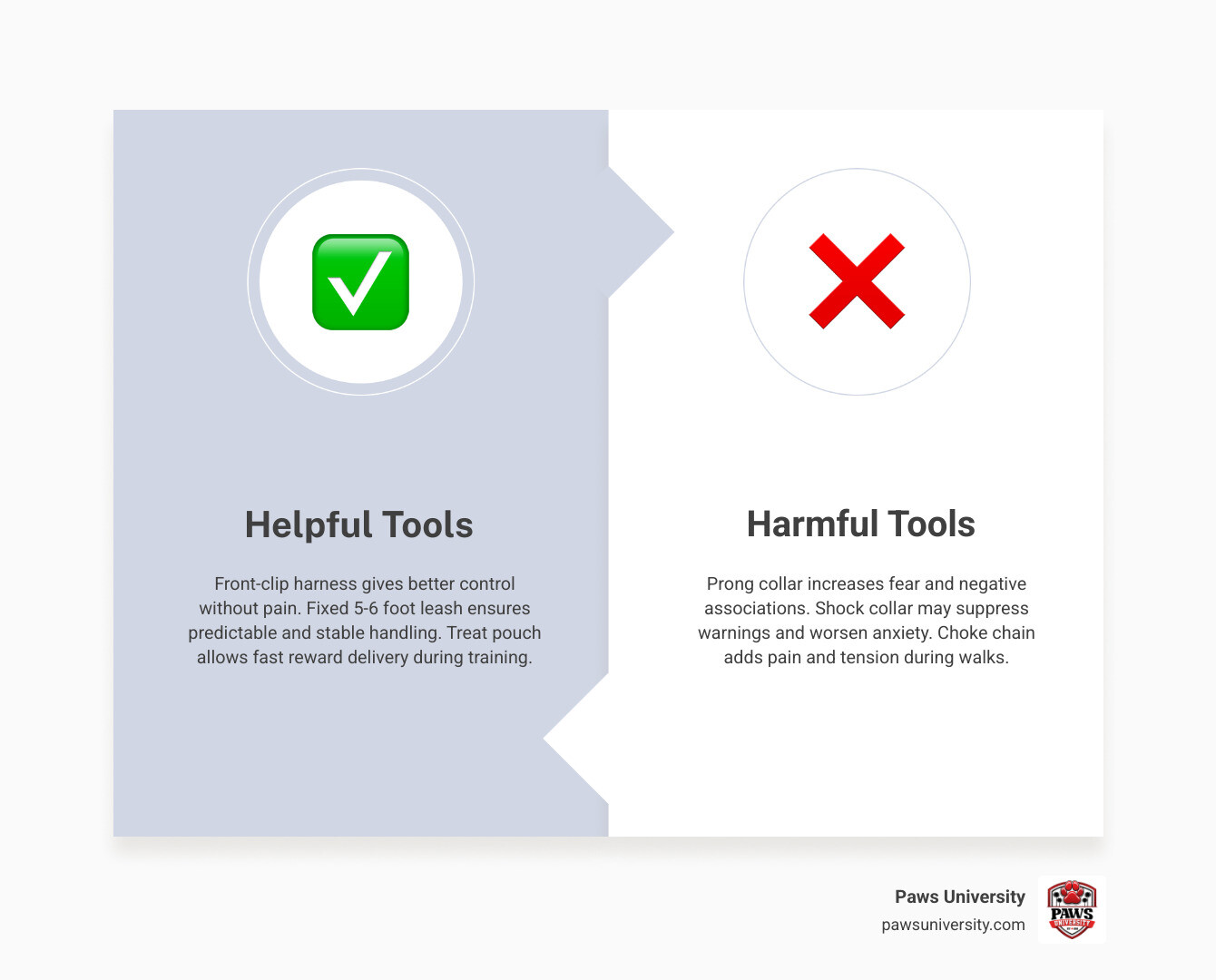
| Helpful tools | Why they help | Harmful tools | Why they can hurt progress |
|---|---|---|---|
| Front-clip harness | Better control without pain | Prong collar | Can increase fear and negative associations |
| Fixed 5-6 foot leash | Predictable, stable handling | Shock collar | May suppress warnings, worsen anxiety |
| Treat pouch | Fast reward delivery | Choke chain | Adds pain and tension |
| Basket muzzle if needed | Safety during training | Retractable leash | Poor control, constant tension |
| Clicker or marker word | Clear communication | Leash pops/corrections | Can create trigger = punishment association |
A front-clip harness and a standard leash are often the best starting point. Add a treat pouch so rewards are quick, not buried in the bottom of your pocket like forgotten treasure.
For another perspective on gear and route planning, see Leash Reactivity in Cities: How to Walk a Reactive Dog | Tails.
Why Aversive Tools Should Be Avoided
Punishment may stop the visible behavior in the short term, but it does not fix the emotion driving it.
If your dog sees another dog and then gets corrected, your dog may learn:
- Other dogs predict discomfort
- It is not safe to communicate
- I should skip the growl and escalate faster next time
That is how warning signs get suppressed. The dog may look "better" right up until they do not.
Aversive tools also raise the risk of:
- Increased anxiety
- Stronger negative associations
- Redirected aggression
- Trust breakdown between dog and handler
If your dog is fearful, punishment can turn fear into panic. If your dog is frustrated, punishment can add conflict on top of frustration. Neither is progress.
Safe Exercise and Enrichment Alternatives
Reactive dogs still need movement, sniffing, and fun. In fact, they often need more decompression, not less.
Safe options include:
- Sniff walks in quiet areas
- Long-line exploration in secure spaces where allowed
- Food puzzles and scatter feeding
- Nose work games
- Chews and licking activities
- Training games in the yard
- Controlled play with appropriate dog friends if your dog enjoys that
In Hawaii County, our warm climate and outdoor lifestyle make it especially helpful to use spacious, low-traffic environments for decompression. Sniffing under trees, exploring grassy areas, and moving through calmer open spaces can help lower arousal between training sessions.
At Paws University, we have seen how supervised play and appropriate outlets can reduce frustration-based behavior for many dogs. The goal is not to flood your dog with stimulation. It is to meet their needs in a way that does not keep filling the stress bucket.
Frequently Asked Questions about Correcting Leash Reactivity
Is leash reactivity the same as aggression?
No. Leash reactivity and aggression are not the same thing.
A reactive dog is usually having a big response to a specific trigger because of fear, frustration, or overarousal. An aggressive dog has a stronger intent to threaten or harm. Some reactive dogs can also have aggression concerns, but many do not.
That distinction matters because it changes the training plan. Most leash-reactive dogs need behavior modification and careful management, not punishment.
If your dog has bitten, attempted to bite, or cannot recover after reactions, get professional help promptly. Start with your veterinarian to rule out pain or medical causes, then seek a qualified rewards-based trainer. In more severe cases, a veterinary behaviorist may be appropriate, especially if progress stalls or baseline anxiety is very high.
How long does it take to see improvement?
Usually, owners can notice early signs of improvement within a few weeks if they are consistent with management and training. Bigger, more reliable changes often take weeks to months.
A realistic timeline looks like this:
- First 2-3 weeks: fewer blowups if management improves
- 1-3 months: better recovery, easier check-ins, clearer coping skills
- 3-6 months and beyond: stronger emotional change and more reliable real-world behavior
Progress is not linear. Your dog may do beautifully one day and then lose it at a trash can the next day because life is rude and trigger stacking is real. That does not mean training failed. It means your dog is a living creature, not a software update.
The goal is not perfection. The goal is a dog who can recover faster, stay under threshold more often, and move through the world with more confidence.
What should I do if my dog reacts in the moment?
Do not punish. Do not argue. Do not force a sit inches from the trigger. And definitely do not take the reaction personally.
Instead:
- Increase distance immediately
- Turn and move away in a calm, purposeful way
- Use your emergency U-turn, hand touch, or find it game if your dog can still respond
- Once you are far enough away, let your dog decompress
- End the walk if needed
After a reaction, your dog may need several minutes or longer to settle. Recovery matters. A short, successful reset is better than pushing onward into more triggers.
If your dog reacts often on walks, your first job is not tougher obedience. It is better setup.
Conclusion
Learning how to correct leash reactivity is really about three things: understanding the cause, preventing rehearsal, and changing your dog's emotional response through rewards-based training.
When we slow down, respect threshold, and teach calm patterns consistently, most dogs get much better. They may never love every close encounter, and that is okay. What we want is a dog who feels safer, thinks more clearly, and trusts us to guide them.
At Paws University, we take that long-view approach seriously. Since 2002, we have served Hawaii County from our premium seven-acre West Hawaii campus, using rewards-based training, supervised play, and practical real-world support to help dogs build better behavior and better coping skills.
If you would like to learn more, visit More info about training services.