Why Puppy Socialization Training Is the Most Important Thing You'll Do for Your Dog
Puppy socialization training is the process of safely exposing your young dog to people, animals, sounds, surfaces, and environments so they grow into a calm, confident adult — and the window to do it right is shorter than most owners realize.
Here's what you need to know at a glance:
| Key Fact | Detail |
|---|---|
| Critical period | 3 to 14 weeks of age |
| Goal | 90 positive experiences before 14 weeks |
| When to start classes | As early as 7-8 weeks (one vaccine set required) |
| Biggest risk of skipping it | Behavioral problems — the #1 cause of death in dogs under 3 |
| Core method | Short, positive, controlled exposures |
If your puppy is between 8 and 14 weeks old, right now is the single most important time in their entire life. Their brain is wired to absorb new experiences and form lasting impressions about the world. What they learn — or don't learn — in these weeks shapes how they behave for the rest of their life.
Miss this window, and you may spend years managing fear, anxiety, or aggression that could have been prevented in just a few months.
That's not an exaggeration. According to the American Veterinary Society of Animal Behavior (AVSAB), behavioral problems — not infectious diseases — are the number one cause of death for dogs under three years of age. Most of those problems trace back to gaps in early socialization.
I'm Allen Daniels, co-founder of Paws University in Kailua-Kona, and I've spent over 25 years applying the same trust-based, reward-driven training principles I learned as a professional dolphin trainer to puppy socialization training and behavioral development in dogs. In the sections below, I'll walk you through exactly how to do this right — step by step, starting today.
Understanding the Critical Window for Puppy Socialization Training
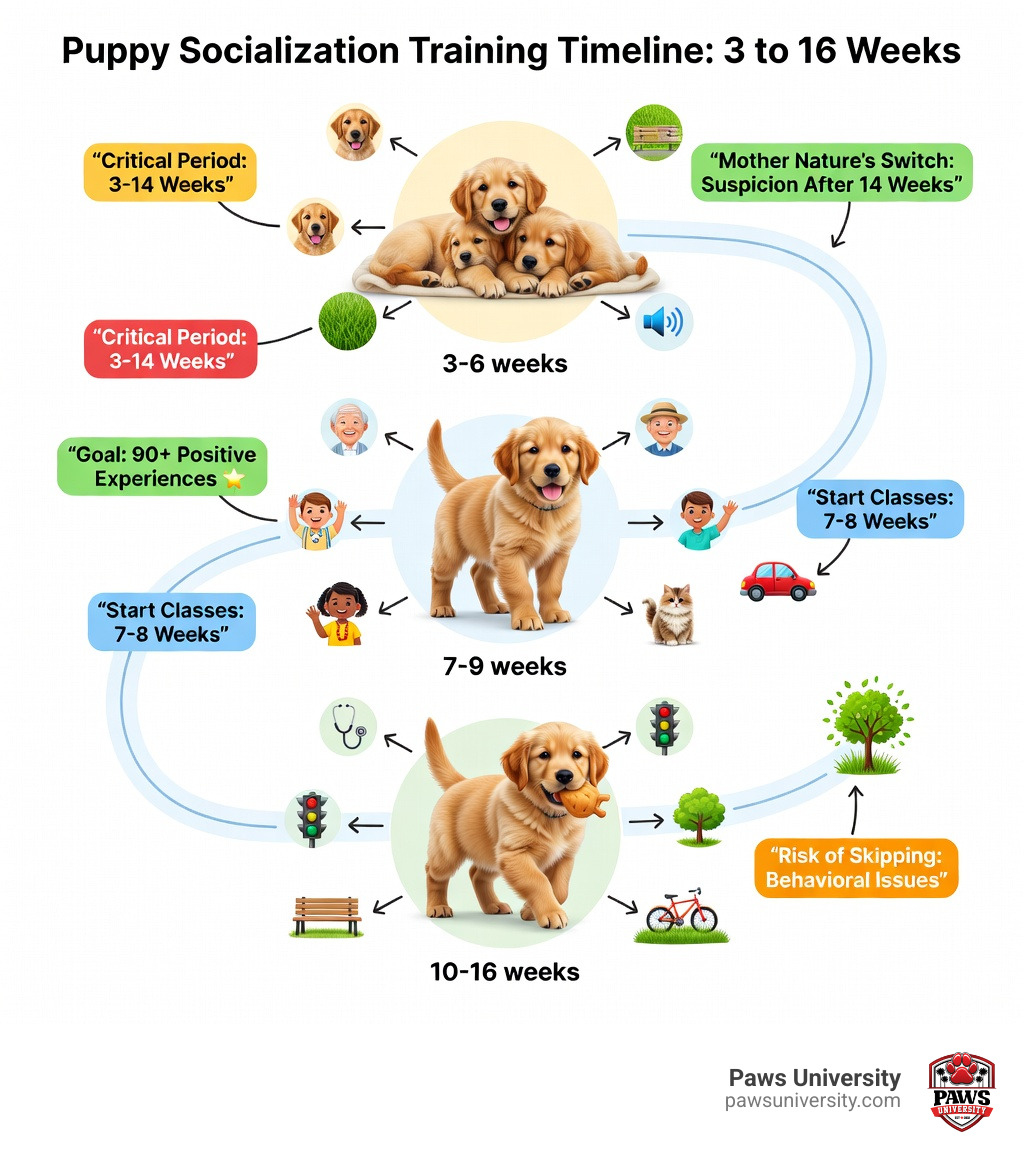
When we talk about the "critical period" for a puppy, we are referring to a biological window of brain plasticity that typically occurs between 3 and 14 weeks of age. During this time, a puppy’s brain is like a sponge; they are naturally more curious than they are fearful. They are biologically predisposed to accept new things as a normal part of life.
Once this window begins to close around 14 to 16 weeks, Mother Nature flips a switch. For a wild canine, being suspicious of new things after this age is a survival mechanism. For a pet living in Kailua-Kona, however, being suspicious of a neighbor in a sun hat or a loud delivery truck leads to lifelong anxiety.
According to the AVSAB Position Statement on Socialization, the primary time for puppy socialization training is these first three months. If we don't introduce them to the diversity of the human world during this time, they may develop "stranger danger"—a fear of anything or anyone unfamiliar.
Why Early Puppy Socialization Training Can Save a Dog's Life
It sounds dramatic to say socialization saves lives, but the statistics back it up. Behavioral issues are the leading reason dogs are relinquished to shelters or, in tragic cases, face behavioral euthanasia. A dog that is terrified of the world is a dog that is more likely to bite out of fear or become impossible to handle at the vet.
By investing in puppy socialization training early, we are building a foundation of confidence. We want our dogs to look at a new situation and think, "Oh, that's different! I wonder if I get a treat for being calm?" rather than "That's scary! I need to run or fight." As highlighted in the ASPCA Socialization Guide, proper socialization strengthens the owner-dog bond, making the dog a more integrated and joyful part of the family.
Balancing Socialization with Vaccination Risks
One of the most common questions we hear at Paws University is: "Is it safe to take my puppy out before they have all their shots?"
For years, the standard advice was to keep puppies inside until they were fully vaccinated at 16 weeks. However, modern veterinary medicine and behavior science have shifted. Because the critical socialization window closes before the vaccination series is finished, waiting until 16 weeks often means missing the most important developmental phase of the dog's life.
The AVMA Socialization Resources suggest that the risk of behavioral problems is far greater than the risk of infectious disease, provided you are smart about where you go.
| Risk Category | Waiting Until 16 Weeks | Starting at 7-8 Weeks (Safely) |
|---|---|---|
| Infectious Disease | Extremely Low | Low (if avoided high-traffic areas) |
| Fear/Aggression | High Risk | Low Risk |
| Separation Anxiety | Increased Risk | Reduced Risk |
| Adaptability | Difficult to develop | Naturally developed |
Safe Environments for Puppy Socialization Training
The key to safe puppy socialization training is controlling the environment. You shouldn't take an 8-week-old puppy to a public dog park where the vaccination status of other dogs is unknown. Instead, look for:
- Sanitized Indoor Facilities: Professional training centers that require proof of vaccination for all participants.
- Vaccinated Peers: Playdates with healthy, adult dogs that you know are up to date on their shots.
- Professional Supervision: Programs like the AKC S.T.A.R. Puppy Program provide a structured environment where trainers can intervene if play gets too rough or a puppy becomes overwhelmed.
The "Rule of 7" and Beyond: A Socialization Checklist
A popular benchmark in the training world is the "Rule of 7," which suggests that by the time a puppy is 7 weeks old, they should have been exposed to 7 different surfaces, 7 different types of people, and 7 different environments. For puppy socialization training, we like to take that even further.
Experts recommend aiming for 90 different pleasurable situations by the time your puppy is 14 weeks old. This doesn't mean 90 hours of training; it means 90 brief, positive "pings" of experience.
Key Categories for Exposure
When working through your checklist, think about the things your dog will encounter living here in West Hawaii. Use the Puppy Socialization Guidelines to help categorize your efforts:
- Diverse People: Children (who move differently than adults), people with beards, people wearing sunglasses or hats, and people using wheelchairs or walkers.
- Novel Sounds: Sirens, thunder, vacuum cleaners, and the sound of waves or heavy rain on a tin roof.
- Varied Surfaces: Grass, sand, gravel, tile, hardwood, and even wobbly surfaces like a safe low platform.
- Handling and Grooming: Touching ears, paws, and tails. Introduce the sight and sound of brushes, nail clippers, and running water.
- Environments: Car rides (start with short, 5-minute trips), the vet's office (just for a "happy visit" where they get treats and no needles), and quiet public areas where you can sit on a bench and watch the world go by.
How to Recognize and Manage Stress During Training
The most important word in puppy socialization training is positive. Exposure without a positive association is just "flooding," which can actually make a puppy more fearful. We want to watch our puppy's body language closely to ensure they are having a good time.
Signs your puppy is comfortable:
- Loose, wiggly body.
- Wagging tail.
- Willingness to take treats.
- Curious approach toward the new thing.
Signs your puppy is stressed:
- Lip licking or yawning (when not tired).
- Whale eye (seeing the whites of their eyes).
- Tucked tail or cowering.
- Refusing high-value treats.
Avoiding Common Socialization Mistakes
One of the biggest mistakes owners make is forcing an interaction. If your puppy is scared of a trash can, don't drag them toward it. This is called "flooding," and it can cause the puppy to shut down. Instead, give them distance. Let them look at the object from 20 feet away while you give them treats. As they relax, move a foot closer.
Other mistakes include:
- Unsupervised Dog Parks: These are often "wild west" environments where a single bad experience with an aggressive dog can traumatize a puppy for life.
- Coddling Fear: If your puppy is scared, don't pick them up and coo, "It's okay, baby!" in a worried voice. This confirms to them that there is something to be worried about. Instead, remain calm, move away from the trigger, and encourage them with a happy, "Let's go this way!"
- Over-stimulation: Puppies need a lot of sleep (up to 18-20 hours a day!). A 3-hour outing to a busy market is too much. Keep sessions short—15 minutes is often plenty.
Scientific research on puppy behavior shows that puppies who are allowed to move at their own pace develop much stronger resilience than those forced into scary situations.
Frequently Asked Questions about Puppy Socialization
Can I socialize my dog if they are older than 16 weeks?
Yes, but the process changes. While the "critical window" has closed, dogs are still capable of learning throughout their lives. For older dogs, we focus on desensitization and counter-conditioning. This means very slowly changing their emotional response to something they already fear. It takes more patience and a slower pace, but with the help of adult dog classes or the AKC Canine Good Citizen program, you can still make great strides in their confidence.
What should I look for in a professional puppy class?
A good puppy class is more than just a room full of dogs. Look for:
- Small Groups: To ensure the trainer can monitor every interaction.
- Size/Style Pairing: Ensuring a 4lb Maltese isn't being trampled by a 25lb Great Dane puppy.
- Positive Reinforcement: The use of treats, praise, and play rather than "corrections" or punishment.
- Sanitization: The facility should be cleaned with veterinary-grade disinfectants before every class.
How do I handle a puppy that is already showing fear?
Take baby steps. If your puppy is afraid of other dogs, don't go to a park. Sit in your car at the far end of a parking lot near a pet store and feed your puppy bits of chicken every time they see a dog walk by. Increase the "difficulty" only when your puppy is consistently relaxed and looking to you for treats. If the fear is severe, always seek a professional consultation with a trainer who specializes in positive reinforcement.
Conclusion
The effort you put into puppy socialization training today is the greatest gift you can give your dog. It is the difference between a dog that has to be locked away when guests arrive and a dog that can accompany you to a cafe or on a hike through the beautiful trails of the Big Island.
At Paws University, we’ve seen thousands of puppies transform into confident, happy adults through supervised play and structured training on our seven-acre campus. We believe that every dog deserves the chance to feel safe and secure in the world. If you're ready to start your journey, you can find more info about puppy training services on our website.
Remember: the window is short, but the benefits of a well-socialized dog last a lifetime.