Why Choosing the Right Dog Kennel for Anxious Dogs Changes Everything
Finding the right dog kennel for anxious dogs is one of the most important decisions you can make for a dog that struggles with separation, storms, or being left alone.
Here's what to look for — fast:
| Feature | Why It Matters |
|---|---|
| Solid or semi-solid panels | Reduces visual overstimulation |
| Reinforced frame and latches | Prevents escape and self-injury |
| Proper sizing (stand, turn, lie) | Creates a den-like sense of safety |
| Smooth ventilation holes | Airflow without paw or tooth injury |
| Rewards-based introduction | Builds a positive association with the kennel |
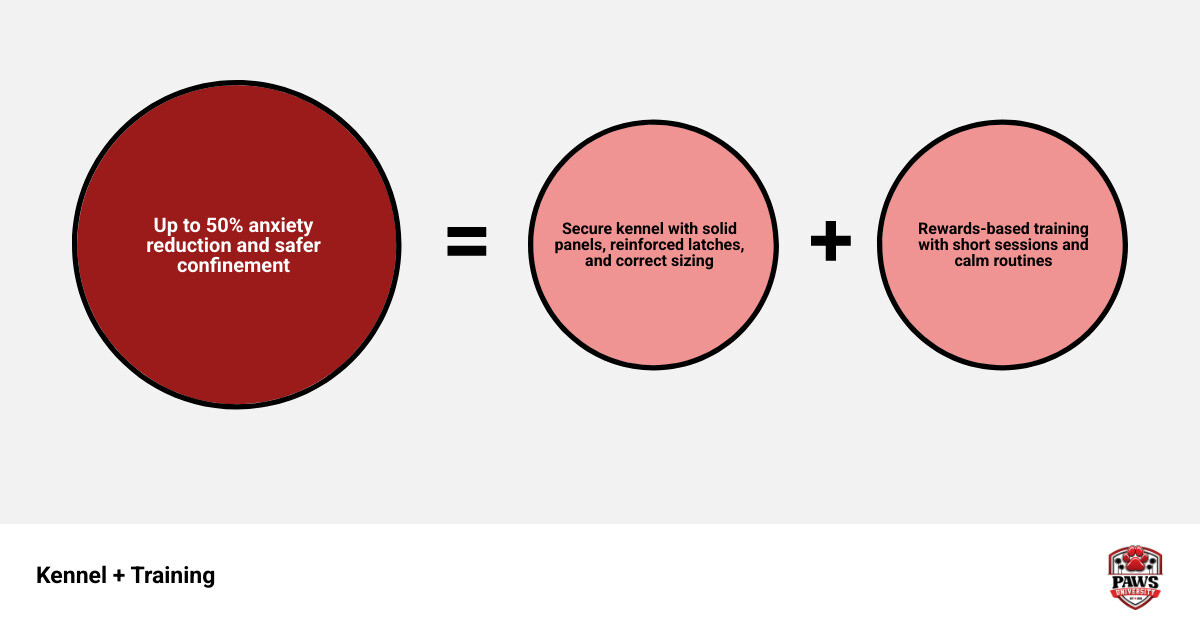
These five factors work together. A strong kennel alone won't calm an anxious dog — but the right kennel combined with consistent training can reduce anxiety symptoms significantly.
Research suggests that roughly 72.9% of dogs show signs of anxiety, with separation anxiety being one of the most common triggers. Yet many dog owners are still using standard wire crates or plastic kennels that simply aren't designed for a dog that panics, escapes, or injures itself trying to get out.
This guide covers everything — from materials and sizing to training steps and when to ask for professional help.
I'm Allen Daniels, co-founder of Paws University in Kailua-Kona, and I've spent over 25 years applying science-backed, rewards-based training methods to behavioral challenges — including helping West Hawaiʻi dog owners find the right dog kennel for anxious dogs and build the routines that actually make it work. My background started with professional marine mammal training in the early 1990s, and the same trust-based principles I used with 500-pound dolphins are the foundation of every anxiety case I work with today.
Common dog kennel for anxious dogs vocab:
What Makes a Dog Kennel for Anxious Dogs Safe and Effective
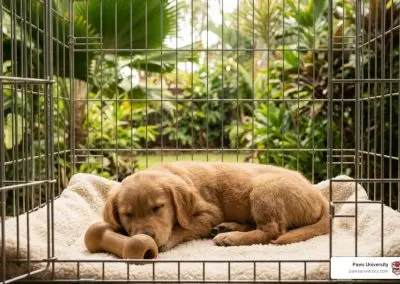
A safe kennel for an anxious dog does two jobs at once:
- It keeps the dog physically secure.
- It helps the dog feel emotionally safer.
That means we want a setup that feels den-like without feeling trapped, has good airflow without dangerous gaps, and is strong enough that a panicked dog cannot bend, chew, or burst through it.
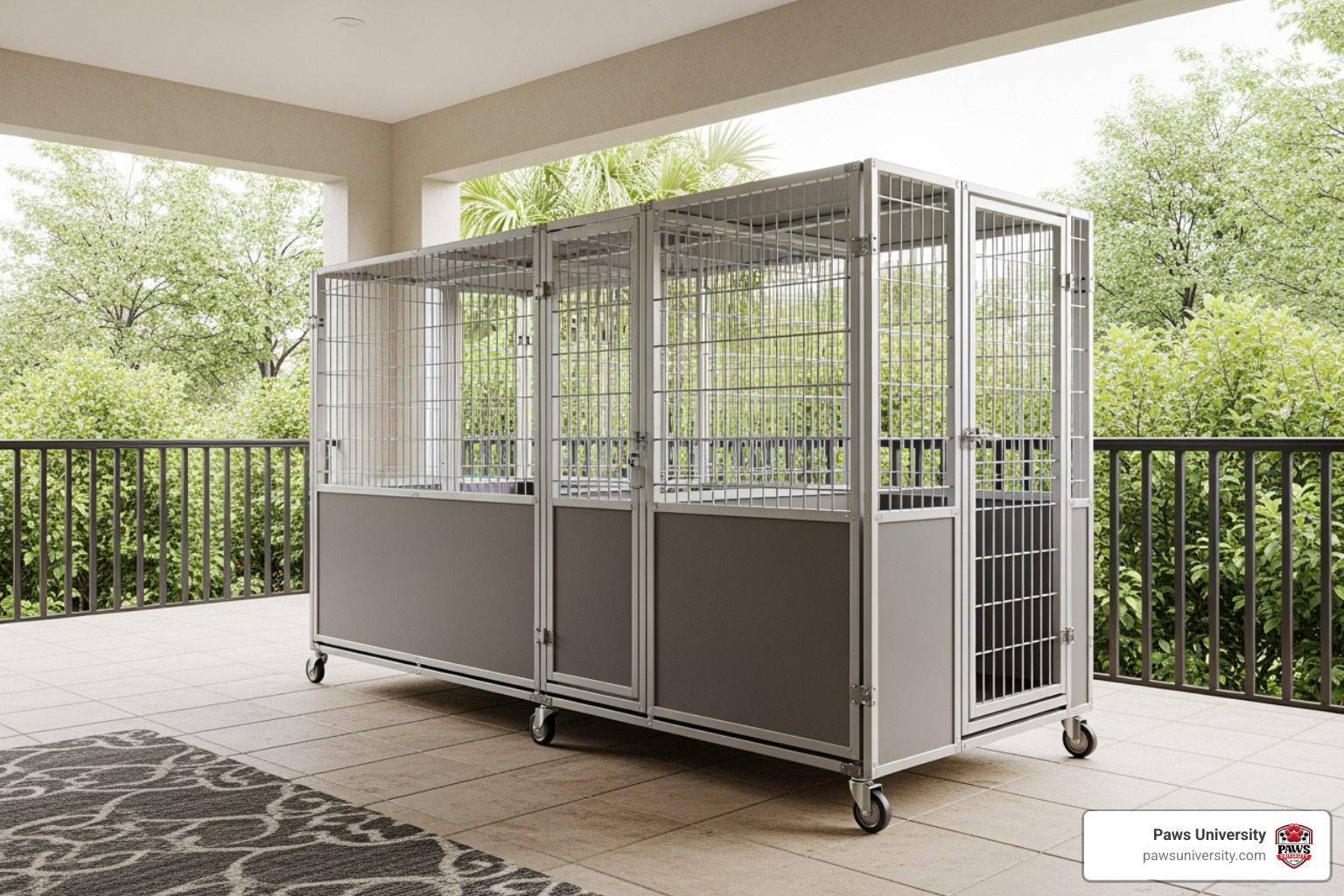
For many anxious dogs, the best kennel is not the most open one. It is the one that lowers stimulation. Solid or semi-solid sides can reduce constant visual scanning. Smaller, smooth ventilation openings can help prevent dogs from catching paws, noses, or teeth while still allowing airflow. Reinforced doors and reliable latches matter because escape attempts are not just inconvenient - they can become injury events.
For large or powerful dogs, heavy-duty construction becomes even more important. A kennel that is merely "fine for calm dogs" may fail fast when faced with a determined escape artist having a full panic moment at 2 a.m. Dogs are talented. Anxious dogs are talented in a way that keeps hardware designers awake at night.
Key signs your dog needs a specialized dog kennel for anxious dogs
Some dogs do well in a standard crate. Others make it obvious they need something safer and more thoughtful.
Signs include:
- bending crate wires
- chewing doors or corners
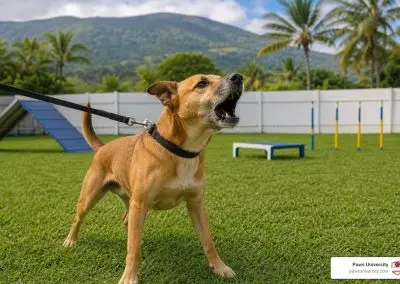
- frantic barking or howling
- heavy drooling or panting during confinement
- scratching until nails wear down
- pacing and spinning before entering
- soiling the kennel only when left alone
- self-injury around the mouth, paws, or nose
- panic during storms, fireworks, or strong wind
- destructive behavior that appears only during isolation
If that sounds familiar, it is worth reading more about separation anxiety. Shelter data also suggests anxiety-related behavior is common, with roughly 20% to 40% of shelter dogs showing signs that can improve with proper enrichment, routine, and secure housing.
Features that matter most in a dog kennel for anxious dogs
When we evaluate kennel safety for anxious dogs, we focus on these features first:
- Reinforced frame
- Chew-resistant materials
- Secure latch system
- Rounded or smooth edges
- Ventilation openings that do not allow paw or tooth entrapment
- Removable tray for fast cleanup
- Double-door access for easier handling
- Lockable wheels for controlled movement
- Balanced privacy and airflow
- Easy sanitation
Self-locking or multi-point latch systems are especially useful for escape-prone dogs. A simple slide bolt may be enough for a relaxed Labrador. It is often not enough for a panicked dog who has apparently studied mechanical engineering in secret.
Choosing the Right Size, Material, and Layout
Sizing and material choices can make or break a kennel’s success. Too small and the dog feels cramped. Too large and the space may stop feeling secure, while also encouraging pacing, toileting in one corner, or frantic movement.
The general sizing rule is simple: your dog should be able to stand naturally, turn around comfortably, and lie down fully stretched without being pressed against the walls.
Material matters too. Here is the big-picture comparison:
| Material | Best For | Watch Outs |
|---|---|---|
| Heavy-duty aluminum | Strong, lighter than steel, good for escape-prone dogs | Premium option, some models are heavy to move |
| Heavy-duty steel | Extremely sturdy home setups | Very heavy, may rust faster in humid conditions if poorly finished |
| Standard wire | Calm, already crate-trained dogs | Overstimulation, bending, paw injuries, escape risk |
| Plastic | Travel or short-term calm confinement | Limited durability for panic chewers |
| Soft-sided | Calm, trained dogs only | Not suitable for high anxiety or escape behavior |
For Hawaii County homes, climate matters. We always want shade, airflow, and dry footing. A kennel placed in a hot, stuffy corner is not calming. It is a sweat box with a roof. Covered lanais, indoor corners with air movement, or shaded interior spaces usually work better than direct sun exposure.
Best sizing rules for large and high-energy dogs
Large anxious dogs need enough room for comfort, but not so much room that the kennel feels like an empty garage.
Use these checks:
- Measure standing height to the top of the head or ears, whichever is taller.
- Measure nose to tail base for body length.
- Add enough room for lying flat and easy turning.
- Make sure shoulders are not brushing both sides.
- For young dogs still growing, use dividers when appropriate rather than starting with an oversized space.
Mobility comfort matters too. Older large dogs, dogs recovering from stress-related injuries, and deep-chested breeds often need a little extra thought around door width, flooring grip, and how easily they can enter and exit.
For a deeper look at building positive kennel habits, see our guide to crate training.
How double-door designs and lockable wheels improve daily use
These features sound practical because they are practical - and that matters a lot for anxious dogs.
A double-door design helps by:
- giving you more entry options
- reducing the need to corner or drag a nervous dog
- making it easier to place the kennel in a room
- allowing safer cleaning and bedding changes
- supporting calmer transfer routines
Lockable wheels help by:
- letting you reposition the kennel without lifting
- making deep cleaning easier
- allowing you to move the kennel toward family activity during training, then back to a quieter area
- keeping the kennel stable once in place
A kennel that is easier for us to use consistently is usually better for the dog too. Smooth routine lowers stress.
How Crate and Kennel Training Can Reduce Anxiety
The kennel itself is only half the plan. Training is the other half.
Research referenced in this topic area suggests crate training can reduce anxiety symptoms by up to 50% when it is used consistently as part of a broader behavior plan. That does not mean every dog will relax overnight. It does mean the kennel can become part of the solution instead of part of the problem.
The goal is not "put dog in box and hope for emotional growth." The goal is to teach the kennel to predict calm, safety, food, rest, and routine.
A good kennel routine includes:
- gradual desensitization
- positive associations with food and rest
- short, successful practice sessions
- calm departures and arrivals
- familiar bedding when safe
- appropriate chew or food enrichment
- predictable daily rhythm
For additional reading on shelter-style enrichment principles that support emotional regulation, see Behavior and Enrichment.
Rewards-based crate training steps for anxious dogs
We use a simple progression:
- Start with the door open.
- Toss treats in and let your dog choose to go in.
- Feed meals near the kennel, then just inside it, then farther back.
- Add a cue such as "kennel" or "rest."
- Reward calm body language, not just entry.
- Briefly close the door for a second or two, then open it before stress rises.
- Gradually increase distance and duration in tiny steps.
- Keep greetings and exits low-key.
Important rules:
- Never force the dog inside.
- Never use the kennel as punishment.
- Do not jump from 30 seconds to 30 minutes.
- End sessions while your dog is still successful.
Some dogs need days. Some need weeks. Some need months, especially if they have a history of panic or bad kennel experiences. Progress is still progress.
If your dog melts down when you leave, our article on leaving anxiety can help.
Common kennel mistakes that make anxiety worse
Even a well-built kennel can backfire if the routine around it is wrong.
Common mistakes include:
- choosing a crate that is too big
- choosing a crate that is too small
- using the kennel only when leaving the house
- rushing door-closed training
- making emotional, dramatic goodbyes
- placing the kennel in a noisy or hot spot
- poor ventilation
- using wire crates for dogs that injure themselves on bars
- leaving an anxious dog confined too long
- expecting exercise deprivation to create calm
That last one deserves a quick note. Tired dogs are often calmer, yes. But exhaustion is not treatment. We want healthy exercise, enrichment, and rest - not a dog who is simply too worn out to protest.
If barking and escape attempts are part of the picture, read our guide here.
Safety and Usability Features That Improve Everyday Life
Sometimes small design details make a huge difference in safety and sanity.
A kennel for an anxious dog should be secure for the dog and manageable for the humans caring for that dog. If cleanup is hard, doors stick, or the roof traps heat and debris, consistency drops. And anxious dogs really do best with consistency.
Why removable trays, pointed roofs, and self-locking latches matter
Removable trays:
- speed up cleanup after accidents
- help control odor
- support better hygiene
- reduce the time your dog spends near mess or stress scent
Pointed roofs:
- can help shed leaves, debris, and rain in outdoor or semi-outdoor setups
- reduce pooling in wet weather
- improve weather handling in tropical conditions
Self-locking latches:
- reduce accidental escapes
- provide more secure closure during busy routines
- help when a dog learns to bump or paw basic door hardware
- support safer containment for high-arousal moments
These features do not "treat" anxiety by themselves. What they do is make the environment safer, cleaner, and more predictable. For anxious dogs, predictable is gold.
Where to place a kennel for the calmest results
Location matters more than many owners think.
The best spot is usually:
- quiet but not isolated
- shaded and well ventilated
- away from harsh afternoon sun
- away from nonstop foot traffic
- close enough to normal household rhythm that the dog does not feel banished
- buffered from storm noise when possible
Good placement options often include:
- a calm indoor corner
- a covered patio or lanai with strong shade and airflow
- a room where the family passes through quietly
- a sleeping area with a predictable bedtime routine
In Hawaii County, heat and humidity should always shape placement decisions. We want air movement, dry flooring, and protection from direct sun and wind-driven rain.
Best Types of Dog Kennels for Anxious Dogs in 2026
There is no single best kennel type for every anxious dog. The right choice depends on the trigger.
Broadly, these are the main categories in 2026:
- Heavy-duty home crates for escape-prone dogs
- Furniture-style dens for mild anxiety and home integration
- Soft-sided crates for calm, already trained dogs
- Travel kennels for transport
- Storm-calming dens that focus on sound and environmental comfort
- Professional boarding kennels with trained supervision
Some owners also use calming bed options inside or alongside a kennel to increase den comfort for dogs who like to burrow. Examples of anxiety-focused product categories include smart calming crate designs and den-style calming beds. We mention these as examples of kennel styles and comfort concepts, not as one-size-fits-all answers.
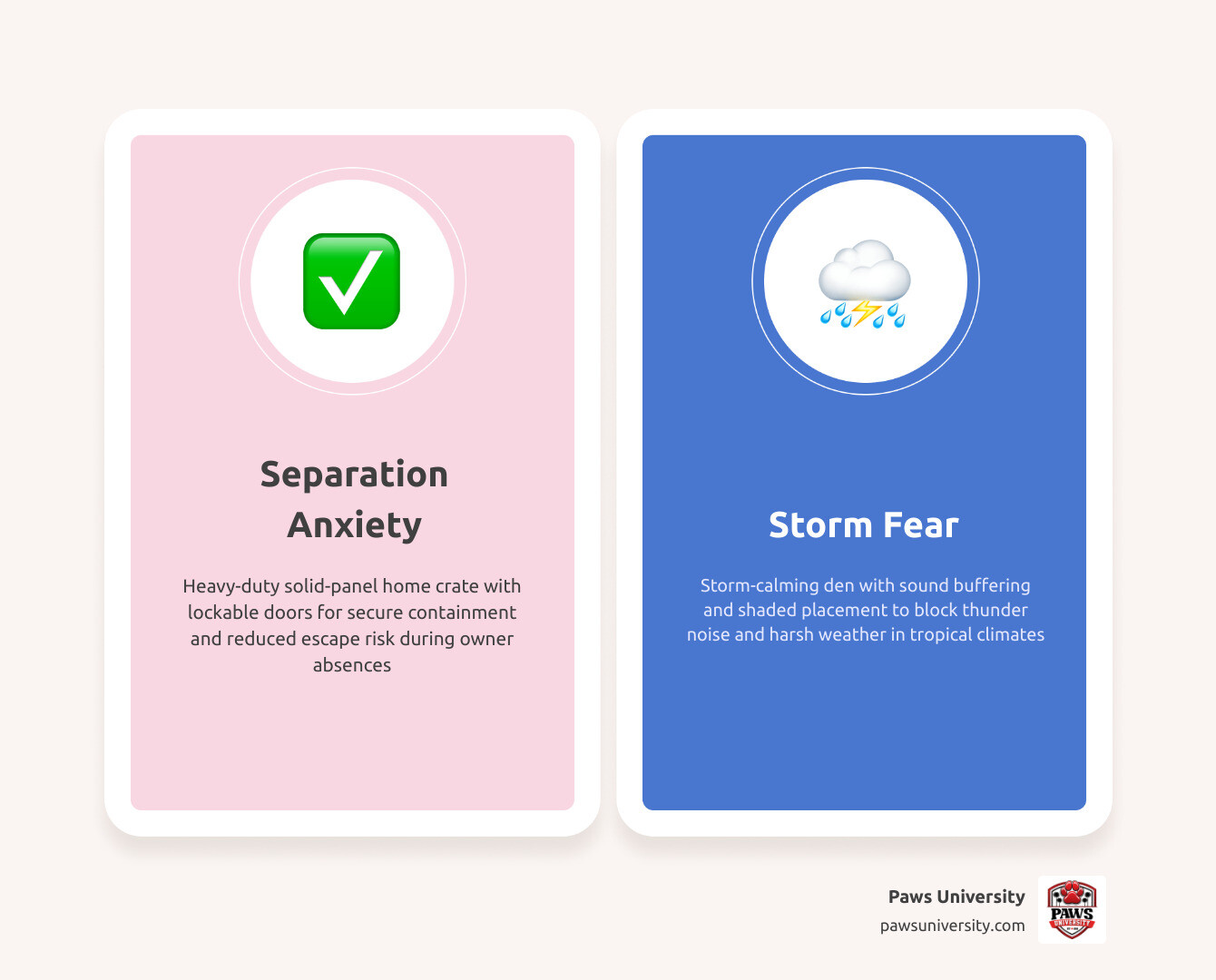
Which kennel style fits separation anxiety, storm fear, or escape behavior
Here is the simplest match-up:
-
Separation anxiety
- Best fit: den-like home kennel with structured training plan
- Key features: privacy, airflow, strong latches, calm placement
-
Storm fear or noise sensitivity
- Best fit: more enclosed setup with reduced stimulation and comfortable bedding
- Key features: sound buffering, shaded placement, familiar routine
-
Escape behavior
- Best fit: heavy-duty solid-panel or semi-solid kennel
- Key features: reinforced frame, secure hardware, smooth ventilation openings
-
Travel needs
- Best fit: dedicated travel kennel built for transport, not just living room use
- Key features: stability, sizing, safe ventilation
-
Mild anxiety with strong den preference
- Best fit: furniture-style den or kennel paired with calming bedding
- Key features: comfort, routine, low-pressure introduction
When a home kennel is not enough and extra support helps
Some dogs need more than a great kennel and a solid routine.
Please get extra help if your dog:
- breaks teeth or nails trying to escape
- bloodies paws or nose
- panics even during very short absences
- cannot eat when left alone
- shows escalating distress instead of slow improvement
- has a history of trauma, severe noise phobia, or self-harm
That is when we may recommend adding:
- veterinary evaluation
- behavior support
- a structured daytime routine
- trial-based boarding practice
- short daycare stays for dogs who benefit from supervised activity
If your dog may eventually need care away from home, start by reading Where to Find the Best Dog Kennel Boarding Hawaii Has to Offer and The Best Vacation Dog Boarding Hawaii Has to Offer. Gradual transitions matter.
At Paws University, our premium day care, boarding, and training environment in Hawaii County can also help dogs who need structure, supervised play, and routine rather than abrupt all-day isolation.
Frequently Asked Questions about Dog Kennels for Anxious Dogs
Can an anxious dog sleep in a kennel overnight?
Yes, if the dog is already comfortable and crate-trained.
Overnight kennel use works best when:
- your dog has had a calm bedtime routine
- potty needs are met before bed
- the kennel is familiar
- the dog willingly enters
- bedding is safe and comfortable
- the environment is quiet and cool
For puppies, newly adopted dogs, or dogs with active panic in confinement, overnight success may take time. We do not want the first full-night kennel session to be the emotional equivalent of being dropped into final exams without attending class.
Are wire crates bad for anxious or escape-prone dogs?
Not always, but they are often a poor fit for high-anxiety or escape-prone dogs.
Wire crates can:
- increase visual stimulation
- bend under pressure
- allow dogs to catch paws, jaws, or collars
- encourage frantic digging or bar-biting
- feel too exposed for dogs who crave a den-like space
Some calm, well crate-trained dogs do perfectly fine in wire crates. But for dogs with panic, storm fear, or a history of breaking out, heavier and less visually open options are often safer.
How long should an anxious dog stay in a kennel?
Keep sessions short enough that your dog can succeed.
As a general rule:
- start with very short training sessions
- build duration gradually
- give breaks for movement, potty, and decompression
- use enrichment thoughtfully
- avoid extended isolation as a substitute for treatment
Anxious dogs do better with many successful short reps than with long, stressful confinement. Quality beats duration every time.
Conclusion
The best dog kennel for anxious dogs is not just strong. It is properly sized, thoughtfully placed, easy to manage, and paired with rewards-based training that teaches your dog, "This is my safe place."
If your dog is dealing with separation stress, storm fear, escape behavior, or barking when left alone, start with the basics:
- choose a secure kennel with low-injury design
- size it correctly
- place it in a calm, shaded area
- build positive associations slowly
- get professional help early if panic is severe
That combination is what changes outcomes.
At Paws University, we help dogs in Hawaii County build safer routines through training, supervised day care, and premium boarding on our seven-acre campus. If you want help creating a calm confinement plan that fits your dog’s needs, explore our training services.
You can also learn more about our broader services here: