What to Look for in Seven Acres on Hawaiʻi Island
Seven acres on Hawaiʻi Island can offer room for a home, crops, animals, and outdoor space. The best parcel depends on what you want to do with it. Before falling for a view, check the land’s zoning, lava hazard zone, water and power access, road conditions, and usable ground. Those details can matter more than the acreage on the listing.
The island’s climates vary widely. A site suited to a coffee orchard may need a different plan from a drier parcel in Kaʻū. This guide will help you compare locations and spot the questions to ask before you buy.
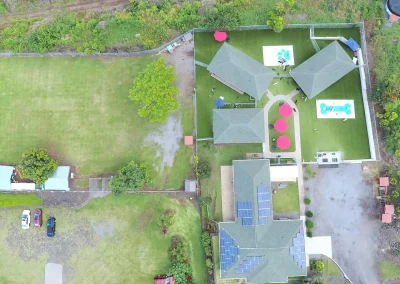
I’m Allen Daniels, a Hawaiʻi Island native and co-founder of Paws University, where I’ve helped run a seven-acre outdoor campus in Kailua-Kona since 2002. That hands-on experience shapes my approach to developing and managing Big Island seven acres: start with what the land can support, not just how much of it there is.
Planning a lifestyle on larger acreage often ties into broader goals, whether that means creating a relaxed Big Island setting, supporting year-round dog wellness in Hawaii, or reinforcing basic obedience for outdoor activities.
The Unique Appeal of Big Island Seven Acres Parcels
Hawaii Island stands out among the Hawaiian chain because of its sheer scale, geological youth, and rich agricultural heritage. For buyers considering big island seven acres, the appeal often lies in creating a relaxed Big Island setting with enough room for a home, agricultural use, and privacy without taking on the maintenance demands of a much larger property. This medium-sized acreage occupies a distinct sweet spot: it is expansive enough to provide complete seclusion and productive agricultural capacity, yet manageable enough for a family or small team to maintain without requiring industrial-grade farming equipment.
The topography across Hawaii County allows parcels of this size to capture sweeping Pacific vistas alongside towering mountain views of Hualalai, Mauna Kea, or Mauna Loa. Unlike smaller residential lots where neighbors are directly adjacent, seven acres lets you buffer your living spaces with native vegetation, botanical plantings, or working orchards. This acreage size offers sufficient land to create dedicated zones for home living, farming, animal care, and conservation.
Climate Zones and Agricultural Potential of Big Island Seven Acres
One of the most fascinating aspects of Hawaii Island is its incredible variety of microclimates. Within a short drive, conditions can transition from arid coastal plains to temperate upland forests. The suitability of seven acres depends heavily on elevation and average rainfall.
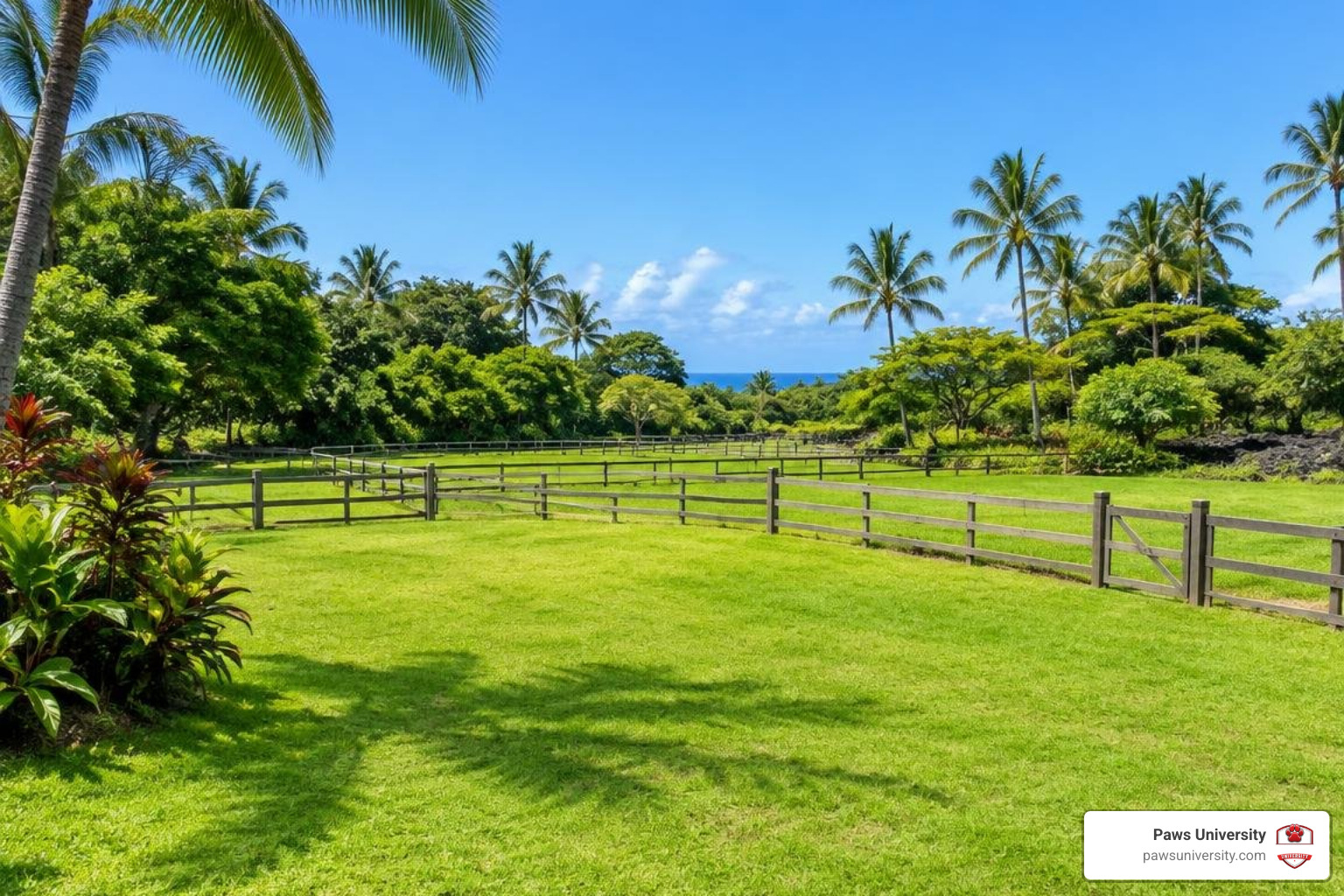
In the renowned Holualoa coffee belt on the slopes of Hualalai, elevations between 700 and 2,000 feet provide rich volcanic soil, morning sun, and regular afternoon cloud cover. These conditions are ideal for cultivating Kona coffee, specialty avocados, and citrus. Moving south into Kealakekua, deep soil beds and consistent rainfall support flourishing orchards filled with hundreds of mature macadamia nut trees, over a hundred mango trees, white pineapples, bananas, and papayas.
Further south in the Naalehu district of Kaʻū, expansive open pastures experience warm, breezy coastal conditions. These lower-elevation plains lend themselves to diversified agroforestry, tropical fruit production, or livestock grazing. Understanding the elevation, soil depth, and moisture patterns of your specific region ensures you choose agricultural projects that thrive naturally.
Homesteading, Private Retreats, and Expansive Land Uses
A seven-acre footprint provides the physical space required for versatile, multi-use development. Many landowners utilize this acreage to establish sustainable homesteads focused on regenerative food forests, organic gardens, and small-scale livestock husbandry.
Beyond standard residential layouts, seven acres allows for:
- Multi-Generational Compounds: Designing a main dwelling alongside permitted agricultural support structures so extended family can live and work together.
- Equestrian Facilities: Constructing stables, riding arenas, and fenced paddocks with ample turnout space for horses.
- Canine Enrichment Spaces: Designing expansive outdoor exercise areas, much like the secure grounds utilized for spacious outdoor dog play areas where pets can exercise safely in a structured, supervised environment.
- Agritourism & Farm Education: Cultivating specialty crops like cacao, vanilla, or exotic tropical blooms that invite sustainable, educational farm-tour opportunities.
County Zoning Regulations and Lava Hazard Considerations
Navigating land use policies on Hawaii Island requires an understanding of local zoning designations and environmental hazard maps. The Hawaii County Government oversees planning, zoning administration, and building permits through the County Planning Department. Every prospective property owner must verify what activities, dwellings, and structures are permitted on a given parcel before beginning site development.
Understanding Agricultural Zoning from A-1A to A-20A
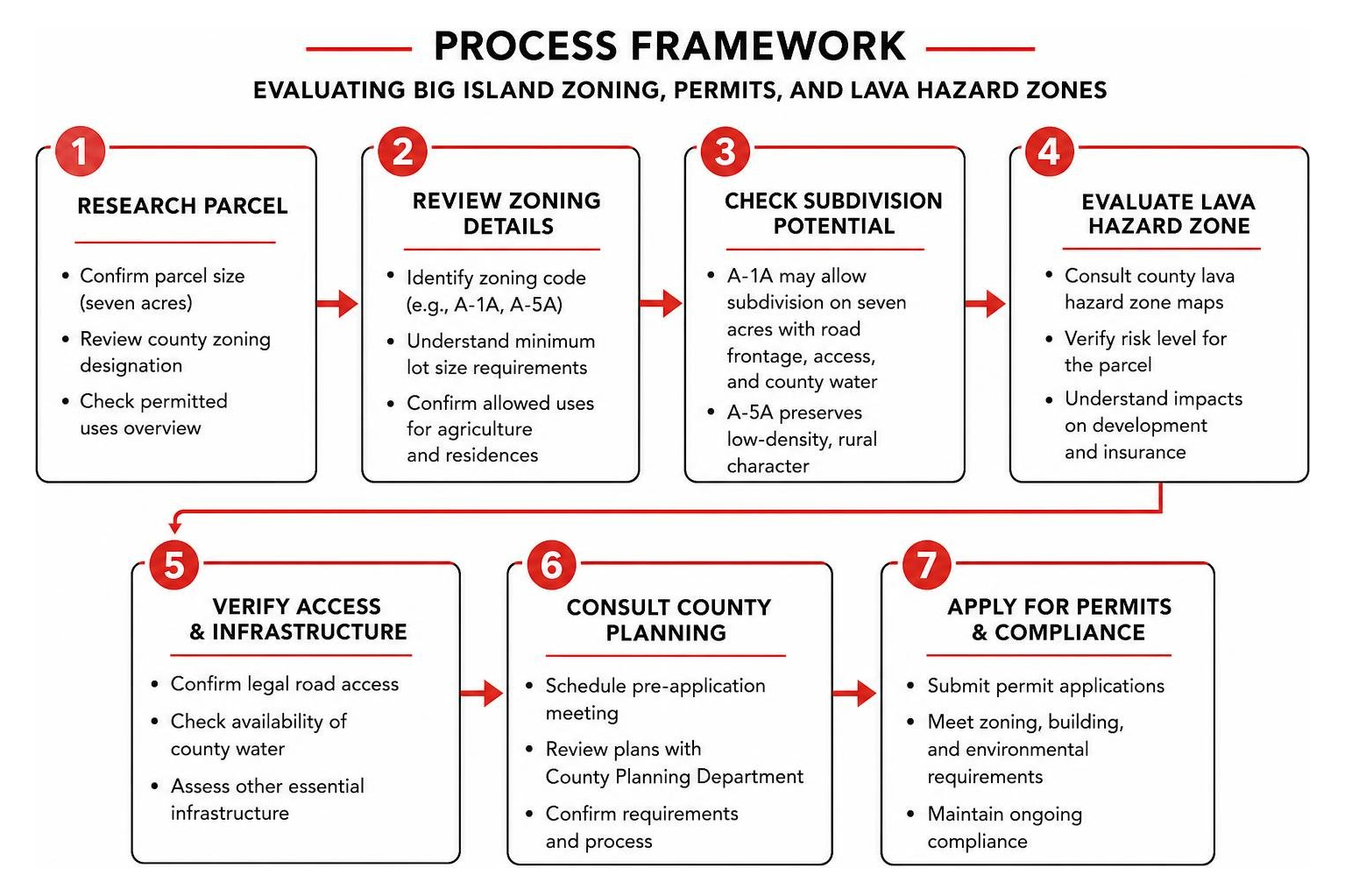
Most seven-acre parcels on the island fall under agricultural zoning designations. The numerical suffix in these zoning codes specifies the minimum lot size required for subdivision:
- A-1A (Agricultural, 1-acre minimum): Offers substantial flexibility. On a seven-acre parcel, this designation may allow for potential subdivision if road frontage, access, and county water requirements are met. It allows agricultural operations alongside residential uses.
- A-5A (Agricultural, 5-acre minimum): Often found in upland agricultural subdivisions like Kona Uplands. A seven-acre lot under A-5A zoning guarantees that surrounding properties remain spacious and low-density, protecting rural privacy.
- A-20A (Agricultural, 20-acre minimum): Frequently applied to larger rural tracts in Kaʻū and Hamakua. While you cannot subdivide a seven-acre parcel with A-20A zoning, it permits farming, ranching, and farm dwelling construction in accordance with county building codes.
For detailed land management, soil preservation, and crop selection strategies tailored to these agricultural zones, property owners frequently consult University of Hawaii CTAHR agricultural research, which provides invaluable regional crop data for local growers.
Assessing Lava Hazard Zones and Environmental Risks
The United States Geological Survey (USGS) categorizes Hawaii Island into nine distinct Lava Flow Hazard Zones, based on the location and historical frequency of volcanic eruptions:
- Lava Zone 1 & 2: Areas closest to active vents on Kilauea and Mauna Loa. These zones present the highest long-term volcanic risks, which can significantly affect property insurance availability and building requirements.
- Lava Zone 3: Covers areas such as Kealakekua, parts of Kaʻū, and portions of Puna. Eruptions have historically covered less of this land than in Zones 1 and 2, but standard hazard assessments are still standard practice during property planning.
- Lava Zone 4 through 9: Includes regions like Holualoa, Kailua-Kona, Kohala, and Hamakua. These areas have lower historical volcanic activity due to topography or older volcanic origins, resulting in the most straightforward insurance terms and standard building parameters.
Evaluating the lava hazard zone alongside flood designations (such as Flood Zone X, indicating minimal flood hazard) helps you plan appropriate building locations and long-term site infrastructure.
Infrastructure, Utilities, and Development Essentials
Transforming unimproved acreage into a functioning homestead or farm estate requires deliberate infrastructure planning. While some parcels come with county water meters, paved road frontages, and standard electrical connections, many medium-sized parcels rely on self-sufficient, off-grid systems.

Managing Water Catchment, Power, and Waste Systems
Infrastructure development generally centers on three essential components:
- Water Systems: In regions without municipal county water access, rainwater harvesting (catchment) is the standard method for residential and agricultural supply. A proper system includes food-grade storage tanks, multi-stage filtration, and ultraviolet (UV) purification to ensure clean, reliable water for domestic use.
- Electrical Power: Depending on the distance to the nearest utility pole, installing solar photovoltaic arrays paired with modern battery storage banks often proves more efficient and self-sufficient than extending the public power grid.
- Wastewater Management: Hawaii County enforces regulations for wastewater systems. New residential developments require engineered septic systems designed to protect groundwater quality and coastal reef ecosystems, replacing older legacy cesspools.
Comparing Land Footprints: Big Island Seven Acres Versus Other Parcel Sizes
Choosing the right land size requires balancing your development ambitions against ongoing property stewardship demands.
| Feature | 5-Acre Parcel | 7-Acre Parcel | 15-Acre Parcel |
|---|---|---|---|
| Primary Suitability | Single residential estate, hobby orchard, small equestrian paddock | Diversified farm, multi-use homestead, private retreat, secure animal acreage | Commercial farming, cattle grazing, extensive agroforestry |
| Maintenance Scope | Moderate; manageable by an individual homeowner | Balanced; accommodates multiple distinct zones with routine mowing and pruning | High; generally requires heavy machinery or dedicated farm labor |
| Zoning Commonality | Frequently A-5A or A-1A | A-1A, A-5A, or historical parcels | Frequently A-20A or large A-5A tracts |
| Infrastructure Demands | Compact utility footprint | Modular layout for homes, barns, and solar arrays | Extended roadways, wide fencing, and multi-tank water distribution |
| Buffer and Privacy | Excellent separation from neighbors | Complete privacy with dedicated natural greenbelts | Extreme seclusion; border management requires substantial perimeter fencing |
A seven-acre parcel provides adequate acreage to establish distinct utility zones, orchards, and open yards while avoiding the overwhelming land maintenance responsibilities associated with larger commercial agricultural tracts.
Frequently Asked Questions About Big Island Acreage
What crops grow best on seven acres in West Hawaii?
West Hawaii's volcanic soil and elevation gradients create prime conditions for a variety of specialty crops. In upland districts such as Holualoa and Kealakekua, Kona coffee trees, macadamia nut orchards, avocados, and mangoes thrive. At mid-to-lower elevations, white pineapples, bananas, papayas, citrus varieties (such as Meyer lemons and Tahitian limes), and cacao produce prolific harvests when managed with proper wind protection and soil amendments.
How does lava zone designation impact land development?
Lava hazard zones categorize land based on proximity to active volcanic vents and historical flow paths. Parcels situated in Lava Zones 3 and 4 typically have broader homeowner insurance options and standard building requirements compared to Zones 1 and 2. Building site planning in all zones benefits from assessing local topography, rock outcroppings, and natural drainage paths before grading building pads.
Can you build multiple homes on agriculturally zoned parcels?
Under Hawaii County zoning guidelines, agriculturally zoned parcels generally permit one primary farm dwelling. Additional farm dwellings or worker accommodations may be permitted depending on the property's specific zoning classification (such as A-1A versus A-20A), overall acreage, and whether the landowner demonstrates active, commercial agricultural production. All secondary structures must comply with county building permit processes and wastewater regulations.
Conclusion
A seven-acre property on Hawaii Island provides an ideal canvas for agricultural pursuits, sustainable homesteading, and peaceful rural living. By carefully evaluating microclimates, zoning regulations, lava hazard designations, and utility requirements, you can build a self-sufficient island sanctuary that harmonizes with Hawaii’s natural landscape.
At Paws University, our team has operated on an expansive seven-acre campus in Kailua-Kona since 2002. As West Hawaii's first premium dog care facility, we have designed our acreage to provide structured, positive-reinforcement environments where dogs thrive through supervised outdoor exercise and social enrichment. Whether you are establishing your own island homestead or seeking premium dog boarding on the Big Island, the possibilities offered by seven acres of open island land are truly extraordinary.