Why Your Dog Is Growling at You (And What to Do About It)
If you're wondering how do i stop my dog from growling at me, here's a quick answer:
- Stop what you're doing - Don't push through the growl. Back off calmly.
- Don't punish the growl - It's communication, not defiance. Punishment makes things worse.
- Identify the trigger - Fear, pain, resource guarding, or territorial behavior are the most common causes.
- Use positive methods - Lure your dog away with treats instead of physically moving them.
- Reduce stressors - Manage the environment to prevent the situation from repeating.
- See a vet if it's sudden - New or unexpected growling can signal pain or illness.
- Get professional help if it escalates - A certified trainer or behaviorist can build a safe, lasting plan.
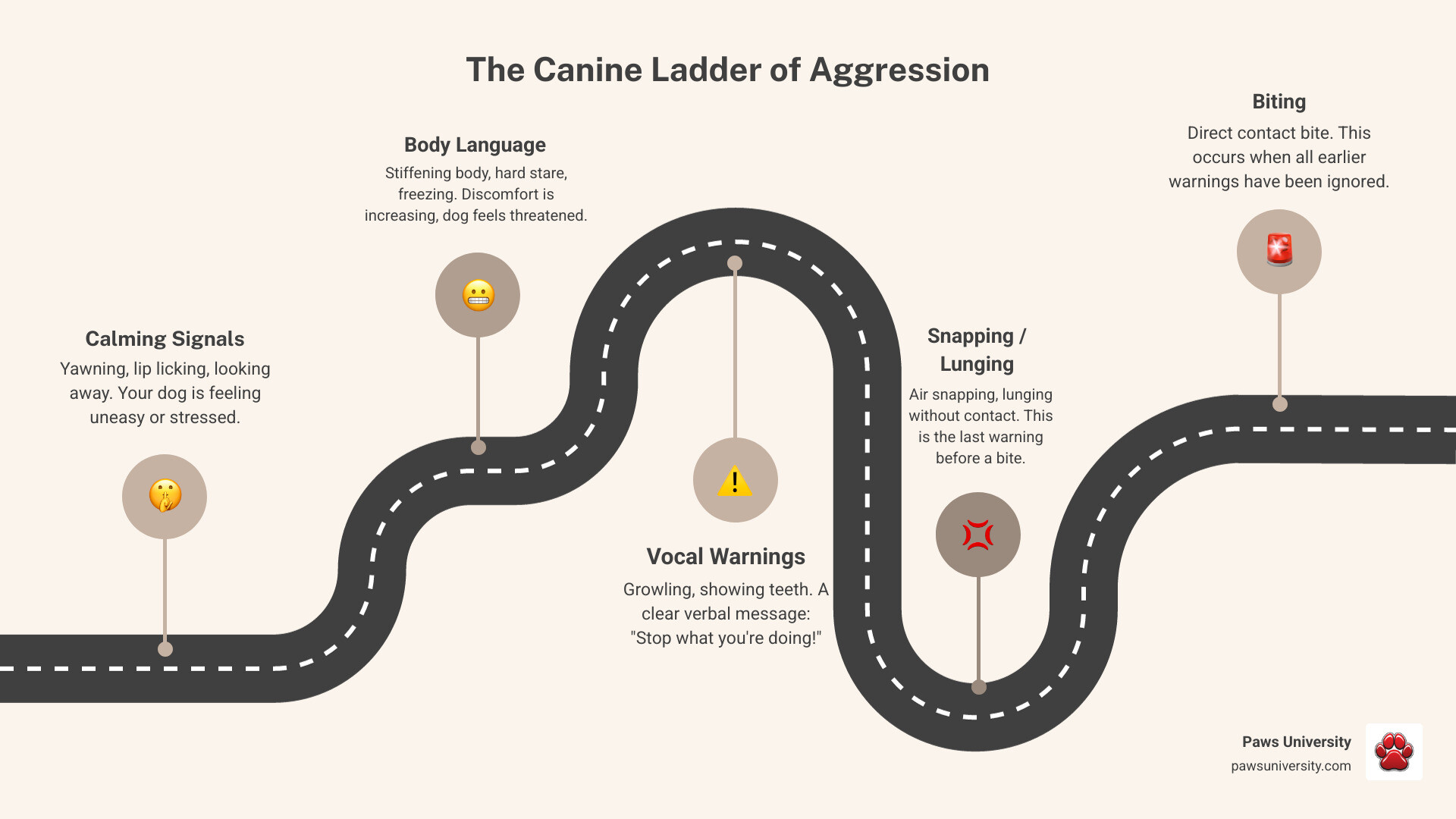
A growl is not your dog being "bad." It's actually the opposite - it's your dog talking to you. Dogs growl to say "I'm uncomfortable" or "please stop." It's one of the last warnings before a bite. The real problem isn't the growl itself. It's whatever is causing your dog to feel that way.
Understanding that distinction changes everything about how you respond.
I'm Allen Daniels, co-founder of Paws University and a professional animal trainer with over 30 years of experience applying operant conditioning - first with dolphins, then with dogs - to solve exactly the kind of behavioral challenges like how do i stop my dog from growling at me that keep dog owners up at night. In the sections below, I'll walk you through the causes, safe in-the-moment responses, and proven training techniques to build a calmer, more trusting relationship with your dog.
Understanding Why Your Dog Growls at You
To effectively address the question, "how do i stop my dog from growling at me," we first have to put on our detective hats. Growling is a clinical sign, not a diagnosis. It is a distance-increasing signal meant to stop an advance or a specific interaction.
Common triggers include:
- Fear: This is perhaps the most common root cause. If a dog feels cornered, startled, or overwhelmed by a situation they don't understand, they use a growl to say, "Stay back."
- Resource Guarding (Possession Aggression): Your dog may growl when you approach them while they have a high-value item, such as a bone, a favorite toy, or even a stolen sock. They are communicating that they aren't willing to share or lose that item.
- Territoriality: This often happens when someone approaches the dog’s "space," such as their crate, their bed, or even the front door when the mail carrier arrives.
- Pain: A dog that is usually friendly but suddenly starts growling when touched may be suffering from an underlying medical issue.
- Play: Not all growls are scary! Many dogs growl during a vigorous game of tug-of-war or while wrestling with a furry friend.
Scientific research on aggressive dog behavior suggests that understanding the context—the "who, what, where, and when"—is vital to determining the function of the growl.
Is growling always a sign of aggression?
In short: No. While we often associate growling with a threat, it is a nuanced form of vocalization. Context is everything. To tell if a growl is "friendly," look for "metasignals." These are secondary body language cues that tell you the growl is part of a game.
A play growl is often higher-pitched and short. You’ll likely see a "play bow" (front legs down, rump in the air), a wagging tail, and a loose, "floppy" body. In contrast, a warning growl is usually a low, menacing rumble accompanied by a stiff posture, a hard stare, and a closed mouth.
| Feature | Play Growl | Warning Growl |
|---|---|---|
| Body Language | Loose, wiggly, play bows | Stiff, frozen, leaning forward |
| Eyes | Bright, blinking, soft focus | Hard stare, "whale eye" (showing whites) |
| Tail | Broad, fast wag | Still, vibrating, or tucked |
| Mouth | Open, "grin-like" | Closed, lip curling, showing teeth |
When growling indicates a medical issue
If your dog’s behavior changes overnight, the first stop shouldn't be a trainer—it should be a veterinarian. Sudden onset growling is a major red flag for pain. Conditions like arthritis, dental abscesses, ear infections, or internal injuries can make a dog extremely sensitive to physical touch.
According to Veterinary guidance on canine growling, growling is an agonistic signal used in defense. If a dog is hurting, they will use that signal to protect their body from further discomfort. We always recommend ruling out medical issues before beginning a behavior modification program.
How do I stop my dog from growling at me immediately?
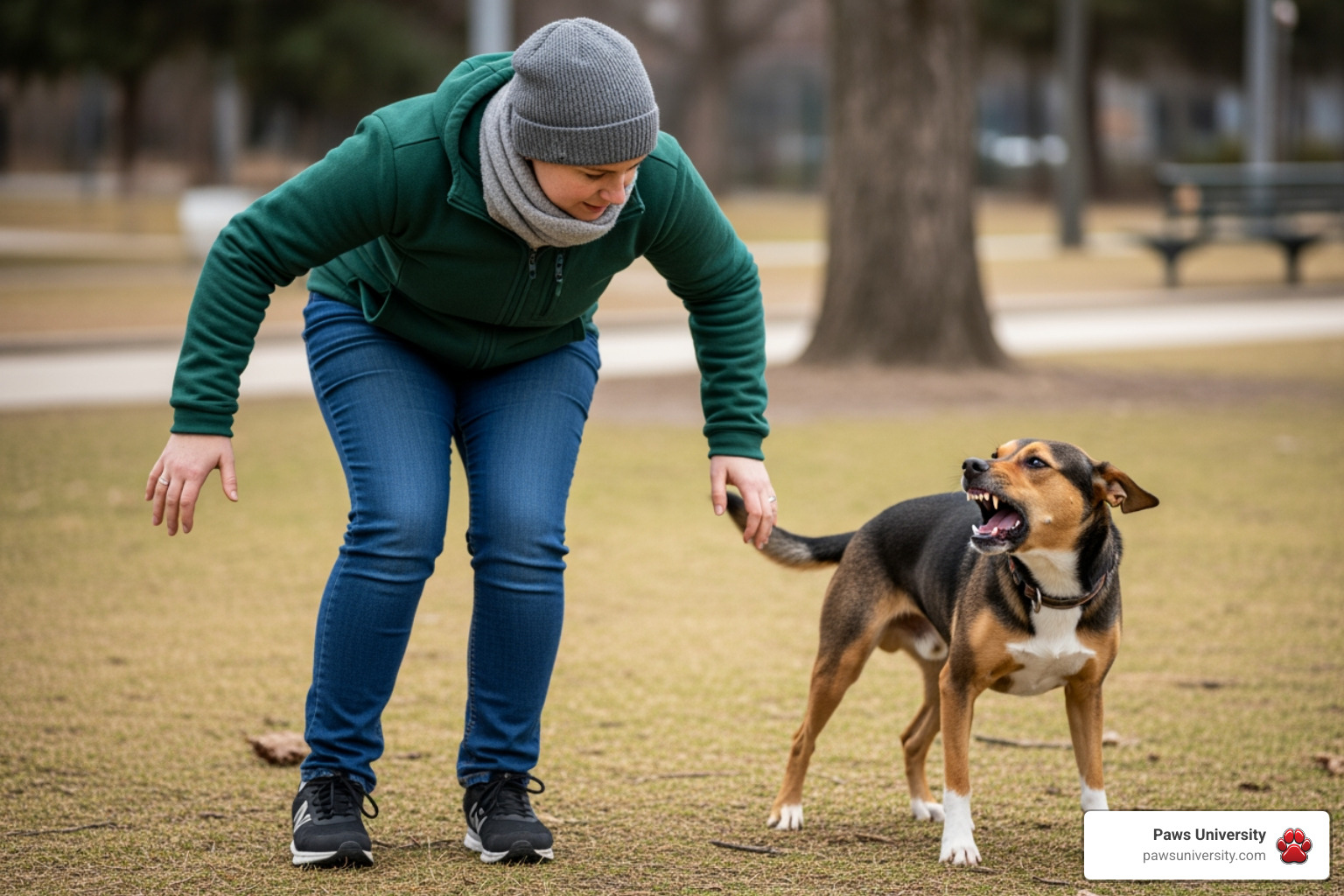
When your dog growls at you, your immediate reaction determines whether the situation de-escalates or turns into a bite. The goal is safety and the preservation of trust.
- Freeze and Stop: Whatever you are doing—reaching for a collar, leaning over them, or trying to move them—stop immediately.
- Back Off: Slowly increase the distance between you and the dog. Do not turn your back abruptly, but don't loom over them either.
- Avoid Eye Contact: A direct, hard stare can be perceived as a challenge or a threat by a stressed dog. Look slightly away.
- Neutral Noise: Sometimes a soft, neutral noise like a whistle or a gentle tongue click can break the dog's "trance" and get their attention without being confrontational.
- Redirect: Once you have a bit of distance and the dog has relaxed slightly, use a high-value treat or a favorite toy to lure them to a different area.
Why you should never punish a growling dog
It is a natural human instinct to want to correct a growl. You might feel the urge to yell "No!", "Alpha" them, or use a "balanced" correction. Do not do this.
Punishing a growl is like taking the batteries out of a smoke detector because you don't like the noise. The fire (the underlying stress or fear) is still there, but you’ve removed the warning system.
If you teach a dog that growling results in punishment, they may stop growling—but they won't stop feeling threatened. Eventually, the dog may skip the growl entirely and go straight to a bite. This is how we end up with "bites that come out of nowhere." Furthermore, dominance theory has been debunked in modern animal behavior. Your dog isn't trying to be the "boss"; they are trying to feel safe.
If you are struggling with this, looking into our Training services can help you understand how to communicate with your dog without using force.
Proven Training Techniques to Prevent Growling
Once the immediate tension has passed, we focus on long-term solutions. We use positive reinforcement, counterconditioning, and desensitization to change how the dog feels about the trigger.
Counterconditioning involves pairing the "scary" thing with something wonderful (usually high-value treats like chicken or cheese). If your dog growls when you approach their food bowl, you might start by tossing a piece of steak from across the room. Over time, the dog learns: "When my human approaches, amazing things happen!"
For those looking for specialized help, Fear Free trainer resources provide a directory of professionals committed to reducing stress and anxiety in pets.
Teaching "Off" and "Touch" to stop my dog from growling at me
Physical force—like shoving a dog off the couch—is a major trigger for growling. Instead, we teach cues that make the dog want to move.
- The "Off" Cue: Hold a high-value treat near the dog’s nose and lure them off the furniture. The moment their paws hit the floor, say "Off" and give the reward. Repeat this until they move at the verbal cue alone.
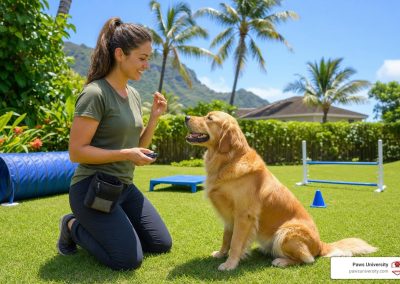
- The "Touch" (Hand Target): This is one of the most versatile tools in a trainer's belt. You teach the dog to touch their nose to your palm. This allows you to move the dog anywhere in the house without ever laying a hand on them.
Many KPA-certified trainers prioritize these "hands-off" communication methods to build a stronger bond between owner and pet.
Managing the environment to stop my dog from growling at me
Training takes time. In the meantime, we manage the environment to prevent the dog from being "practicing" the growling behavior.
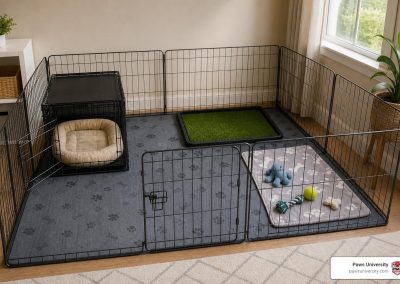
- Baby Gates: Use gates to keep the dog out of areas where they tend to guard (like the bedroom or the kitchen).
- Alternative Spots: If your dog growls when you move them off the couch, make a "super comfy" dog bed right next to the couch. Reward them heavily for choosing their own bed.
- Treat Pouches: Keep a treat pouch on you at all times. This allows you to reward good, relaxed behavior the moment it happens.
Professional organizations like CTC-certified trainers emphasize that management is 50% of the battle in any behavior modification plan.
When to Seek Professional Help
While many mild cases of growling can be handled with patience and positive reinforcement, some situations require an expert. You should seek professional help if:
- The behavior is escalating: The growls are becoming more frequent or more intense.
- There is a bite history: If your dog has already snapped at or bitten someone, safety is the priority.
- Multiple triggers: Your dog is growling at a variety of things (strangers, family members, other dogs).
- You feel unsafe: If you are afraid of your own dog, you cannot effectively train them.
At Paws University, we offer Private Training options designed to address these complex behavioral issues in a safe, controlled environment. If you are outside the West Hawaii area, you can find Professional behavior modification resources to find force-free experts near you.
Frequently Asked Questions about Dog Growling
Why does my dog growl when I try to move them off the couch?
This is often a mix of resource guarding (the couch is a "high-value" spot) and a lack of bodily autonomy. Imagine if someone tried to physically shove you out of your favorite armchair while you were napping! Most dogs respond much better to being lured off with a treat or being asked to "Touch" a hand target than being physically pushed.
Can I stop my dog from growling by showing dominance?
No. In fact, trying to "show dominance" through alpha rolls or physical corrections usually makes the problem worse. A 2009 study from the University of Pennsylvania found that 41% of dogs responded aggressively when their owners used confrontational training methods (like growling back or physical force). Positive reinforcement builds trust; dominance builds fear.
How long does it take to change a dog's growling behavior?
There is no "magic wand." It depends on how long the behavior has been happening and the underlying cause. However, a good rule of thumb is the "Three-Month Rule." It takes about three days for a dog to decompress from a stressful event, three weeks to learn a new routine, and three months to truly feel secure and change their emotional response to a trigger.
Conclusion
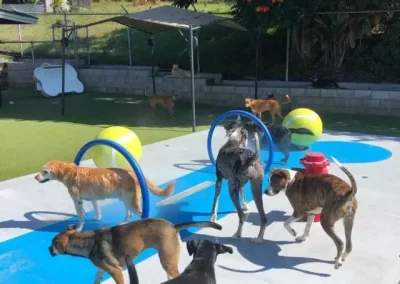
At Paws University, we believe that every dog wants to be a "good dog"—they just need the right tools to communicate. Our seven-acre campus in Kailua-Kona has been West Hawaii’s premier facility since 2002, and we’ve seen how supervised play and positive reinforcement can transform a reactive dog into a confident companion.
If you’re struggling with how do i stop my dog from growling at me, remember: be patient, stay positive, and don't be afraid to ask for help. You can learn more About Us and our philosophy on our website.
Ready to build a better relationship with your pup? Explore Professional Training at Paws University and let’s start working together to turn those growls into tail wags.