
How to Start Training a Foster Dog
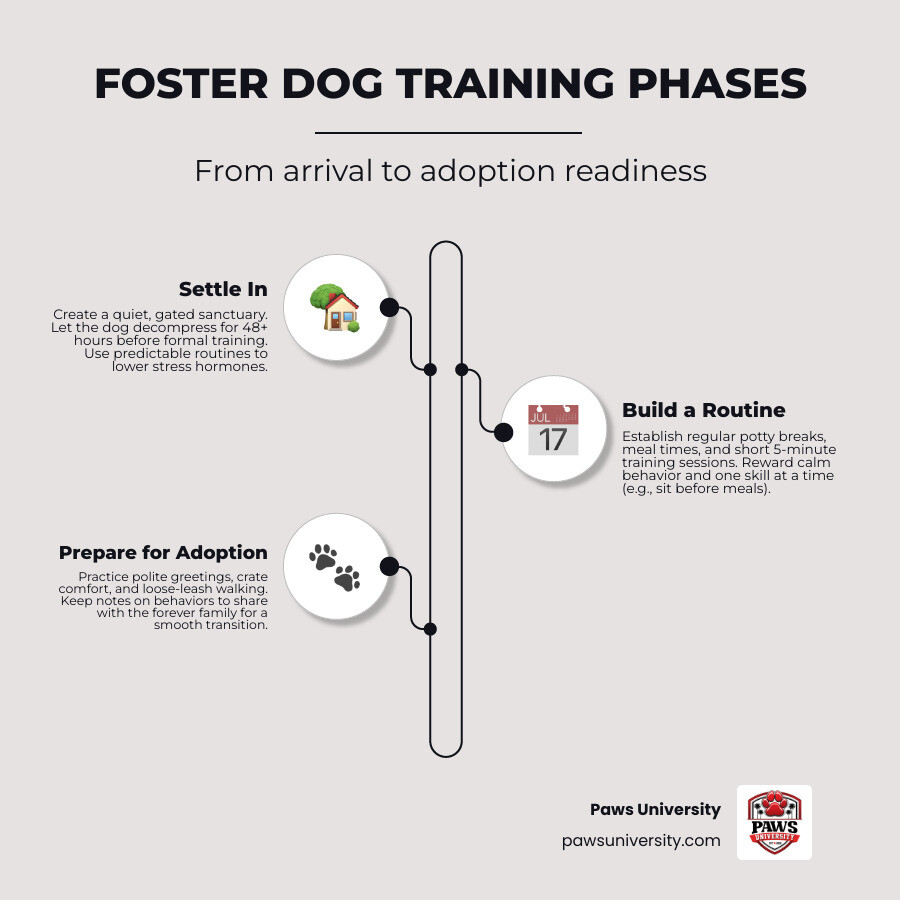
Dog training for foster dogs starts with a calm routine, not a long lesson. Give your new foster dog a quiet place to settle. Take them outside on a regular potty schedule, and reward them right away when they go. Then practice one useful skill at a time, such as sitting before meals, in short five-minute sessions. Keep introductions to pets, children, and new places slow and supervised.
These small steps help a dog feel safe while building the manners a future family can continue at home. As your foster dog settles in, watch for new behaviors and adjust the routine to fit the dog in front of you.
I’m Allen Daniels, co-founder of Paws University, and I’ve trained dogs using reward-based methods for more than 25 years. In this guide, I’ll show you how to make dog training for foster dogs practical from the first day through the move to a forever home.
The Decompression Phase: Setting the Stage for Success
Bringing a foster dog into your home is an incredible act of service, but it also represents a massive life disruption for the animal. Whether the dog arrived from a crowded shelter, an animal control intake facility, or a previous home, their nervous system is likely overloaded. Cortisol and adrenaline levels remain elevated for at least 48 hours after leaving a high-stress kennel environment, and full physiological decompression typically requires at least two weeks.
During these early days, prioritize quiet decompression over formal obedience lessons. Setting up a dedicated "gated community"—using baby gates, exercise pens, and a quiet room—gives your foster dog a secure sanctuary where they can rest without feeling pressured to interact. As outlined in the Dog Foster Care Manual, establishing a predictable daily schedule from day one provides the emotional safety net rescue dogs need.
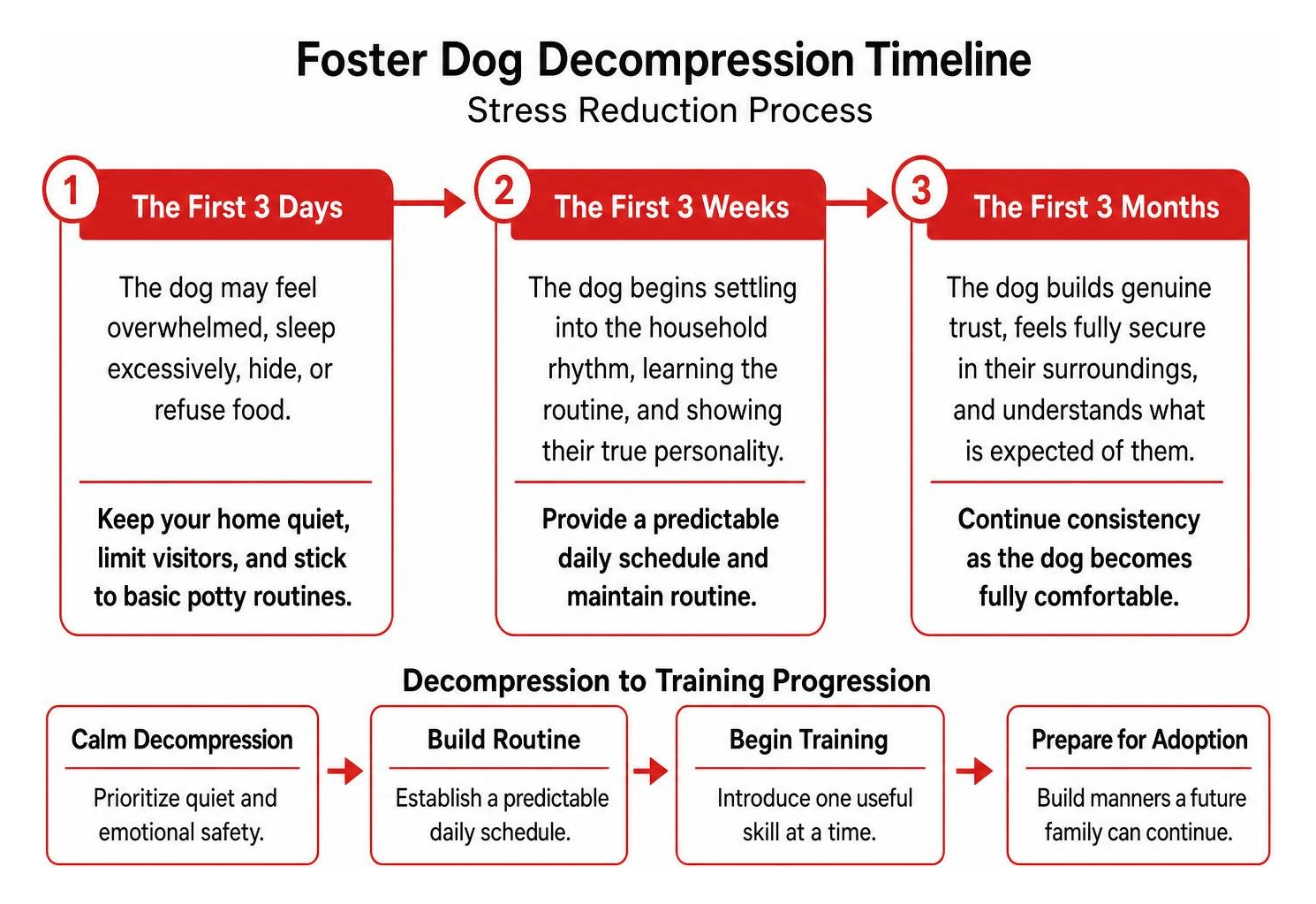
Follow the 3-3-3 guideline commonly recognized in rescue work:
- The First 3 Days: The dog may feel overwhelmed, sleep excessively, hide, or refuse food. Keep your home quiet, limit visitors, and stick to basic potty routines.
- The First 3 Weeks: The dog begins settling into the household rhythm, learning the routine, and showing their true personality.
- The First 3 Months: The dog builds genuine trust, feels fully secure in their surroundings, and understands what is expected of them.
Standard shelter protocols, such as those detailed in the 2026 Dog Foster Care Handbook, emphasize that giving a dog space during this initial window prevents behavioral setbacks. Focus purely on environmental safety, high-value rewards for calm behavior, and scheduled outdoor breaks.
Navigating the Honeymoon Period
Many foster parents experience the "honeymoon period"—a transition window lasting roughly two weeks during which a newly arrived rescue dog appears exceptionally calm, quiet, and compliant. While it is tempting to believe the dog arrived fully trained, this subdued behavior is often a natural coping mechanism while the dog quietly evaluates their safety and surroundings.
As the dog decompressess, their true personality, confidence, energy levels, and potential boundary-testing habits will emerge. You might notice behaviors that were absent during week one, such as barking at the doorbell, jumping up to greet you, or showing reluctance on the leash.
To navigate this transition smoothly:
- Maintain early boundaries: Do not grant unrestricted freedom of the entire house just because the dog was calm on day two. Keep gates and management tools in place.
- Keep a daily behavioral journal: Note what times of day the dog is most active, how they react to specific household sounds, and what food rewards they value most.
- Train the dog in front of you: Avoid guessing a dog's past history. Address the exact behaviors you observe in the moment with patience, predictability, and positive reinforcement.
Essential Principles of Dog Training for Foster Dogs
Training a foster dog does not require hours of formal drilling each day. In fact, long training sessions often lead to mental fatigue, frustration, and overstimulation. Instead, effective foster care relies on five-minute micro-sessions integrated into everyday routines.
Our training methodology relies exclusively on positive, rewards-based reinforcement. Using high-value treats—such as cooked chicken, string cheese, or freeze-dried meat—allows you to capture and reward desirable behaviors instantly. Reviewing practical dog training tips can help you establish clear reward markers (such as a crisp "yes!" or a clicker) that tell the dog precisely when they have made the right choice.
Building Confidence Through Dog Training for Foster Dogs
Many shelter dogs arrive with compromised confidence due to repeated rehoming or lack of early environmental exposure. Rather than jumping straight into complex obedience cues, use low-pressure enrichment games to foster curiosity and problem-solving:
- Scatter Feeding: Instead of feeding meals from a standard bowl, toss kibble into a snuffle mat, a rolled-up towel, or clean grass in a secured yard. Foraging naturally lowers heart rates and engages the dog's olfactory system.
- Low-Pressure Relationship Games: Practice the "treat toss" game. Rather than forcing a shy dog to take treats directly from your hand, gently toss treats slightly behind the dog. This relieves social pressure and rewards them for remaining in your presence.
- Predictable Reward Delivery: Build clear marker cues so the dog understands where and when reinforcement happens, eliminating the frustration that causes frantic behaviors.
Core Manners That Boost Adoption Retention
Securing an adoption is only half the battle; ensuring the dog remains permanently in their new home is the ultimate goal. Behavioral incompatibility is a primary reason dogs are returned to shelters. By mastering foundational dog obedience, you provide your foster dog with transferable skills that every prospective adopter appreciates.
Focus your short daily sessions on these four foundational manners:
- The Automatic Sit: Teach the dog that sitting quietly is the universal key that unlocks everything they want—meals being set down, doors opening, leashes being clipped, and hands delivering affection.
- Polite Doorway Etiquette: Ask for a sit-stay or wait at entryways to prevent darting. Release the dog with a clear release cue like "free" or "let's go."
- Loose-Leash Fundamentals: Reward the dog anytime they choose to walk beside your hip on a relaxed, J-shaped leash. Never jerk or yank the leash; if the dog pulls, stop smoothly like a tree, wait for slack, mark the check-in, and move forward.
- The "Leave It" and "Trade" Cues: Teach the dog that giving up an item voluntarily results in something even better, establishing impulse control without creating conflict.
Step-by-Step Protocols: House-Training and Crate Comfort
House-training regressions are common when a dog transitions from a concrete kennel or an outdoor-only background into a home. Treat every foster dog—regardless of their reported adult history—as though they are learning house manners for the first time.
To establish clean indoor habits, implement structured house-training rescue dog protocols:
- Frequent Potty Breaks: Take adult foster dogs outside 4 to 6 times daily (puppies need breaks every 30 to 60 minutes when awake). Always take them out immediately after waking, 15 to 20 minutes after eating, after vigorous play, and right before bedtime.
- Use a Dedicated Elimination Spot: Take the dog on-leash to the same outdoor area each time so familiar scent markers trigger elimination.
- Reward Immediately: Deliver a high-value treat and quiet praise the exact second their paws finish the potty stance outside—never wait until you walk back into the house.
- Strictly Zero Punishment: If an accident occurs indoors, never yell, scold, or push the dog's nose toward the spot. Punishment creates fear, causing dogs to hide when they need to eliminate. Clean the area thoroughly using an enzymatic cleaner to eliminate organic pheromone residues completely.
Establishing Crate Security and Independence
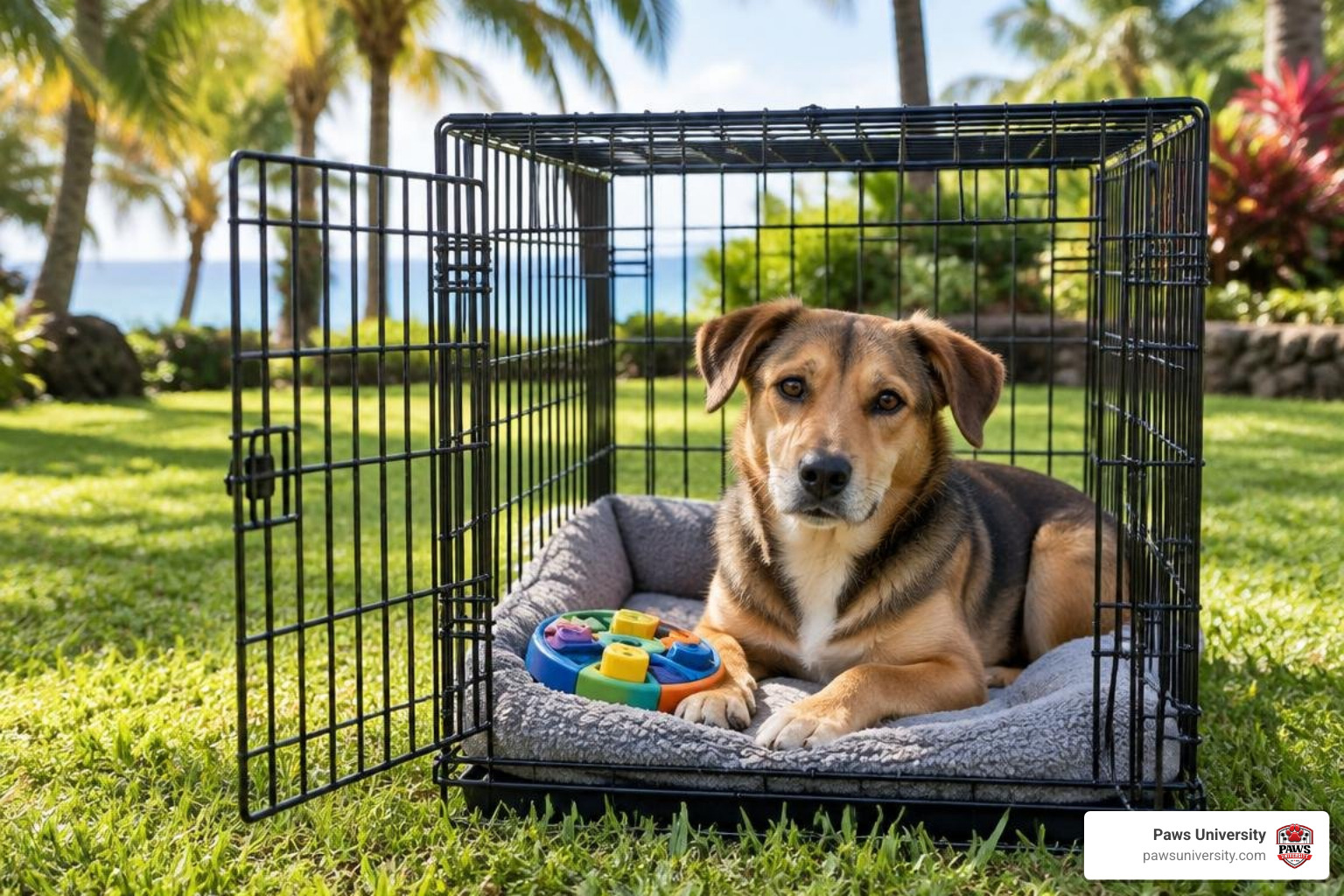
A crate should serve as a safe, cozy den, never a tool for punishment. Crate training provides foster dogs with a designated retreat, keeps them safe during unsupervised moments, and prepares them for veterinary visits, travel, and adoption transitions.
Follow these steps to build positive crate associations:
- Leave the Door Open: Set up the crate in a central, quiet living area with the door permanently propped open. Place soft bedding inside.
- Mealtime in the Crate: Feed your foster dog their daily meals directly inside the open crate to build positive associations.
- High-Value Enrichment: Provide stuffed, frozen puzzle toys, lick mats, or durable chews exclusively inside the crate.
- Micro-Stays: Begin closing the door for 30 to 60 seconds while you sit nearby, dropping small treats through the wire. Gradually build duration while practicing teaching a foster dog to be comfortable alone.
Managing Household Dynamics and Safe Introductions
Safely integrating a foster dog into a home with existing pets and children requires patience, physical barriers, and close supervision. Rushing introductions before a rescue dog has decompressed is a frequent cause of household friction.
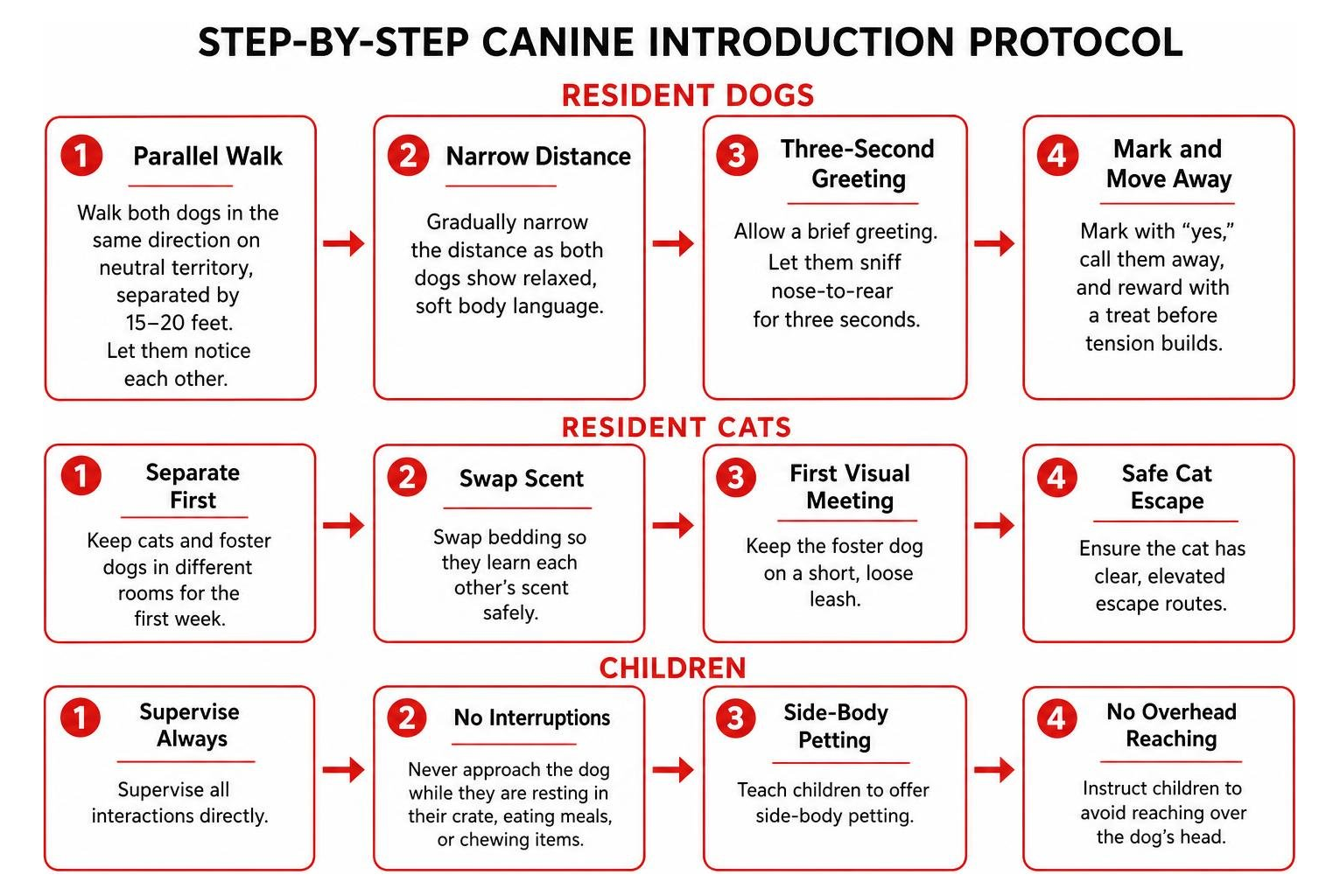
When introducing a foster dog to resident pets:
- Resident Dogs: Begin with a parallel walk on neutral territory (such as a quiet sidewalk). Walk both dogs in the same direction, separated by 15 to 20 feet, allowing them to notice each other without direct face-to-face tension. Gradually narrow the distance as both dogs show relaxed, soft body language. When allowing a brief greeting, apply the "three-second rule": let them sniff nose-to-rear for three seconds, mark with "yes," and cheerfully call them away for a treat before tension builds.
- Resident Cats: Keep cats and foster dogs separated in different rooms for the first week, swapping bedding so they learn each other's scent safely. When conducting the first visual meeting, keep the foster dog on a short, loose leash while the cat has clear, elevated escape routes.
- Children: Supervise all interactions directly. Teach children never to approach a foster dog while they are resting in their crate, eating meals, or chewing on high-value items. Instruct children to offer side-body petting rather than reaching over the dog's head.
For broader community outings and neighborhood walks, follow our guide on socializing an adult rescue dog to keep exposure positive and controlled.
Addressing Common Behavioral Challenges
Rescue dogs frequently exhibit normal canine behaviors that become problematic inside a home setting. Using positive reinforcement and management resolves these issues without conflict:
- Jumping Up: Dogs jump to bring their faces closer to ours for greeting. Apply the "four-paws-on-the-floor" rule: cross your arms, turn your torso away calmly, and withhold all eye contact and touch when the dog jumps. The moment all four paws touch the floor, immediately reward with calm praise and a treat dropped at ground level.
- Mouthy Play and Nipping: Shelter dogs often enter homes with excess arousal. If your foster dog mouths your hands, emit a calm verbal marker, instantly freeze play for 10 to 15 seconds, and redirect their teeth onto an appropriate chew toy or braided rope.
- Resource Guarding: Never forcibly snatch toys, chews, or food bowls away from a foster dog. If you need an item the dog possesses, initiate a trade. Toss several pieces of premium food nearby, and pick up the object only after the dog has voluntarily moved away to eat the treats. If you notice signs of stress, learn more about managing canine reactivity triggers to keep your household safe.
Adapting Methods: Puppies Versus Adult Foster Dogs
Training approaches must adjust depending on whether you are fostering a young puppy or an adult canine with previous life experiences.
| Training Category | Foster Puppy (Under 6 Months) | Adult Foster Dog (1+ Years) |
|---|---|---|
| Housetraining Frequency | Every 30–60 minutes when awake; capacity is roughly 1 hour per month of age | 4–6 scheduled outings per day; routine-focused |
| Primary Training Focus | Bite inhibition, basic handling desensitization, gentle novel exposure | Decompression, loose-leash walking, impulse control, doorway manners |
| Exercise & Stimulation | Frequent, short bursts of supervised play and nap cycles | Two 30-minute structured walks and daily food puzzle enrichment |
| Socialization Needs | Critical early exposure window; positive pairing with varied sounds/surfaces | Low-pressure assessment; counter-conditioning to established triggers |
| Confinement Setup | Exercise pen with cleanable floor surfaces, pee pads, and crate | Dedicated quiet room with baby gates and a comfortable open crate |
Age-Specific Dog Training for Foster Dogs: Puppies vs. Adults
When fostering young puppies, early development centers on bite inhibition and gentle environmental exposure. When a puppy nips too hard during play, emit a high-pitched yelp ("ouch!"), pause play briefly, and return with an appropriate chew toy. This mimics natural littermate feedback, teaching the pup crucial jaw control. Pair this with foundational puppy training steps to build early confidence with household objects like brooms, novel floor surfaces, and gentle paw handling.
Adult foster dogs, on the other hand, require support in unlearning shelter coping habits and adapting to household rules. Adult dogs benefit heavily from structured daily predictability, clear leash walking routines, and dedicated decompression time to undo kennel stress.
Frequently Asked Questions About Foster Dog Training
How much time should I spend training my foster dog each day?
You do not need dedicated multi-hour training blocks. Aim for three to five short micro-sessions lasting about 3 to 5 minutes each throughout the day. "Habit stacking"—practicing sits before setting food bowls down, asking for a wait before opening exterior doors, or practicing down-stays during television commercial breaks—integrates manners effortlessly into daily life.
What should I do if my foster dog displays unmanageable behavioral issues?
If your foster dog exhibits severe separation distress, persistent resource guarding, or reactivity that compromises safety, contact your rescue organization's foster coordinator immediately. Implement strict physical management (such as baby gates, closed doors, and separate feeding areas) to prevent incidents. Avoid using punitive tools like shock or prong collars, which increase anxiety and exacerbate aggression. Your rescue group can connect you with an experienced positive reinforcement professional.
How do I prepare my foster dog for a smooth transition to their forever home?
Help your foster dog succeed by documenting their personality traits, daily schedule, favorite high-value treats, and known cues in an adoption profile. Share notes on how they handle car rides, leash walks, and crate time. Sending the dog to their adoptive family with a familiar blanket, their current food, and a consistent routine ensures a smooth, confidence-building handoff.
Conclusion
Fostering a dog is a lifesaving gift that creates vital space in shelters while providing vulnerable animals with the individual care they need to thrive. By pairing structured decompression with positive, rewards-based training, you transform an uncertain rescue dog into a confident, well-mannered companion ready for their permanent home. Every sit, loose-leash step, and calm greeting you practice builds the bridge to a successful, lifelong adoption.
At Paws University, our team is committed to supporting dogs and their handlers across Hawaii County through our spacious seven-acre outdoor campus in Kailua-Kona. Whether you need expert behavioral guidance, day care socialization, or boarding support, explore our premium canine training services to help your dog reach their fullest potential.