How to Socialize a Fearful Dog Without Rushing Them
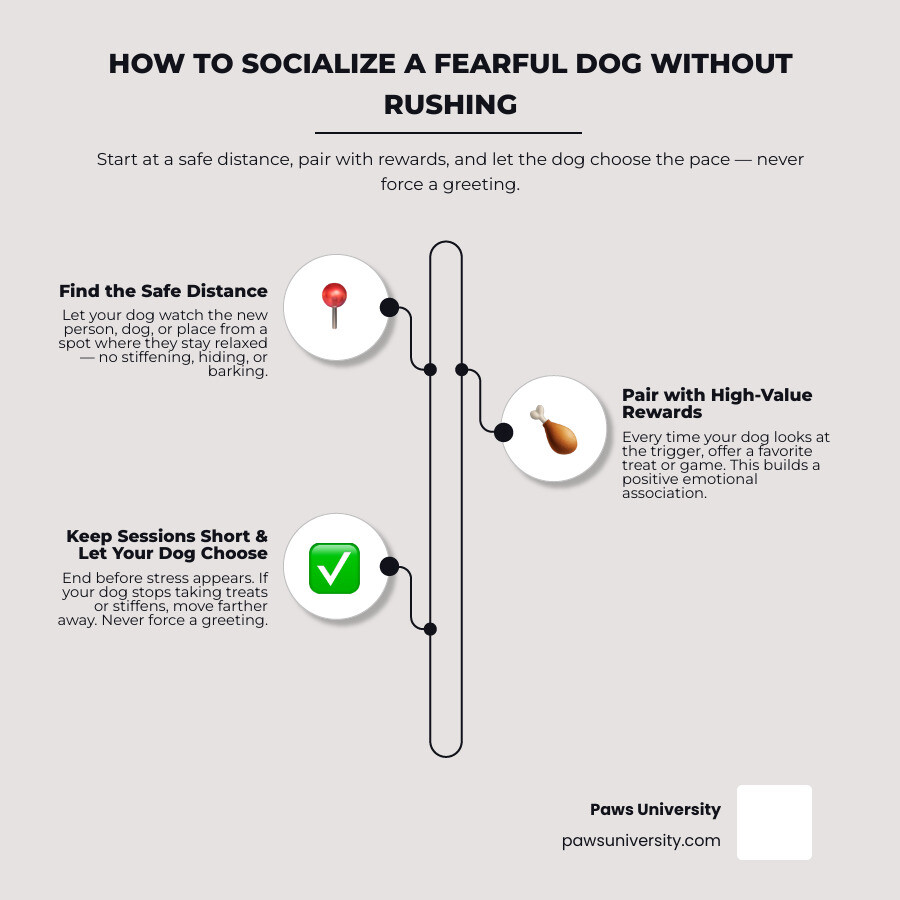
Learning how to socialize a fearful dog starts with giving them space. Let your dog watch a new person, dog, or place from a distance where they can stay relaxed. Pair that sight with a favorite treat or game. Keep the session short, and move farther away if your dog stiffens, hides, barks, or stops taking treats. Never force a greeting. The goal is to help your dog feel safe, not to make them meet everyone.
I'm Allen Daniels, co-founder of Paws University in Kailua-Kona, and I've worked with dogs using reward-based training since 1999. I'll show you how to socialize a fearful dog at a pace that builds trust.
Understanding how to socialize a dog begins with low-stress environments, especially when learning how to socialize a dog without a dog park to keep interactions structured and safe.
Understanding Canine Fear: Signs, Causes, and Emotional Thresholds

When we see a puppy freeze, cower, or retreat, we are witnessing an emotional survival mechanism. Fear in dogs is rarely about stubbornness or spite; it is rooted in biology. According to canine welfare science on socialization, the primary developmental socialization phase in puppies closes between 12 and 16 weeks of age, with the period between 3 and 5 weeks being the most influential stage for social bonding. When puppies miss positive exposure to diverse sights, textures, sounds, and social stimuli during this window, their brains naturally categorize unfamiliar elements as potential threats.
Fear can also stem from genetic predispositions or past trauma. While past abuse does occur, natural genetics and developmental deprivation account for a vast majority of fearful behaviors. Recognizing these deficits early helps us address the signs of a poorly socialized dog before fear solidifies into defensive reactivity.
Before an anxious dog barks, lunges, or snaps, they communicate distress through subtle micro-signals:
- Yawning when not tired
- Frequent lip licking or tongue flicks
- Displacement sniffing (suddenly sniffing the ground to avoid looking at a trigger)
- Whale eye (showing the white crescent of the eye)
- Tense, stiff body posture or sudden stillness
- Panting when the weather is cool and physical exertion is low
Identifying Your Dog's Fear Threshold
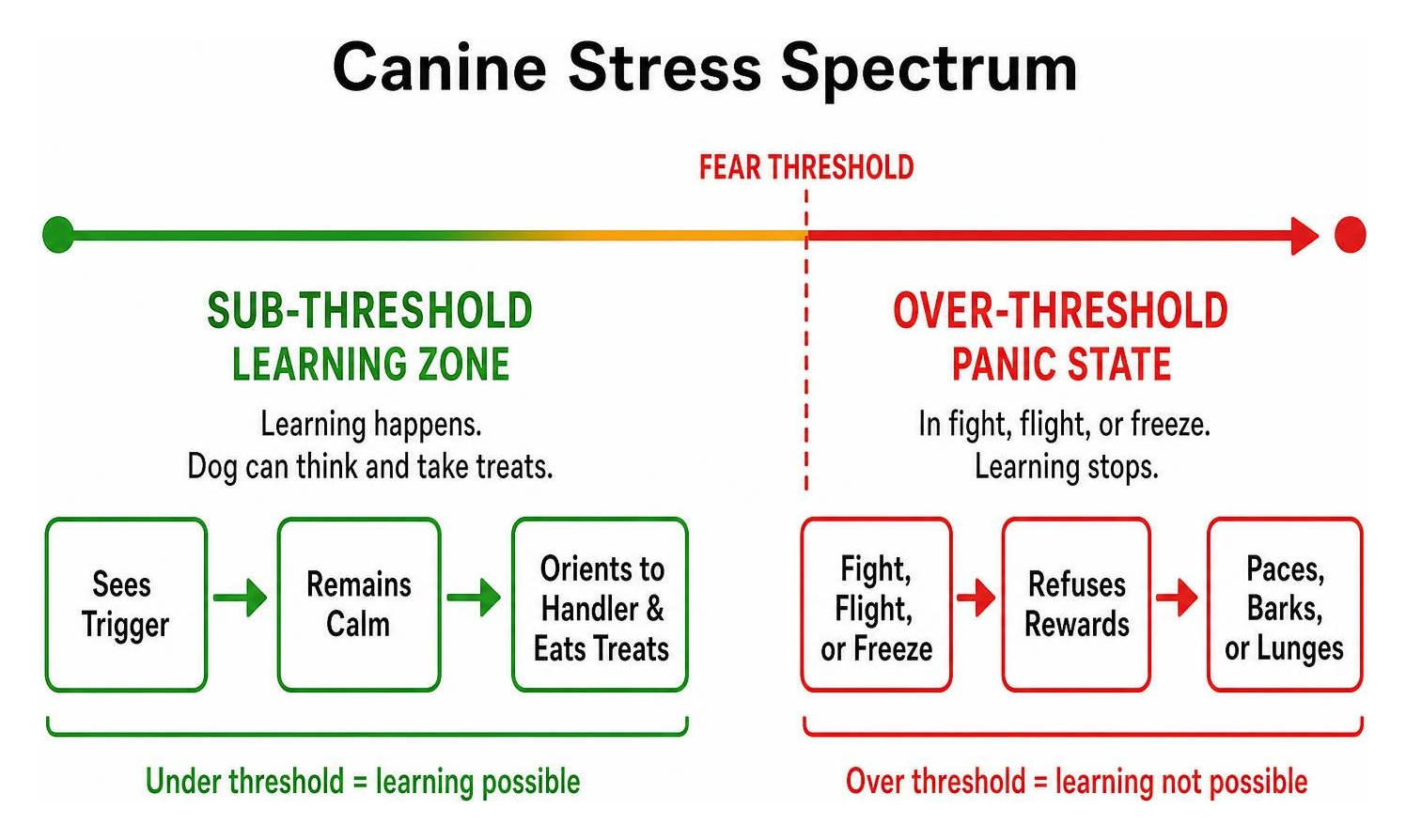
Learning to read your dog means mastering their emotional threshold. A dog is "under threshold" when they can see a trigger—such as an unfamiliar person, another dog, or a novel object—and remain calm, orient to their handler, and eagerly eat treats.
When pushed "over threshold," the canine brain enters a fight, flight, or freeze state. In this heightened emotional zone, learning stops completely. A dog over threshold may refuse prized rewards, pace frantically, or bark. To build confidence, we always work beneath this line.
One of the most effective ways to build tolerance without triggering anxiety is practicing the do nothing exercise for calm observation. By finding a quiet park bench or observing novel stimuli from a stationary, comfortable distance, your dog learns that observing the world does not require active defense or social interaction.
Setting Up a Predictable and Safe Home Sanctuary
A nervous dog cannot build resilience in the outside world if their home environment feels chaotic. Fearful dogs thrive on predictability, routine, and clear spatial agency.
When bringing home a fearful or undersocialized dog, implement these foundational sanctuary principles using step-by-step puppy socialization methods:
- Create a Dedicated Retreat: Provide a cozy, covered crate or playpen placed in a low-traffic corner. This serves as an absolute safe zone where nobody reaches in, bothers, or handles the dog.
- Establish Predictable Routines: Set consistent times for meals, potty breaks, and rest. Predictability lowers baseline cortisol and helps an anxious nervous system decompress.
- Respect the Decompression Timeline: Newly adopted rescue dogs often need several weeks of quiet decompression before formal public exposure begins.
- Offer Choice-Based Engagement: Never corner or reach directly over a timid dog. Allow them to choose when to approach you and when to retreat to their sanctuary.
Step-by-Step Guide: How to Socialize a Fearful Dog Safely
Rehabilitating a fearful dog requires two proven scientific pillars: systematic desensitization (gradually introducing triggers at sub-threshold levels) and classical counter-conditioning (pairing the trigger with a high-value positive experience).
Using positive reinforcement for shy dogs fundamentally rewires their underlying emotional response from dread to anticipation.
To implement counter-conditioning effectively:
- Choose Ultra-High-Value Reinforcers: Reserve exceptional rewards—such as small pieces of roast chicken, string cheese, or freeze-dried meat—exclusively for counter-conditioning sessions.
- Establish Distance Baselines: Start at a distance where your dog notices the trigger but displays zero stress signs.
- Execute the Pairing: The moment your dog notices the trigger, immediately deliver high-value treats. When the trigger leaves view, stop feeding. The equation must always be: Trigger appears = delicious rewards arrive; Trigger vanishes = party ends.
- Keep Sessions Short: Five to ten minutes of positive, low-stress exposure is far more productive than prolonged outings that deplete your dog's mental stamina.
How to Socialize a Fearful Dog Around Strangers with the Treat Retreat Game
Direct human greetings can be terrifying for an insecure dog. Facing a dog head-on, leaning over their space, or extending a hand can trigger intense defensive fear.
The Treat Retreat game mechanics, created by trainer Suzanne Clothier, removes social pressure by using physical distance as an active reward alongside food:
- Position the Helper: Have the visitor sit comfortably at an angle rather than facing the dog directly. Instruct them to avoid direct eye contact and remain still.
- Toss Behind the Dog: When the dog looks toward or takes a single step toward the helper, the helper gently tosses a high-value treat behind the dog.
- Double Reinforcement: This delivery mechanic rewards the dog with food while simultaneously encouraging them to move away from the trigger, providing immediate social relief.
- Chest-Level Delivery: The helper should drop or toss treats smoothly from the center of their chest to avoid broad, sudden arm gestures that might startle the dog.
- Handler Advocacy: Step in and politely protect your dog if visitors try to rush in, reach over their head, or force affection.
How to Socialize a Fearful Dog with Other Dogs Using Parallel Walks
Fearful dogs often find direct, head-on greetings on a tight leash confrontational. Natural canine greetings occur in curves with side-to-side body alignment.
When helping your dog adapt to other canines, reference our practical guide to socializing an adult dog and our puppy socialization guide for other dogs.
To conduct safe dog-to-dog introductions:
- Pair with a Placid Helper: Select a calm, neutral, and thoroughly non-reactive canine partner.
- Walk in Parallel: Begin walking both dogs in the same direction on neutral ground, maintaining a wide distance between them (such as opposite sides of a quiet street).
- Gradually Close the Gap: As both dogs demonstrate relaxed body language and loose walking, gradually decrease the lateral distance over multiple sessions.
- Enforce the 3-Second Greeting Rule: If you eventually allow a brief sniff, limit the interaction to three seconds before cheerfully calling your dog away and rewarding them. This prevents tension from escalating into defensive posturing.
Socialization Pitfalls: What to Avoid with an Anxious Dog
Well-intentioned owners often make mistakes that accidentally heighten their dog's fear. Understanding what not to do is just as important as knowing the right training steps.
| Practice | Harmful Flooding Approach | Safe Controlled Socialization |
|---|---|---|
| Exposure Level | Forcing maximum proximity to triggers until the dog gives up | Starting at large distances where the dog feels safe and relaxed |
| Stranger Greetings | Letting strangers reach over, corner, and pet the dog | Using Treat Retreat and allowing the dog full agency to approach or retreat |
| Environment | Uncontrolled settings like dog parks or crowded events | Structured, quiet outdoor settings with predictable spacing |
| Response to Fear | Correcting or scolding growls and barks | Increasing distance and pairing sub-threshold triggers with treats |
| Greeting Style | Tight leash, face-to-face tension | Parallel walking and the 3-second greeting rule |
Major Socialization Mistakes to Avoid
- Flooding: Forcing a dog into an overwhelming situation (like a noisy market or crowded festival) in hopes they will "get used to it" leads to learned helplessness, traumatic sensitization, and escalated panic.
- Unstructured Dog Parks: Dog parks are unpredictable environments filled with unchecked energy and rude canine behaviors. Many owners find rapid behavioral breakthroughs when they ditch the dog park for structured exposure.
- Punishing Communicative Cues: Scolding a dog for growling or barking suppresses their warning system without changing their underlying fear. A dog taught not to growl is far more likely to bite without warning when overwhelmed.
- Patting on Top of the Head: Towering over a timid dog to pat the top of their head feels intimidating. If contact is welcomed, gentle strokes on the chest or under the chin are far less threatening.
Long-Term Confidence: Professional Guidance, Medical Support, and Realistic Goals
Rehabilitating a fearful dog is a journey measured in months and years, not days. Most fearful dogs show profound improvement with consistent, rewards-based guidance, but a naturally reserved dog may never become an extroverted social butterfly. Our true training goal is calm neutrality: helping our dogs feel secure, comfortable, and indifferent to the world around them.
- Decompression (Weeks 1 to 4): The dog begins learning home routines and decompressing from high baseline stress.
- Active Counter-Conditioning (Months 2 to 6): The dog establishes clear baseline thresholds and begins forming positive associations with distant triggers.
- Functional Confidence (Months 6 to 12+): The dog moves comfortably through daily environments, settles around novel distractions, and looks to their handler for safety.
For generalized anxiety or extreme noise phobias, consulting a veterinary behaviorist can be transformative. Behavioral medication is not a shortcut; it is a humane medical bridge that reduces neurochemical panic so cognitive learning can take place.
Supplementing your counter-conditioning with low-pressure enrichment activities like nose work, scent tracking, and simple trick training can also bolster your dog's problem-solving resilience. Learn more about building confidence around strangers to support your dog's ongoing progress.
Frequently Asked Questions About Fearful Dog Socialization
How long does it take to socialize a fearful or unsocialized dog?
Rehabilitating an undersocialized or fearful dog depends on genetics, past experiences, and consistency. While basic decompression typically occurs within 4 to 6 weeks, noticeable behavioral milestones around complex triggers often require 6 to 12 months of structured counter-conditioning.
Does comforting a frightened puppy reinforce their fear?
No. Fear is an involuntary emotional response, not an operant behavior. You cannot reinforce fear by offering soothing words, gentle presence, or physical comfort. Providing safety and reassurance helps lower your dog's stress response and builds foundational trust.
When should I consider behavioral medication for a fearful dog?
You should consult your veterinarian or a veterinary behaviorist if your dog exhibits chronic baseline anxiety, completely refuses food rewards in mildly stimulating environments, or cannot drop below threshold despite extensive distance management.
Conclusion
Supporting a fearful puppy or rescue dog requires patience, clear advocacy, and gentle, rewards-based leadership. By honoring your dog's pace, protecting their personal space, and celebrating small victories, you replace anxiety with lasting confidence.
At Paws University, our premium seven-acre campus in Kailua-Kona provides the ideal tropical island setting for positive behavioral transformation. Whether your pup needs gentle foundational guidance or you want to expand their skills, explore our structured positive reinforcement training programs designed to help every dog flourish.