Why So Many Dogs Pull — and How to Finally Fix It
If you're trying to teach your dog loose leash walking, here's the short answer:
- Start indoors in a distraction-free space
- Reward your dog the moment the leash goes slack — not after
- Stop moving the instant the leash tightens
- Build slowly from quiet areas to busier environments over 30 days
- Keep sessions short — 10 to 15 minutes, two to three times daily
That's the core of it. The rest is consistency.
Pulling on the leash is one of the most common problems dog owners ask trainers about. And it makes sense — your dog's natural walking pace is faster than yours, and every time they lunge forward and still get to move ahead, they learn that pulling works.
Over time, that habit gets deeply reinforced. Walks become a tug-of-war instead of something you both enjoy.
The good news? Pulling is a learned behavior — which means it can be unlearned. A loose leash, where the clip points down and the leash forms a relaxed curve (sometimes called a "smile" shape), is absolutely achievable with the right approach.
I'm Allen Daniels, co-founder of Paws University and a professional animal trainer with roots in operant conditioning developed during my decade training marine mammals — the same science-backed, rewards-based methods I now use to teach dogs loose leash walking every day in West Hawaiʻi. In the guide below, I'll walk you through a clear 30-day plan to get there.
Teach dog loose leash walking further reading:
Why Loose Leash Walking Matters for You and Your Dog
When we leash up our dogs, we often forget that we are bringing two different species with completely different natural velocities together. A human's average walking speed is significantly slower than a dog's comfortable trot. Left to their own devices, dogs naturally move faster, which is why pulling is such an easy habit for them to form.
Furthermore, dogs have an innate physical response known as the opposition reflex (or thigmotaxis). When they feel pressure against their neck or chest, their natural physical instinct is to pull against it rather than yield to it. If we pull back, they pull harder. It is a physical feedback loop that quickly turns a casual neighborhood stroll into an exhausting workout.
But teaching a loose leash isn't just about saving your shoulders and wrists from strain. It has massive mental health benefits for your dog. A tight leash communicates tension and stress directly to your dog, which can actually fuel unwanted behaviors like barking, lunging, and reactivity.
On the flip side, a loose leash allows your dog the physical freedom to engage in natural behaviors like sniffing. Sniffing is incredibly mentally stimulating for dogs — it is essentially their way of reading the local news. Research shows that dogs on longer leashes (8–15 feet) sniff more and exhibit lower heart rates, indicating a distinct calming effect. By allowing your dog to sniff politely on a slack leash, you are helping them burn mental energy, leaving them far more relaxed than they would be after a fast, stressful march.
To learn more about setting your puppy up for lifetime success on the leash, check out our guide on how to Walk This Way and Master the Leash with Your New Puppy.
The Right Gear to Teach Dog Loose Leash Walking
Before starting your 30-day training journey, we need to make sure you have the right tools. Using the wrong equipment can accidentally reinforce pulling or cause physical discomfort to your dog.

Here is the essential gear checklist we recommend:
- A 6-Foot Fixed Leash: A standard flat leather or nylon leash is the gold standard for training. You want to avoid retractable leashes at all costs. Retractable leashes maintain constant tension on the line, which actively teaches your dog that they must pull to extend their walking range.
- A Non-Restrictive Front-Clip Harness: Front-clip harnesses are fantastic management tools because they redirect your dog’s forward momentum. When they pull, the front attachment gently steers them back toward you.
- A Head Halter (Optional): For very strong pullers or large breeds, a head halter can be a game-changer. It works similarly to a horse halter, guiding the dog's head back to you when they try to forge ahead.
- High-Value Treats: Think roasted chicken, small cubes of cheese, or freeze-dried liver. Do not use dry kibble for outdoor training; we need treats that can successfully compete with the sights and smells of Hawaii County.
- A Dedicated Treat Pouch: Fast reward delivery is key. A waist-worn pouch ensures you can mark and treat within that crucial two-second window.
To help you choose the best setup, here is a quick breakdown of how common walking tools compare:
| Tool | Pros | Cons | Best Used For |
|---|---|---|---|
| Front-Clip Harness | Redirection of momentum; prevents neck strain. | Can restrict shoulder movement if poorly fitted. | Everyday training and immediate pulling management. |
| Flat Collar | Lightweight; easy to slip on and off. | High risk of trachea strain if the dog pulls hard. | Dogs who already understand basic leash manners. |
| Head Halter | Excellent physical leverage for large, strong dogs. | Requires a desensitization period; some dogs dislike it. | High-energy pullers and dogs undergoing intensive retraining. |
For a deeper look at selecting humane walking gear and understanding how physical mechanics affect training, you can read the Animal Humane Society's guide to loose leash walking.
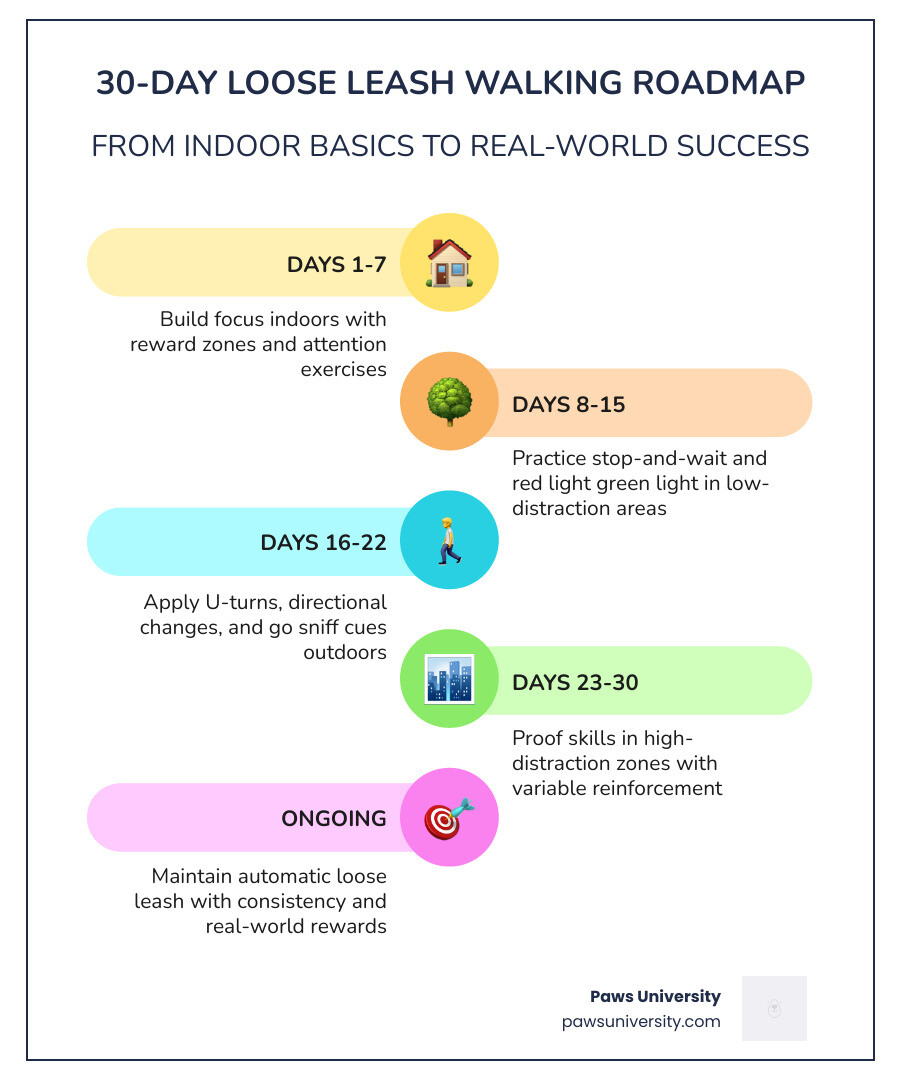
Step-by-Step 30-Day Training Plan
Achieving a beautiful, slack leash is a journey of small, consistent steps. We recommend practicing in short, focused blocks of 10 to 15 minutes, two to three times a day, rather than trying to train during your regular, long exercise walks. This keeps your dog's brain fresh and prevents frustration for both of you.

If you are raising a young dog in Hawaii County, you can align these steps with our local advice on How to Teach Your Puppy to Heel in Hawaii County.
Phase 1: Foundation Skills Indoors (Days 1-7)
The biggest mistake owners make is trying to teach loose leash walking in the middle of a highly distracting park. During Week 1, we strip away all external stimuli and build core focus indoors.
- Build the Reinforcement Zone: Stand in a quiet room with your dog off-leash. Decide which side you want your dog to walk on (traditionally the left). Hold high-value treats in the hand opposite your dog, and feed them right at the seam of your pants, next to your knee. Deliver the treat with your knuckles facing forward. Repeat this until your dog naturally gravitates to that "reinforcement zone" beside your leg.
- Introduce the Leash and "Let's Go": Clip on your 6-foot leash. Let it hang in a relaxed "J" shape. Take one single step forward. If your dog moves with you and keeps the leash loose, mark with an enthusiastic "Yes!" or a clicker and deliver a treat at your knee.
- Use Hallway Walls as Barriers: If your dog keeps drifting away or turning in front of you, practice walking down a narrow hallway. Keep your dog between you and the wall. This physical barrier naturally guides them to stay straight and close to your side.
- Practice Attention Exercises: Stand still and wait for your dog to look up at you. The moment they make eye contact, mark "Yes!" and reward. We want them to learn that paying attention to you is highly profitable.
For professional-grade puppy raising tips on establishing these early focal points, explore the Guide Dogs loose leash walking foundations.
Phase 2: How to Teach Dog Loose Leash Walking in Low-Distraction Areas (Days 8-15)
Now that your dog understands the reinforcement zone indoors, we can slowly transition to slightly more stimulating environments, such as your backyard, patio, or driveway.
- The "Red Light, Green Light" Method: Start walking. The instant the leash tightens (even a tiny bit), stop moving immediately. You are now a tree. Do not pull back or yank the leash. Simply stand still and wait.
- Wait for Self-Correction: Your dog will likely pull for a few seconds. Stay patient. The moment they turn back to look at you or take a step backward to relieve the tension, mark "Yes!" and reward. The loose leash becomes the "green light" that allows forward movement to resume.
- Apply Penalty Yards: If your dog is highly focused on something ahead and won't stop pulling, gently back up a few steps to increase the distance between your dog and their goal. This teaches them that pulling actually moves them further away from what they want.
- Vary Your Pace: Walk fast, then slow down, then speed up. This keeps your dog guessing and forces them to pay closer attention to your body movements to keep the leash loose.
Phase 3: Transitioning to Real-World Outdoor Environments (Days 16-22)
During Week 3, we take our show on the road. We will face real-world distractions like rustling palm leaves, tropical scents, and distant neighborhood noises.
- The U-Turn Technique: When walking down the sidewalk, if your dog begins to forge ahead and is about to tighten the leash, say "This way!" in a cheerful voice, turn 180 degrees, and walk in the opposite direction. When your dog turns to catch up to you, mark "Yes!" and reward them as they step into your reinforcement zone.
- Frequent Directional Changes: Do not just walk in straight lines. Make unpredictable turns, circles, and figure-eights. This builds deep engagement because your dog realizes they must watch you to know where you are going.
- Use Environmental Rewards: Forward movement and sniffing are massive rewards for your dog. You do not always have to use treats. If your dog walks nicely on a loose leash toward a patch of grass, reward them by giving a "Go sniff!" cue and letting them investigate.
Phase 4: Proofing and Generalizing to Teach Dog Loose Leash Walking Anywhere (Days 23-30)
In the final week, our goal is to solidify these habits so your dog can walk politely in high-distraction environments, such as busy walking paths or outdoor retail areas.
- Fade the Treats (Variable Reinforcement): Instead of rewarding every single step, start randomizing your treats. Reward after three steps, then seven, then two, then ten. This creates anticipation, much like a slot machine, keeping your dog highly engaged.
- Teach an Automatic Sit: Whenever you stop walking, lure your dog into a sit next to your knee. Eventually, they will learn to sit automatically every time your feet come to a halt. This is incredibly useful when you need to stop to cross the street or chat with a neighbor.
- Maintain Focus Past Thresholds: If you see another dog or a distraction approaching, step off the path to a distance where your dog can remain calm. Feed high-value treats continuously as the distraction passes to build a positive association and keep their attention locked on you.
Troubleshooting Common Leash Pulling Mistakes
Even with a solid plan, training is rarely a perfectly straight line. Here are the most common pitfalls we see owners fall into, and how to avoid them:
- Walking Through the Pull: If your dog pulls and you continue to take even two or three steps forward, you have just reinforced the pulling. Consistency is absolute. If the leash is tight, all forward progress must stop immediately.
- Inconsistent Rules: If you allow your dog to pull on "casual" walks but expect them to walk perfectly during "training" walks, they will become highly confused. Everyone in the household must use the exact same rules.
- Rushing the Environments: Moving from your living room straight to a busy beach path is a recipe for failure. If your dog is constantly pulling and cannot focus, the environment is too distracting. Take a step back to a quieter location.
- Fading Lures Too Slowly: If you walk with a treat constantly held in front of your dog's nose, they are just following the food, not learning the position. Transition quickly to keeping treats out of sight in your pouch, only bringing them out after you mark the correct behavior.
For a comprehensive look at managing high-energy dogs and troubleshooting advanced leash behaviors, take a look at our Kona Dog Training Guide from Puppies to Pros.
Frequently Asked Questions About Loose Leash Training
To help you navigate your training journey, we have compiled answers to some of the most common questions our team receives.
If you are looking for structured, hands-on guidance to help master these skills, our Mastering Manners with Kona Pet Training Classes offer the perfect environment for real-world practice.
How long does it take to train loose leash walking?
Most dogs show significant, noticeable improvement within 2 to 4 weeks of consistent daily practice. Puppies and dogs with no prior history of pulling tend to pick up the concept very quickly. However, adult dogs with deeply ingrained, long-term pulling habits may require 6 to 8 weeks of steady training before the behavior becomes their default choice across different outdoor settings.
Can I use a retractable leash for training?
We strongly recommend avoiding retractable leashes. Because they require constant tension to keep the line extended, they actively teach your dog that pulling forward is the only way to gain more freedom. Additionally, they present safety hazards in public spaces, making it much harder to guide or redirect your dog quickly when distractions appear. A standard 6-foot fixed leash is always the safest and most effective tool for training.
What should I do if my dog is more interested in the environment than treats?
If your dog ignores treats outside, it usually means the environment is too distracting, or your treats aren't high-value enough. Try upgrading to roasted chicken or hot dog slivers.
You can also use the Premack Principle (environmental reinforcement): use the environment itself as the reward. If your dog wants to sniff a tree, wait for them to look at you and slacken the leash first. Once they do, mark "Yes!" and immediately walk with them to the tree as their reward.
Conclusion
Teaching your dog to walk on a loose leash takes patience, consistency, and a clear plan. By breaking the training down into manageable steps and starting in low-distraction environments, you can replace the daily tug-of-war with a relaxed, enjoyable walk that benefits both you and your canine companion.
At Paws University, we have been helping West Hawaii’s pet community since 2002. Located on a beautiful seven-acre campus, we provide premium pet daycare, boarding, and rewards-based training services designed to build a lifetime bond between you and your dog.
Ready to transform your daily walks? Explore our premium training programs and find the perfect fit for your companion by visiting our Paws University Training Services page today.