Is Your Dog Falling Apart When You Leave? Here's What to Know
Dogs with high separation anxiety don't just miss you when you walk out the door — they panic. And that panic can look like shredded furniture, nonstop barking, or accidents on the floor from a dog who is otherwise fully housetrained.
This is one of the most common and misunderstood behavior problems in dogs. Here's a quick overview before we dive deeper:
Dogs most prone to separation anxiety:
- Belgian Malinois
- German Shepherd
- Border Collie
- Labrador Retriever
- Cavalier King Charles Spaniel
- Vizsla
- Australian Shepherd
Most common signs to watch for:
- Destructive behavior focused on doors and windows
- Continuous barking or howling within minutes of you leaving
- House soiling despite being housetrained
- Pacing, drooling, or trembling
- Escape attempts that sometimes cause self-injury
Boredom vs. separation anxiety — the key difference:
| Boredom | Separation Anxiety | |
|---|---|---|
| Destruction | Random, scattered | Focused on exit points |
| Vocalization | Occasional | Continuous, immediate |
| Settles down alone | Yes, eventually | No |
| Improves with toys | Often | Rarely |
| Elimination indoors | Unlikely if trained | Common |
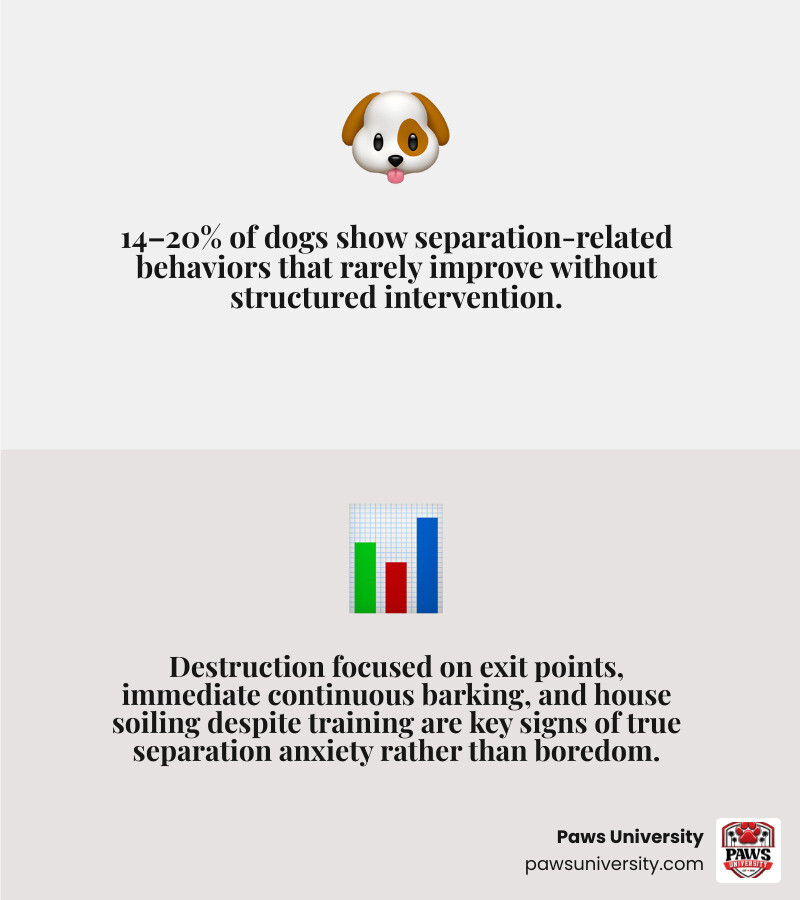
Estimates suggest 14–20% of dogs show some form of separation-related behavior — and for many, it doesn't get better on its own without the right intervention.
I'm Allen Daniels, co-founder of Paws University in Kailua-Kona, and over 25+ years of working with dogs with high separation anxiety, I've seen how the right rewards-based approach can turn a panicking dog into a calm, confident one. Let's walk through everything you need to know.
Terms related to dogs with high separation anxiety:
Understanding Dogs with High Separation Anxiety
To understand dogs with high separation anxiety, we must first recognize that this is not a case of a "bad dog" acting out of spite. It is a genuine clinical disorder. When we talk about separation-related disorders, we are describing a physiological panic response.
The American College of Veterinary Behaviorists classifies true separation anxiety as a clinical panic disorder. When a dog with this condition is separated from their primary attachment figure, their nervous system enters a state of fight-or-flight. This is comparable to a human experiencing a severe panic attack. The behaviors that follow—whether they are howling, scratching at the door, or pacing—are involuntary expressions of terror, not calculated acts of disobedience.
Because it is a clinical disorder, punishing a dog for these behaviors is not only ineffective, but it also actively worsens the condition. It layer-cakes fear on top of existing panic. Instead, we must treat the issue with scientific, rewards-based behavioral protocols. For a deeper look at the underlying mechanics of canine panic, the ASPCA research on separation anxiety offers valuable insights into how these distress patterns manifest.
Clinical Panic vs. Normal Boredom
Distinguishing between a bored dog and a clinically anxious dog is the critical first step in finding the right solution. A bored dog might chew up a shoe or knock over a trash can because they are looking for something to do. However, they will eventually settle down, take a nap, or play with their toys.
A dog experiencing clinical panic, on the other hand, is incapable of settling. Their behavior is characterized by:
- Exit-Point Destruction: Panicked dogs focus their destructive energy almost exclusively on barriers. You will see claw marks, shredded drywall, or chewed frames around front doors, back doors, and windows. They are trying to break through the barriers to reach you.
- Persistent Vocalization: While a bored dog might bark once or twice at a passing bird, an anxious dog will howl, whine, or bark continuously, starting almost immediately after you leave. Research shows the latency for vocalization is often under four minutes from the moment of departure.
- Refusal of High-Value Treats: A bored dog will happily devour a peanut-butter-stuffed toy left behind. A clinically anxious dog will ignore even the most delicious treats because their sympathetic nervous system has shut down their appetite.
To truly confirm what is happening when you are away, we highly recommend utilizing video observation. Set up a recording device to capture your dog’s behavior during the first thirty minutes of your absence. If you observe continuous pacing, drooling, or frantic clawing at the door within minutes of your departure, you are dealing with a separation-related disorder rather than simple boredom. If you are struggling with these early signs of stress, our guide on Stop the Shakes with These Proven Anxious Dog Solutions can help you identify baseline anxiety before it escalates.
Common Symptoms of Dogs with High Separation Anxiety
The physical toll of high separation anxiety can be severe. These dogs are under immense physiological stress, which manifests in both behavioral and physical symptoms.
- Inappropriate Elimination: Even fully housetrained dogs may urinate or defecate indoors when panicked. This is not a training failure; the intense fear causes a loss of voluntary sphincter control.
- Hypersalivation and Drooling: You may return home to find puddles of drool on the floor, or your dog's chest completely wet. This extreme salivation is a direct physical result of severe panic.
- Pacing and Circling: Anxious dogs will walk a tight, repetitive path—often back and forth between the door and the window—without stopping to rest.
- Self-Injury: In severe cases, dogs will claw at metal crates or wooden doors until their nails tear, their paws bleed, or they break their teeth.
To help you assess the severity of your dog's condition, we have outlined the symptoms across different levels of anxiety:
| Severity Level | Behavioral Indicators | Physical Indicators | Primary Focus |
|---|---|---|---|
| Mild | Whining, minor pacing, ignoring food initially but eating it later. | Slight panting, alert posture. | Quietly monitoring exit doors. |
| Moderate | Continuous barking, scratching at door frames, chewing non-food objects. | Moderate drooling, dilated pupils, refusal to eat. | Active attempts to locate or reach the owner. |
| Severe | Frantic escape attempts, self-injury (broken nails/teeth), house-soiling. | Profuse drooling, trembling, vomiting, or bloody diarrhea. | Extreme panic, destructive focus on exit barriers. |
Breeds and Triggers of Separation-Related Distress
While any dog can develop separation-related distress, certain factors make some dogs much more vulnerable. This vulnerability is often a combination of genetic wiring and life experiences.
Breeds Most Prone to Solitude Struggles
Some dog breeds have been selectively bred for centuries to work in close partnership with humans. This intense handler attunement is what makes them fantastic working dogs, but it also creates a neurological vulnerability to solitude.
Breeds like the Belgian Malinois, German Shepherd, and Border Collie are designed to constantly monitor their handlers for cues. When they are suddenly left with no one to focus on, their internal drive has nowhere to go, resulting in extreme anxiety. Similarly, gundogs like Labrador Retrievers and German Shorthaired Pointers, as well as companion breeds like the Cavalier King Charles Spaniel, are classic "Velcro dogs." They thrive on physical proximity and can struggle immensely when that proximity is severed.
If you are working with a highly sensitive working breed, understanding their unique breed-specific needs is essential. For example, our specialized breakdown on Managing Belgian Malinois Separation Anxiety explains how their high drive can complicate treatment and how to manage it safely.

Common Triggers for Sudden Onset Anxiety
Separation anxiety does not always develop gradually; it can be triggered suddenly by major life transitions or disruptions to a dog's routine.
- Schedule Changes: A sudden transition from remote work to an in-office schedule is a frequent trigger. The dog, accustomed to constant human presence, is suddenly thrust into hours of unexpected solitude.
- Moving House: A new environment can temporarily shatter a dog’s sense of security. If left alone in an unfamiliar home too quickly, they may associate the new space with panic.
- Loss of a Family Member: The death or departure of a household member (such as a child leaving for college or a divorce) can disrupt the social structure of the home, triggering severe distress.
- Shelter Backgrounds and Rehoming: Dogs sourced from animal shelters or those who have had multiple owners are statistically much more likely to exhibit separation anxiety. The trauma of abandonment and the fear of losing another attachment figure make them highly sensitive to departures.
If you suspect your dog's anxiety was triggered by a recent change, taking immediate steps to rebuild their confidence is vital. You can find practical, immediate advice in our resource on Dog Anxious When Leave Tips.
How to Prevent and Treat Separation Anxiety
Treating dogs with high separation anxiety requires a systematic, science-based approach. We rely on systematic desensitization and counterconditioning—methods that gradually change your dog's emotional state from panic to calm.
Preventing Alone-Time Panic in Puppies
Prevention is always easier than treatment. If you have a young puppy, you have a golden opportunity to teach them that solitude is safe before anxiety ever has a chance to take root.
- Early Socialization: Ensure your puppy is exposed to a wide variety of sights, sounds, and environments during their critical developmental window.
- Independence Training: Do not let your puppy follow you everywhere. Use baby gates or playpens to create brief moments of physical separation while you are still in the house.
- Positive Reinforcement: Reward calm, independent behavior. If your puppy chooses to chew a toy on their bed instead of velcroing to your side, quietly drop a high-value treat between their paws.
- Gradual Alone-Time: Practice leaving your puppy alone for very short, successful intervals—starting with just a few minutes while you fetch the mail—and build up slowly.
For a comprehensive puppy schedule and step-by-step training tips, check out The Ultimate Guide to Teaching Your Puppy to Be Alone.
Step-by-Step Desensitization Protocol
If your dog already suffers from separation anxiety, a structured desensitization protocol is the gold standard for treatment. The core philosophy is simple: never leave your dog alone longer than they can tolerate without panicking. If their threshold is ten seconds, your training starts at eight seconds.
Here is the step-by-step process to build lasting comfort with solitude:
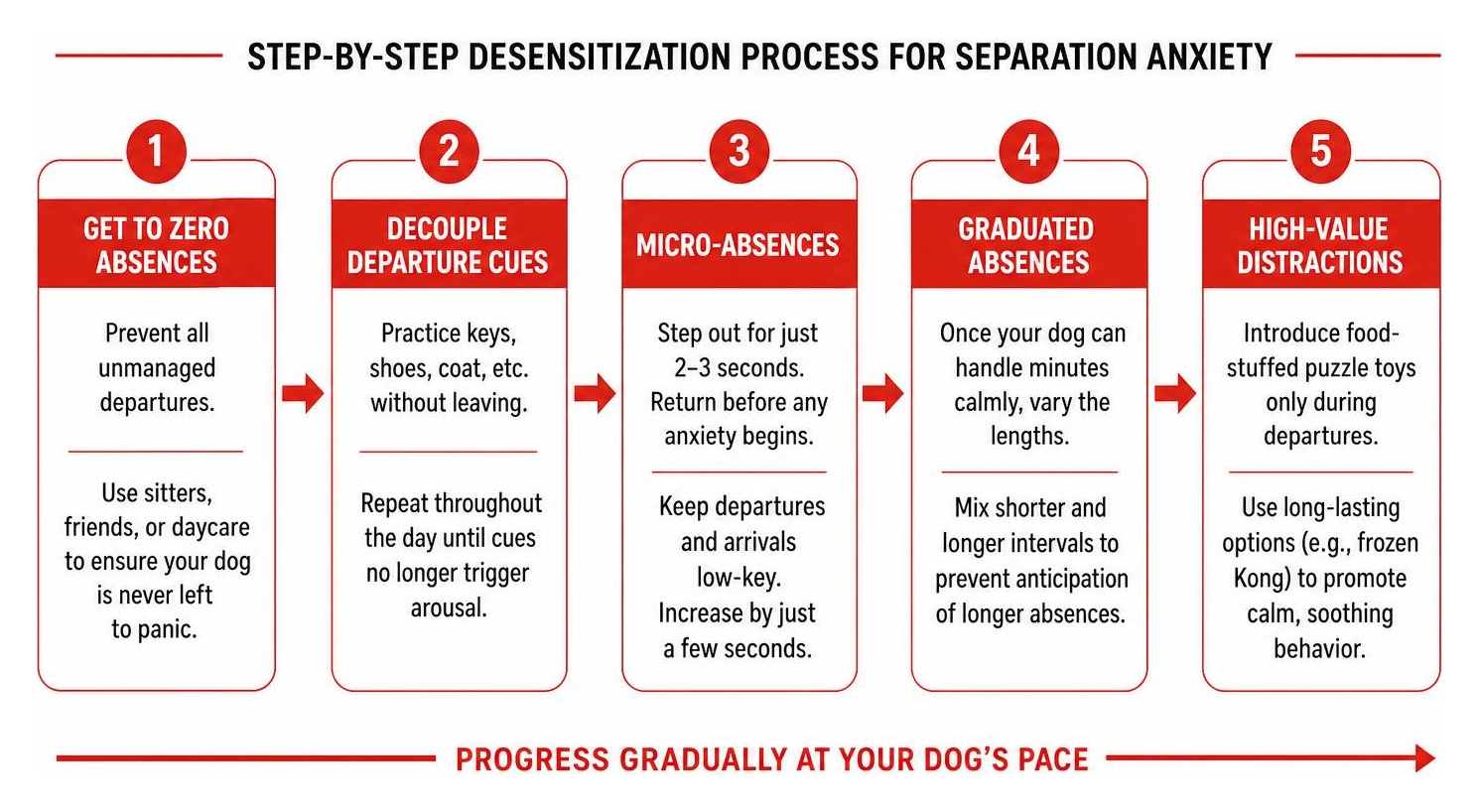
- Phase 1: Get to Zero Absences: During the initial training phase, suspend all unmanaged departures. Every time your dog panics, the neural pathways of fear are reinforced. Utilize pet sitters, friends, or premium dog daycare to ensure your dog is never left to panic.
- Phase 2: Decouple Departure Cues: Your dog likely starts panicking before you even open the door. They recognize the sound of keys, the putting on of shoes, or the grabbing of a coat. Practice these cues throughout the day without actually leaving. Pick up your keys, sit on the couch, and watch TV. Put on your shoes, make a cup of tea, and take them off. Do this until the cues no longer trigger arousal.
- Phase 3: Micro-Absences: Step outside the door for just two to three seconds, then return before any anxiety begins. Keep your departures and arrivals completely low-key; do not hug, apologize, or throw a party when you return. Gradually increase these intervals by just a few seconds at a time.
- Phase 4: Graduated Absences: Once your dog can handle a few minutes calmly, vary the lengths of your departures. If your dog can do ten minutes, do not immediately try eleven. Mix in shorter departures (e.g., three minutes, seven minutes, two minutes, ten minutes) to prevent them from anticipating longer and more stressful absences.
- Phase 5: High-Value Distractions: Introduce long-lasting, food-stuffed puzzle toys only during departures. A frozen Kong stuffed with wet food can provide 20–30 minutes of soothing licking behavior, which naturally lowers a dog's heart rate. However, only introduce food toys once your dog is already comfortable with short absences; otherwise, they may learn to associate the food toy itself with the panic of your departure.
For a highly detailed, daily training schedule that you can customize for your dog, we recommend reviewing the Separation Anxiety in Dogs: A Desensitization Protocol You Can Actually Follow | Pet Care Helper AI. Additionally, the structured approach detailed in Dog Separation Anxiety: A Practical Plan That Gets Results | The Dog Effect offers excellent strategies for maintaining consistency during the protocol.
Supporting Dogs with High Separation Anxiety Through Premium Care
For moderate to severe cases, behavior modification alone can be incredibly slow because the dog's brain is too flooded with stress hormones to learn. In these situations, we must work alongside veterinary professionals to support the dog's physical and emotional well-being.
- Veterinary Consultation: A thorough physical exam is essential to rule out underlying medical issues, such as urinary tract infections or joint pain, which can mimic or worsen anxiety symptoms.
- Medication Support: Daily medications (such as SSRIs) or situational anti-anxiety medications can help lower your dog’s baseline stress, bringing them into a state of mind where they are capable of learning during your desensitization training. Medication is not a "cure-all" or a failure; it is a vital tool that makes training possible.
- Pheromone and Environmental Support: Using calming pheromone diffusers, playing white noise (like a fan or soothing classical music), and providing comfortable, secure resting areas can help create a relaxing environment.
- Premium Daycare and Boarding: When you must travel or work, leaving your anxious dog at a standard kennel can cause severe regression. Choosing a highly structured, premium facility with supervised play and experienced staff is critical. Our specialized team understands how to support sensitive pets; read more about our approach in A Practical Guide to Boarding for Anxious Dogs.

Frequently Asked Questions about Separation Anxiety
Navigating separation-related behavior can be overwhelming, and there is a lot of misinformation out there. Here are the facts behind the most common questions we receive.
Can getting a second dog cure separation anxiety?
No. This is one of the most common misconceptions in the dog world. True separation anxiety is an attachment issue directed at a specific human, not a general fear of being alone. Adding a second dog rarely helps because the panicking dog is not missing canine company—they are missing their specific attachment figure. In some cases, the anxious dog's panic can even transfer to the new dog, leaving you with two stressed pets instead of one.
Should I crate a dog with separation anxiety?
Only if the dog is already fully crate-trained and views the crate as their ultimate safe haven. For many dogs with high separation anxiety, confinement in a tight space triggers severe claustrophobia and "confinement anxiety." This can lead to frantic escape attempts, resulting in broken teeth, torn nails, and severe facial cuts. If your dog panics inside a crate, it is far safer to use baby gates to confine them to a dog-proofed room, or to utilize specialized, heavy-duty setups. For a complete safety guide on this topic, see The Complete Guide to Dog Kennels for Anxious Dogs.
How long does it take to resolve separation anxiety?
There is no quick fix. Because we are retraining a deep-seated panic response in the brain, progress is measured in weeks and months, not days. Mild cases may show significant improvement in 4 to 8 weeks, while severe cases can take 6 months or longer of consistent, daily desensitization. The key to success is absolute consistency and maintaining a slow, steady pace that never pushes your dog past their panic threshold.
Conclusion
Managing dogs with high separation anxiety is undeniably challenging, but with patience, a rewards-based approach, and the right support system, real progress is entirely possible. Remember to celebrate the small victories—a dog who lies down for five seconds after you close the door is a dog who is actively learning that they are safe.
At Paws University, we are dedicated to helping dogs and their owners navigate these behavioral hurdles. Located on a beautiful, spacious seven-acre campus in Hawaii County, our premier West Hawaii facility offers supervised play and premium day care designed to reduce behavioral issues and build social confidence in a safe, tropical setting.
If you are ready to take the next step in your dog's training journey under the warm Kona sun, explore our Paws University Training Services to see how we can support you and your canine companion.