Why Your Dog Panics When You Leave (And What to Do About It)
If your dog gets anxious when you leave, you're dealing with something far more common than most people realize. Research suggests that 8 out of 10 dogs struggle to cope when left alone — and half of them show no obvious signs at all.
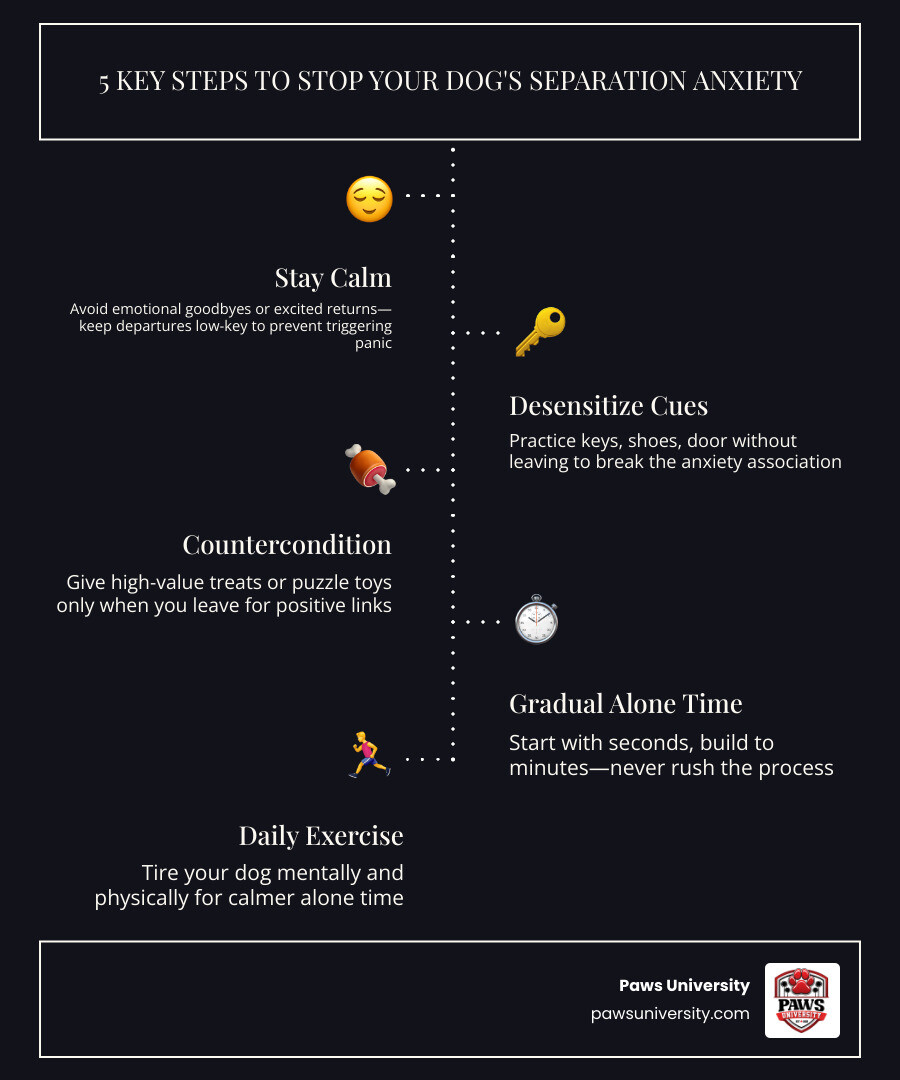
Here's what to do if your dog gets anxious when you leave:
- Stay calm during departures and arrivals — big emotional goodbyes make anxiety worse
- Desensitize departure cues — practice picking up keys or putting on shoes without actually leaving
- Use counterconditioning — give a high-value treat or stuffed puzzle toy only when leaving
- Build up alone time gradually — start with seconds, not hours
- Ensure daily exercise — a tired dog is a calmer dog
- Rule out medical issues — some symptoms mimic anxiety but have physical causes
- Consult a vet or professional trainer — for moderate to severe cases, expert help makes a real difference
This isn't bad behavior. It's not spite. It's closer to a panic attack — and it's treatable.
Separation anxiety is one of the most common reasons dogs are surrendered to shelters, which makes it one of the most important problems to address early. The good news: with the right approach, the success rate is high.
I'm Allen Daniels, co-founder of Paws University in Kailua-Kona, and over 25+ years of training dogs using the same positive reinforcement methods I developed working with marine mammals, I've helped hundreds of West Hawaiʻi families whose dog gets anxious when they leave. In this guide, I'll walk you through exactly what's happening in your dog's mind — and the step-by-step process to fix it.
Dog gets anxious when i leave terms to remember:
Understanding Why Your Dog Gets Anxious When You Leave
When your dog gets anxious when i leave, it is rarely a matter of "naughtiness." In the scientific community, this is often referred to as Separation-Related Behavior (SRB). According to Separation Anxiety in Dogs: Signs, Causes, and Prevention, the incidence of these problems is estimated at about 20% of the dog population. That means one in five dogs experiences a genuine panic response when their favorite humans walk out the door.
At our seven-acre campus in West Hawaii, we often see that this anxiety stems from a hyper-attachment to the owner. The dog isn't just "sad"; they are terrified to be alone. Several factors can trigger this:
- Changes in Routine: If you’ve spent the last three years working from home and suddenly switch to an office job in Kona, your dog’s world is turned upside down.
- Shelter History: Statistics show that dogs adopted from shelters are more prone to separation issues. The loss of a previous family can leave a lasting impact on their sense of security.
- Traumatic Events: A single scary event, like a loud thunderstorm or a break-in while the dog was home alone, can link "being alone" with "danger."
- Life Transitions: Moving to a new house or the loss of a family member can trigger an episode of anxiety.
For more deep dives into the mechanics of this condition, explore our Category/Separation Anxiety/ resources. Understanding that this is a distress response—not a lack of training—is the first step toward a calmer home.
Recognizing the Signs of Separation Distress

How do you know if it’s true anxiety? Many owners only realize their dog gets anxious when i leave when they come home to a shredded sofa or a noise complaint from the neighbors. According to the ASPCA, the most common symptoms include:
- Destructive Chewing: Specifically focused on exit points like door frames, windowsills, or your personal belongings that smell like you.
- Vocalization: Persistent howling, barking, or whining that starts within minutes of your departure.
- House Soiling: Even a perfectly house-trained dog may have accidents if they are in the throes of a panic attack.
- Hypersalivation and Panting: You might find "wet spots" on the floor or furniture from excessive drooling.
- Pacing and Escaping: Some dogs will pace in a fixed pattern or attempt to dig through doors, often leading to self-injury like broken nails or cut paws.
If you are noticing these behaviors, it’s helpful to look at Reducing Dog Behavior Issues Without Pulling Your Hair Out for foundational tips on managing overall stress.
Differentiating Anxiety from Boredom
It is easy to mistake a bored dog for an anxious one. A bored dog might chew a shoe because it's fun; an anxious dog chews the door frame because they are trying to reach you.
| Behavior | Separation Anxiety | Boredom/Mischief |
|---|---|---|
| Timing | Starts within 5–30 minutes of leaving. | Can happen anytime during the day. |
| Destruction | Focused on exits (doors/windows). | Focused on "fun" items (pillows, trash). |
| Physical Signs | Drooling, dilated pupils, trembling. | Calm demeanor, sleeping when not active. |
| Vocalization | High-pitched, frantic howling/whining. | Intermittent barking at outside triggers. |
As noted by WebMD, medical issues like urinary tract infections or age-related cognitive dysfunction can also cause "accidents" or vocalization. Always consult your vet to rule out physical pain before assuming it's behavioral.
Step-by-Step: How to Treat Separation Anxiety at Home

Treating a dog that gets anxious involves a process of changing their emotional state. We use a strictly rewards-based approach. The goal is to teach your dog that your departure actually predicts something wonderful.
Desensitizing Departure Cues
Your dog is a master of observation. They know that when you pick up your car keys and put on your "work shoes," you are about to disappear. Their anxiety often peaks before you even leave the house.
To break this cycle, you need to perform these cues without leaving.
- Pick up your keys, then go sit on the couch and watch TV.
- Put on your shoes, walk to the kitchen, make a coffee, and take the shoes off.
- Open the door to the garage, then close it and go back to what you were doing.
By repeating these "mock departures" several times a day, the cues lose their meaning. The keys no longer mean "Mom is leaving"; they just mean "Mom is moving some metal things around." For more on managing noise during this process, check out The Great Crate Escape From Nonstop Barking.
Counterconditioning When Your Dog Gets Anxious When You Leave
Counterconditioning is the process of pairing a scary event with a high-value reward. The classic tool here is a long-lasting food puzzle toy, like a stuffed Kong.
According to Rover, you should offer these "special" treats only when you are leaving. If your dog only gets a peanut-butter-stuffed toy when you walk out the door, they start to look forward to that moment.
Pro Tip: If your dog is too anxious to eat when you leave, the anxiety is likely moderate to severe, and you may need to scale back the duration of your absences. You can also learn more about creating a positive association with their environment in our guide on Crate Training Teaching Your Dog To Love Their Space.
Implementing Graduated Departures
This is the "heavy lifting" of the training. You must build up your dog's tolerance for being alone in tiny increments.
- Step 1: Tell your dog to "stay" or "settle," walk to the door, and come right back.
- Step 2: Step outside for 2 seconds, then return.
- Step 3: Gradually increase to 30 seconds, 1 minute, and 5 minutes.
Research shows a critical "40-minute threshold." Most anxious responses occur within the first 30 to 40 minutes of separation. If your dog can stay calm for 40 minutes, they are often able to settle for much longer periods. For puppies specifically, we recommend How To Quiet A Whining Puppy In Their Playpen For Good to help build that early independence.
The Role of Exercise and Mental Stimulation
A tired dog is a sleepy dog, and a sleepy dog has less energy to devote to a panic attack. In the warm, tropical climate of Hawaii County, we have the advantage of beautiful outdoor spaces for aerobic activity.
Vigorous exercise 20–30 minutes before you leave can significantly lower a dog's baseline stress. However, physical exercise isn't enough; they need "brain work" too.
- Scent Work: Hide treats around the lanai for them to find.
- Snuffle Mats: These mimic the act of foraging in the grass.
- Cognitive Games: Use interactive toys that require the dog to solve a puzzle to get a reward.
At Paws University, our supervised play sessions on our seven-acre campus are designed to provide both the physical outlet and the social stimulation dogs crave. This reduced "pent-up" energy makes home training much more effective. If you're working with a younger pup, How To Successfully Playpen Train Your Puppy Without The Stress offers great tips on balancing play and rest.
When to Seek Professional Help and Medication
Sometimes, despite your best efforts, your dog gets anxious when i leave to a degree that requires intervention. If your dog is injuring themselves, destroying your home, or seems to be in a constant state of terror, it’s time to call in the experts.
Veterinary behaviorists can assess if pharmacological intervention is necessary. According to research on separation-related behavior, medications like fluoxetine or clomipramine can help "lower the ceiling" on a dog's anxiety, making them more receptive to training. These are not "zombie drugs"; they are tools to help the brain learn.
Other aids include:
- Pheromone Therapy: Diffusers or collars that mimic the "calming pheromones" a mother dog produces.
- Compression Wraps: These apply gentle, constant pressure, which can have a dramatic calming effect on some dogs.
Never use medication as a standalone fix. It should always be paired with the behavior modification techniques we've discussed.
Preventing Anxiety in Puppies and New Dogs
The best way to deal with separation anxiety is to prevent it from ever taking root. If you’ve just brought home a new puppy or a rescue dog, start "alone-time training" on day one.
Building Independence Early
Don't let your new dog follow you from room to room like a shadow. Use a "settle" command to encourage them to stay on their bed while you go into another room for a few minutes. This builds confidence and teaches them that you always come back. Using rewards-based methods ensures they associate these moments of independence with positive feelings.
Training for Success When Your Dog Gets Anxious When You Leave
Establish a predictable routine. Dogs thrive when they know what to expect. Feed them, walk them, and train them at roughly the same times each day. This predictability lowers overall cortisol levels. Early playpen training is an excellent way to provide a safe, limited space where they can learn to self-soothe without feeling isolated.
Frequently Asked Questions about Separation Anxiety
Is my dog being spiteful when they destroy things?
Absolutely not. Dogs do not have the cognitive capacity for "spite." When a dog gets anxious when i leave and destroys a door, they are in a state of blind panic. Punishing them when you get home will only make the problem worse, as they will then associate your return with fear and confusion.
Should I use a crate if my dog gets anxious when i leave?
This is a tricky one. For some dogs, a crate is a "den" that feels safe. For others, it triggers "confinement anxiety," and they may break teeth or claws trying to escape. Monitor your dog's reaction. If they are panting heavily or biting the bars, a crate is not the right solution for them. A gated-off room or a secure outdoor area might be better.
Can getting a second dog solve the problem?
Usually, no. Separation anxiety is specifically about the bond with the human. While a second dog might provide some distraction, the anxious dog will likely still panic when the human leaves. In some cases, you might even end up with two anxious dogs! Professional training is a much more reliable path.
Conclusion
Helping a dog that gets anxious when i leave requires patience, consistency, and a lot of aloha. Whether you are practicing short departures or stuffing puzzle toys, you are working to heal a fearful mind.
At Paws University, we’ve been West Hawaii’s premier pet care facility since 2002. Our seven-acre campus in Kailua-Kona provides a supervised environment where dogs can play, learn, and build the confidence they need to thrive. If you’re struggling with your dog’s behavior, we’re here to help with professional training and premium daycare services that reduce stress for both you and your pup.
For more information on how we can support your journey, check out More info about training services. Together, we can turn those departures into a stress-free part of your daily life.