Use the Look at That Game Before Your Dog Reacts
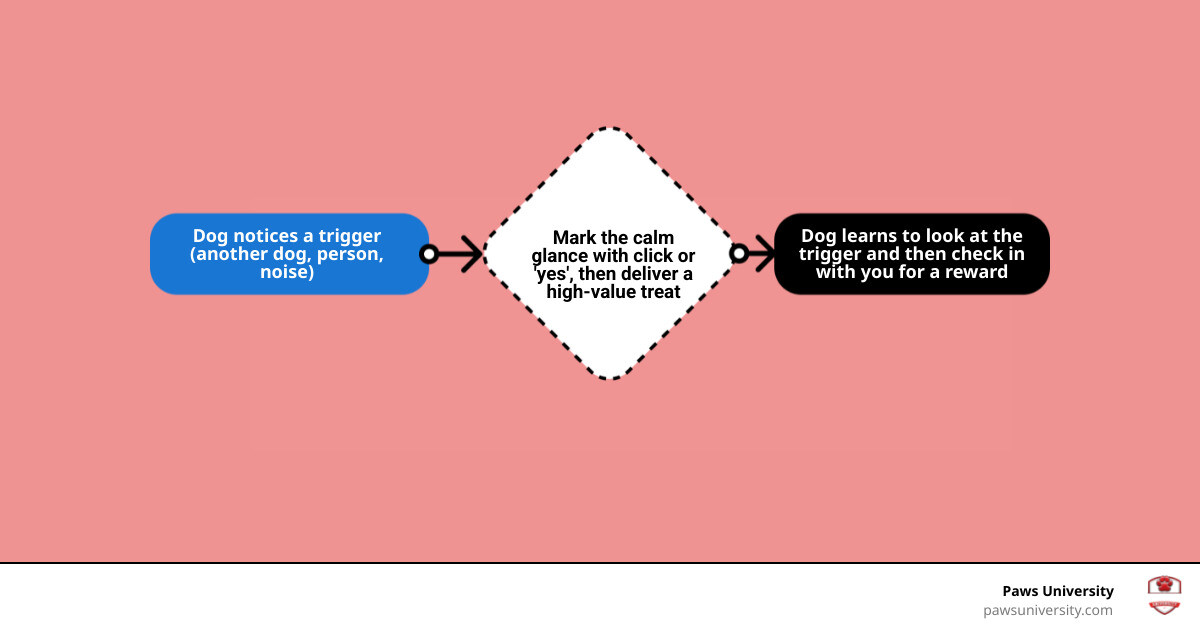
If your dog barks or lunges at other dogs, start the Look at That (LAT) game at a safe distance. Wait for a brief glance at the other dog, mark it with a click or "yes," then give your dog a treat. If your dog stiffens, barks, or cannot take the treat, move farther away. The goal is to help your dog notice a trigger without feeling the need to react.
Created by trainer Leslie McDevitt, LAT turns that calm glance into a repeatable, rewarding choice. It can help with reactivity, but a dog with a bite history needs a safety plan and professional guidance, not the game alone. Used correctly, dog aggression and look at that game training work together to replace fear-based reactions with calm, voluntary check-ins.
I'm Allen Daniels, co-founder of Paws University, where I work with dogs facing aggression. My approach to dog aggression and look at that game training draws on decades of reward-based animal training that began with marine mammals in the late 1980s.
Understanding Dog Aggression and Look at That Game Fundamentals
When a dog displays aggression on leash—whether barking, growling, or lunging—it is rarely an attempt to be "dominant." In the vast majority of cases, canine aggression stems from fear, anxiety, or acute frustration. When an animal encounters a perceived threat, their sympathetic nervous system activates the classic survival mechanisms known as the "4 Fs of fear": Fight, Flight, Freeze, or Fool around.
On a standard leash, your dog cannot choose "flight." Trapped and unable to retreat, an anxious dog defaults to "fight"—making lots of noise and lunging to send the message, "Back off, I'm uncomfortable!"
Every dog has an emotional threshold. Below threshold, your dog is relaxed, fully aware of the environment, and capable of cognitive processing. Above threshold, raw instinct takes over, making learning impossible. By utilizing positive modification protocols for aggressive dogs, we respect these boundaries.
The Look at That game, developed by Leslie McDevitt as part of her groundbreaking Control Unleashed methodology, offers a way out of this cycle. Instead of forcing a dog to ignore an approaching trigger, LAT provides proactive communication. As noted in veterinary insights on the Look at That method, the protocol safely bridges the gap between environmental awareness and emotional safety.
The Science of Dog Aggression and Look at That Game Conditioning
The brilliance of the LAT game lies in how it seamlessly merges two core pillars of behavioral science: classical counter-conditioning and operant conditioning.

- Classical Counter-Conditioning (Pavlovian Association): Before we can change behavior, we must change emotion. When a dog sees a trigger (like an unfamiliar dog) and immediately receives a high-value reward, the emotional valence of that trigger flips. Over time, the internal response shifts from "Oh no, there's that scary thing!" to "Hey, that means chicken is coming!"
- Operant Conditioning (Skinnerian Reinforcement): The dog learns that their own deliberate behavior controls the outcome. Glancing at the trigger without exploding becomes an operant cue that unlocks a reward from the handler.
By engaging both mechanisms, LAT stimulates neural dopamine pathways associated with curiosity and reward rather than adrenaline pathways driven by panic. Understanding these mechanisms of shifting canine emotional valence is why modern trainers prioritize teaching dogs how to process triggers calmly rather than suppressing their emotions.
Why Distraction and Punishment Fail Compared to LAT
Many well-meaning guardians attempt to fix reactivity by violently jerking the leash, using aversives, or shoving food in the dog's face as a distraction. These methods often backfire.
| Training Approach | Mechanism | Emotional Impact | Long-Term Outcome |
|---|---|---|---|
| Punishment-Based (Prong, Shock, Yelling) | Suppresses outward signs (growls/barks) through discomfort or intimidation. | Increases underlying fear and stress; triggers remain terrifying. | High Risk: Leads to "punishment fallout." The dog may stop growling but eventually bites without warning. |
| Simple Distraction (Luring away with food) | Blocks the dog's view or forces eye contact without processing the environment. | Neutral; does not address the root fear of the trigger itself. | Temporary: Fails the moment a distraction is noticed before the treat is presented. |
| Look at That (LAT) (Counter-Conditioning) | Teaches calm observation at a safe distance and rewards voluntary orientation. | Transforms fear into positive anticipation and emotional resilience. | Sustainable: Builds true environmental tolerance, impulse control, and trust. |
Punishment causes behavioral suppression. While it might seem to "work" in the immediate moment, the internal emotional pressure cooker continues to boil until it explodes. If you want to know how to stop dog growling safely, the answer is never to punish the warning growl—it is to change the feeling that caused the growl in the first place.
Step-by-Step Guide to Playing the Look at That Game
Before you begin, set your dog up for success with the right foundation. You will need:
- A comfortable, non-restrictive Y-shaped harness and a standard 6-foot leash (never a retractable leash).
- A clicker or a crisp verbal marker word like "yes."
- Pea-sized, irresistible high-value rewards (roast chicken, freeze-dried liver, or string cheese).

Before working around live triggers, ensure your dog understands marker mechanics in a distraction-free setting. Follow the foundational rules of Leslie McDevitt's LAT game by keeping initial training sessions short (1 to 5 minutes) and playful.
Level 1: Marking the Calm Glance
The goal of Level 1 is simple: teach your dog that looking at a trigger earns a reward from you.
- Establish Distance: Position your dog far away from the trigger—across a wide park or at the far end of an open field. Your dog should be able to see the trigger without showing any tension.
- Observe the Glance: The instant your dog looks toward the trigger, mark that millisecond with your clicker or verbal marker ("yes").
- Deliver the Reward: As soon as you mark, deliver a high-value treat right to your dog's mouth or toss it slightly behind them to reset their body position.
- Repeat: When your dog turns back to look at the trigger again, mark immediately and reward.
Aim for 3 to 5 successful repetitions in a row where your dog calmly looks, hears the mark, and easily turns back to take the food. If your dog freezes or ignores your marker, you are too close. Back up immediately. This sub-threshold control is crucial when establishing safe interventions for preventing dog attacks.
Level 2: Fading the Marker and Building Auto-Disengagement
Once your dog has mastered Level 1, they will start anticipating the treat the moment they see the trigger. This is where we build the "auto-disengage" response:
- Pause Your Marker: When your dog spots the trigger at your baseline distance, do not click immediately. Wait 1 to 2 seconds.
- Reward the Voluntary Turn: Watch your dog's head. The moment they glance at the trigger and choose to whip their head back toward you on their own, mark ("yes!") enthusiastically and deliver a jackpot of treats!
- Decrease Distance Gradually: After achieving 3 to 5 clean auto-disengagements at that distance, take 1 to 5 steps closer to the trigger area and repeat the process.
This progressive reduction of distance teaches deep impulse control. For a structured, comprehensive plan on working through these stages, refer to our step-by-step aggression training framework.
Applying LAT to Different Aggressive Triggers and Environments
The LAT game is exceptionally versatile. While commonly used for leash-reactive dogs, it can be customized for almost any environmental stimulus that causes an adrenaline spike.

Managing Specific Triggers: Dog Aggression and Look at That Game Adaptations
Different triggers present different challenges:
- Motion Sensitivity (Bikes, Skateboards, Runners): Fast-moving objects trigger predatory chase drives alongside anxiety. Practice LAT at significant distances where the motion is slow to the dog's eye, marking the initial sight of movement before the chase reflex kicks in.
- Fence-Line Reactivity: If your dog charges the fence, start inside your home looking through a window. Play LAT as neighbors pass by before moving into the yard on a long line.
- Auditory Triggers ("Hear That"): Dogs that react to doorbells, distant barking, or car doors slamming can play the auditory version. Mark the instant the dog's ears perk up at a sound ("Hear that!"), followed immediately by a treat.
Pairing LAT with early behavioral development helps build solid bite inhibition and environmental resilience, mirroring the techniques in our guide to early manners and impulse control for biting dogs.
Integrating Agility and Focus Games for Better Impulse Control
Reactivity rehabilitation benefits enormously from structured physical and mental outlets. Agility-based exercises naturally cultivate behaviors that are physically incompatible with lunging and barking:
- The Eye Contact Game: Encourages continuous check-ins and builds focus in high-arousal environments.
- Restrained Recalls: Builds explosive enthusiasm for returning to the handler away from distractions.
- Platform and Table Holds: Teaches a dog to hold a stationary, relaxed position while exciting stimuli move around them.
These structured games reduce overall stress baselines, proving that rehabilitating aggression in adult dogs is entirely achievable when you replace panic with purposeful teamwork.
Common Mistakes to Avoid When Using LAT for Aggression
Even experienced handlers run into snags when working through reactivity. Avoid these common pitfalls:
- Working Over Threshold: If your dog cannot eat, is staring fixedly, or is pulling hard on the leash, you have moved too close, too fast.
- Rushing Distance: Stay at a safe distance longer than you think you need to. Progress is measured in calm repetitions, not proximity.
- Missing Early Stress Signals: Barking is a late-stage stress response. Look for subtle precursors: lip-licking, hard staring, yawning, sudden scratching, or stiffening of the tail.
- Luring Instead of Marking: Do not wave food in front of your dog's nose to pull them away from a trigger. The dog must see the trigger first, process it, and be marked for remaining calm.
Reviewing the clinical insights on reactive dog training errors can help keep your timing crisp and your mechanics sound.
When to Seek Professional Behavioral Support
While the LAT game is an exceptional protocol, severe behavioral concerns require an experienced hand. If your dog has a history of landing bites, displaying redirected aggression toward you on leash, or experiencing panic attacks in public, do not navigate the journey alone.
Safety must always come first. Implementing proactive management, such as introducing a comfortable, properly fitted basket muzzle, ensures that everyone remains safe during the rehabilitation process. Consult safety protocols for managing threatening canine behaviors whenever safety is uncertain, and seek out dedicated positive reinforcement specialists.
Frequently Asked Questions About the Look at That Game
How long does it take for the Look at That game to work on aggressive dogs?
Most owners who practice short, 2-to-5-minute sessions daily see their dogs begin offering voluntary check-backs within two to three weeks. However, long-standing fear or aggression requires systematic desensitization over several months to fundamentally rewire conditioned emotional responses.
What should I do if my dog refuses treats during the LAT game?
If a food-motivated dog refuses high-value treats (like fresh meat or cheese), it is a physiological sign that they are over threshold. The sympathetic nervous system has temporarily shut down their digestive processes in preparation for fight-or-flight. Immediately increase distance from the trigger until your dog can breathe, think, and eat again.
Can the Look at That game be used for dogs that bark at noises instead of sights?
Yes. The protocol translates seamlessly into the "Hear That" game. The mechanics are identical: the moment your dog's ears twitch or orient toward an alarming noise (like thunder, sirens, or footsteps outside), mark with your clicker or verbal marker and reward generously before they bark.
Conclusion
Overcoming dog aggression is not about forcing your companion into rigid submission; it is about building trust, emotional stability, and open lines of communication. By transforming terrifying encounters into predictable, rewarding conversations, the Look at That game empowers your dog to make calm, confident choices.
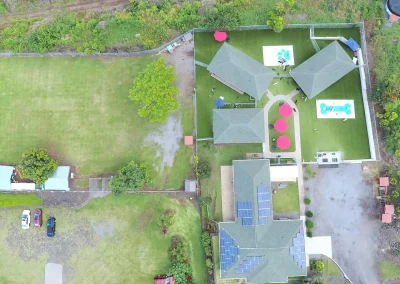
At Paws University, we believe every dog deserves a patient, scientifically sound path to emotional wellness. Established in 2002 on a beautiful seven-acre campus in West Hawaii, our premium facilities are dedicated to enriching canine lives through positive reinforcement and structured, supervised care. Whether your companion needs behavioral rehabilitation or confidence-building socialization, explore our professional positive reinforcement training programs and let our experienced team help you build a calmer, happier life with your dog.