Start Puppy Obedience Training From Day One
Puppy obedience training should begin the day your puppy comes home. Start with a calm routine, potty trips, name recognition, gentle handling, safe social exposure, and short reward-based lessons. The most important early goal is not perfect obedience. It is helping your puppy feel safe, learn what earns rewards, and build good habits before the key socialization window closes around 12 to 16 weeks.
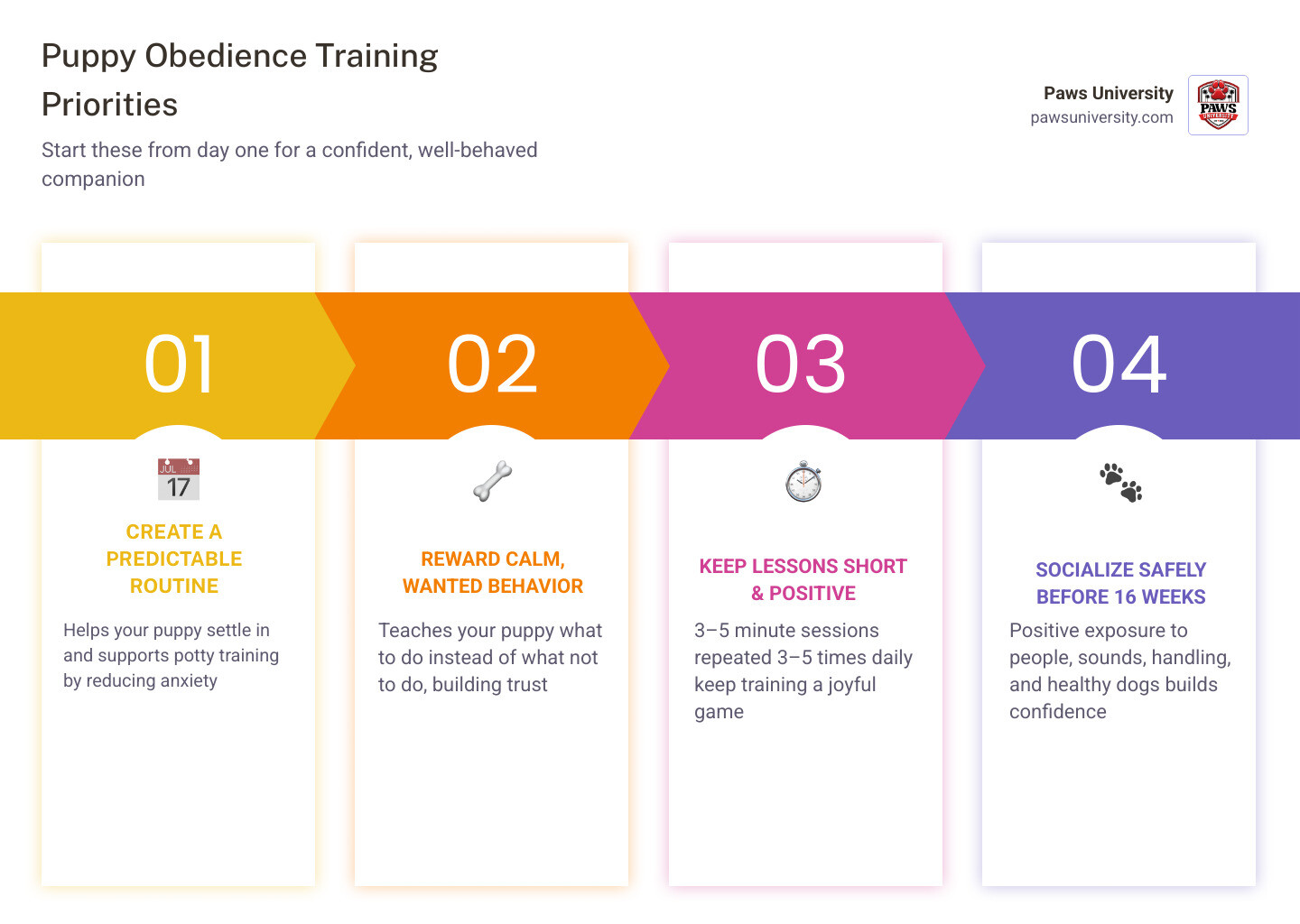
| Quick puppy training priority | Why it matters |
|---|---|
| Create a predictable routine | Helps a new puppy settle and supports potty training |
| Reward calm, wanted behavior | Teaches your puppy what to do instead of what not to do |
| Keep lessons short | Most puppies learn best in 3- to 5-minute sessions |
| Socialize safely | Positive early exposure can build confidence around people, sounds, handling, and other healthy dogs |
| Prevent bad habits | Chewing, jumping, and nipping are easier to guide early than undo later |
The first few days can feel messy. The common 3-3-3 guideline is a helpful reminder: many new dogs need about three days to decompress, three weeks to understand the household routine, and three months to feel truly at home. Patience and consistency matter more than trying to teach every cue at once.
I am Allen Daniels, a Hawaii County native and co-founder of Paws University, with more than 25 years of experience in reward-driven animal training. My work in puppy obedience training is rooted in the trust-based operant conditioning methods I first developed while training marine mammals and later applied to hundreds of dogs.
Foundations of Effective Puppy Obedience Training
Starting early sets your companion up for a lifetime of confidence and polite habits. The imprinting period begins in early life and stretches through 12 to 16 weeks of age. During this sensitive phase, puppies learn how to relate to humans, explore their environment, and interpret social signals. Rather than waiting until a dog is six months old, introducing foundational skills from day one takes advantage of their natural curiosity.
Keeping sessions brief is critical. A young puppy has a short attention span, so structured practice should last only 3 to 5 minutes at a time, repeated three to five times throughout the day. Ending each mini-session on a successful rep ensures training remains a joyful game rather than a stressful chore.
Our entire approach relies on force-free positive reinforcement. Puppies naturally repeat behaviors that lead to favorable outcomes—like treats, play, or praise—and abandon behaviors that do not yield rewards. By focusing on teaching what we want them to do instead of scolding unwanted choices, we build deep mutual trust.
Understanding the mechanics of learning theory makes puppy obedience training far more effective:
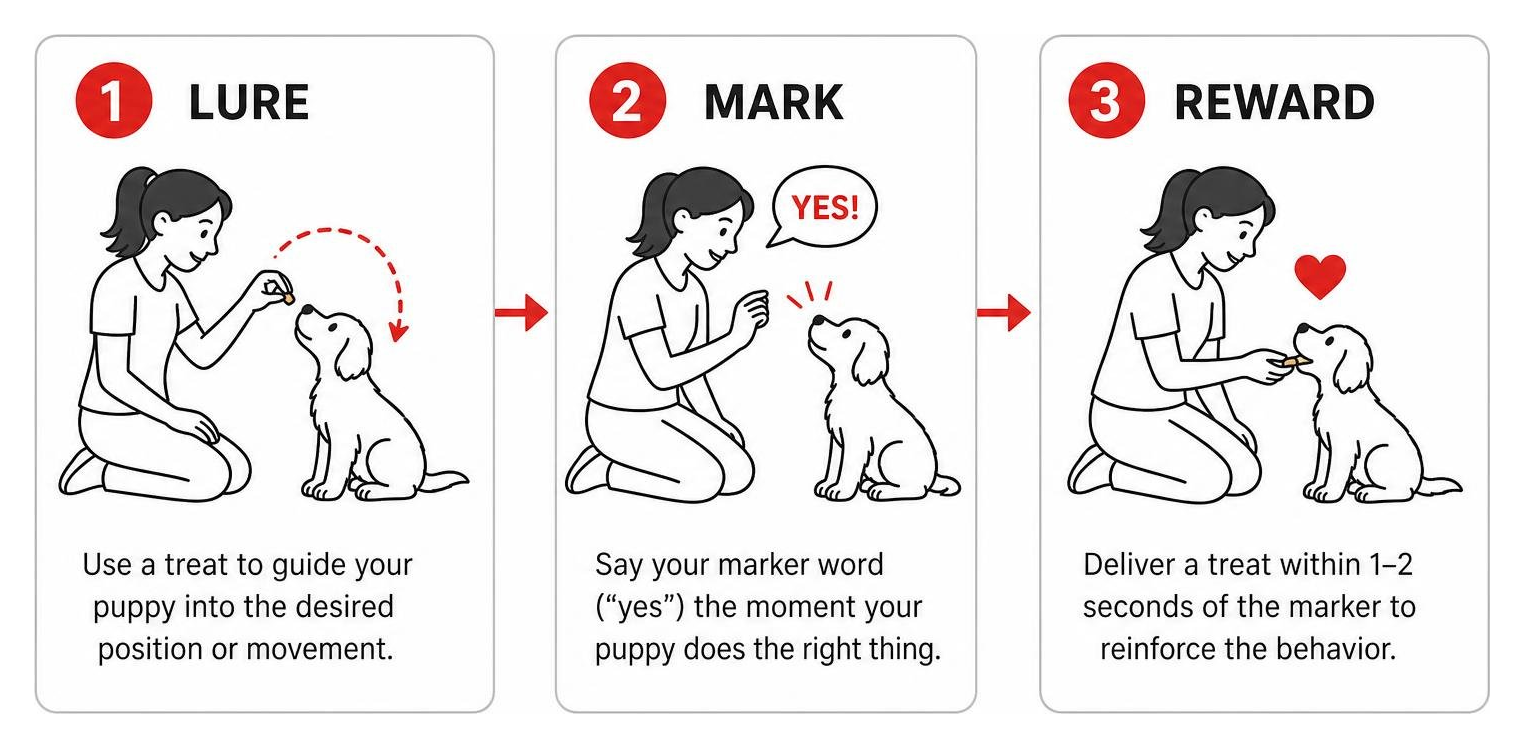
- Marker Signals: A distinct marker word like "yes" or a clicker pinpoints the exact millisecond your puppy performs a correct behavior. Delivering a treat within 1 to 2 seconds of the marker bridges the gap between the action and the reward.
- Luring Mechanics: Luring involves holding a small, high-value treat right at your puppy's nose like a magnet to guide their body into position (such as lifting the treat up and back to bring their bottom to the ground).
- Capturing Behaviors: Capturing means marking and rewarding a natural action when your pup offers it spontaneously, such as sitting calmly by your feet or looking up at your face.
- Shaping: Shaping breaks complex skills down into incremental steps, rewarding small approximations until the full behavior is achieved.
To learn more about foundational behavioral concepts, visit our guide on The Definitive Guide to Teaching Puppy Obedience Basics or explore veterinary insights on Puppy Behavior Basics.
Essential Cues for Puppy Obedience Training
Before diving into complex tricks, focus on core behaviors that keep your puppy safe and manageable around the house. When introducing new cues, teach the physical movement first before adding the verbal word, ensuring your puppy clearly understands the expected action.
- Name Response & Eye Contact: Call your puppy's name in a happy tone. The instant they look toward your eyes, mark with "yes!" and reward. This builds rapid focus even amid light household activity.
- The "Sit" Cue: Hold a small treat directly above your puppy's nose. Gently move it backward over their head. As their eyes track the treat, their bottom will naturally lower to the floor. Mark the moment their hips touch the ground and reward.
- The "Stay" Cue: Ask your puppy to sit. Hold your hand out like a stop sign and wait just one or two seconds before marking and treating. Slowly increase duration first, then distance, and finally real-world distractions.
- Indoor Recall ("Come"): Crouch down, clap gently, and use an enthusiastic voice. When your puppy runs toward you, mark the movement and offer a high-value treat along with warm affection. Never use your recall cue to invite your puppy to something unpleasant, such as nail trimming or baths.
- The "Leave It" Cue: Present a low-value treat inside a closed fist. Allow your puppy to sniff or lick your hand. The moment they back away or break eye contact with your hand, mark and reward them with a superior treat from your opposite hand.
For additional guidance on foundational cues, check out the recommendations on First Behaviors to Teach.
Home Practice vs Group Puppy Obedience Training
Deciding where to train depends on your puppy's current developmental stage. Home practice offers a low-distraction environment ideal for introducing brand-new skills. Inside your living room or backyard, your puppy can focus completely on learning mechanics without being overwhelmed by foreign sights or scents.
However, home training alone cannot recreate the real-world challenges your dog will face as they grow. Group classes provide controlled distraction, teaching your puppy to respond reliably while surrounded by other dogs and people. Participating in structured group settings helps build impulse control in public settings.
When evaluating local training options, consider visiting a class beforehand to observe. Look for environments where participating dogs appear relaxed, engaged, and eager to learn. The instructor should actively guide owners using clear, reward-based methods and maintain ample physical space between dogs to ensure safety. To explore local class formats and group dynamics, read The Definitive Guide to Local Dog Training Classes.
Essential House Habits: Potty, Crate, and Chew Training
Establishing predictable household habits early prevents common frustrations down the road. Most puppies achieve reliable house-training between 4 and 6 months of age when supported by a consistent schedule.
Young puppies have tiny bladders. A helpful rule of thumb is that a puppy can physically hold their bladder for roughly one hour for every month of age, plus one hour when resting. At 8 to 10 weeks old, expect to take your puppy outside every 1 to 2 hours while awake, as well as immediately after waking from naps, finishing meals, or completing active play sessions. Stand quietly in the designated potty area, and when your puppy eliminates, mark the moment and reward with praise and a treat.
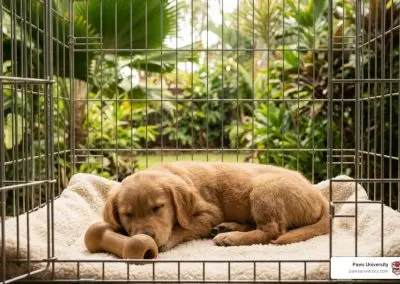
Crates and playpens serve as invaluable management tools. A crate should act as a cozy, comfortable den—never a place for discipline. Introduce the crate slowly by leaving the door open, tossing high-value treats inside, and encouraging your puppy to explore voluntarily. Playpens offer a slightly larger containment zone, giving your puppy room to stretch and play safely with approved toys when direct supervision is not possible. Long stays in crates should always be avoided; young puppies need frequent breaks for exercise, bathroom visits, and social interaction.

| Tool | Primary Purpose | Best Used For | Key Management Tip |
|---|---|---|---|
| Crate | Safe resting den & house-training aid | Short naps, overnight sleep, travel safety | Feed meals inside to build positive associations |
| Playpen | Restricted exercise & play area | Daytime play when owner is busy working nearby | Include a cozy bed, water, and safe chew toys |
| Chew Toys | Teething relief & calm mental focus | Preventing destructive chewing on furniture | Stuff rubber toys with kibble to build engagement |
Teething puppies naturally explore the world with their teeth. Prevent destructive chewing by puppy-proofing your living space—removing loose cords, shoes, and low household items. Whenever your puppy targets an inappropriate item like a table leg or rug, calmly interject and redirect their mouth to an acceptable rubber chew toy or safe dental ring.
For overnight housebreaking routines and management strategies, see our detailed Guide to Overnight Puppy Care.
Safe Socialization and Handling Before Full Vaccination
The primary socialization window closes between 12 and 16 weeks of age. Waiting until a puppy completes their entire vaccination series before introducing them to the outside world can increase the risk of lifelong fearfulness or reactivity. Veterinary experts emphasize that safe early socialization can easily be achieved while protecting health.
To socialize your puppy safely before full vaccination:
- Carry your puppy in your arms, in a sling, or sit together on a clean blanket in public parks to observe sights, sounds, and traffic safely from a distance.
- Arrange playdates in private, secure yards with healthy, fully vaccinated adult dogs known to be friendly toward puppies.
- Expose your pup positively to varied surfaces like grass, gravel, wooden decks, concrete, and shallow water.
- Practice "massage handling" during quiet moments. Gently touch their ears, lift their lips, handle their paws, and run your hands down their body while giving soft praise and treats. This sets the stage for stress-free veterinary exams and grooming sessions.
To step through a complete social exposure plan, refer to our Step by Step Socialization Guide.
Solving Common Behavioral Challenges and Biting
Mouthiness, jumping, and temporary non-compliance are normal aspects of puppy development. Understanding why these behaviors occur allows you to address them calmly without damaging your bond.
Puppies use their mouths during play to learn bite inhibition—the ability to control the force of their jaws. When your puppy nips too hard during play, utter a clear "ouch," stop moving, and disengage briefly for a few seconds. If your puppy continues mouthing, calm down the interaction and redirect their focus to a soft plush toy or durable chew. Persistent evening biting often indicates that a puppy is overtired rather than disobedient, signaling it is time for an enforced nap in their quiet resting area.

Jumping up is another common attention-seeking behavior. Pushing a jumping puppy away or speaking to them can unintentionally reward the behavior with physical contact and eye contact. Instead, practice proactive attention: ask your puppy to sit before greeting them. If all four paws remain on the floor, shower them with calm affection. If they jump, quietly turn your body away until they settle.
When a puppy seems to ignore a known cue, evaluate the environment. Distractions, fatigue, or confusion usually lie at the root of non-compliance. Reduce background distractions, step closer, or return to using a light food lure to help your puppy succeed.
For deeper insights on guiding soft mouth habits, read our resource on How to Stop Puppy Biting.
Navigating Puppy Adolescence and Behavior Red Flags
Around 5 to 6 months of age, your puppy enters adolescence. As hormonal and neurological changes occur, young dogs often test boundaries, act easily distracted, or display temporary regression in previously mastered cues like recall.
Surviving adolescence requires consistency and management:
- Continue using high-value rewards to reinforce core behaviors.
- Use a long line (a 15- to 30-foot leash) outdoors to maintain control during recall practice without permitting unearned off-leash freedom.
- Combine physical exercise with mental stimulation, such as food puzzle toys or scent search games, to burn off adolescent energy.
While testing boundaries is normal, certain behaviors require prompt guidance from a qualified professional:
- Severe Resource Guarding: Stiffening, growling, or snapping when a human or another pet approaches food, toys, or sleeping spots.
- Unwarranted Aggression or Intense Fear: Freezing, intense growling, or lunging at unfamiliar humans or dogs without provocation.
- Extreme Separation Anxiety: Persistent distress, frantic vocalization, or self-injurious attempts to escape when left alone.
Understanding professional roles helps you select the right support. A dog trainer focuses on building mechanical skills, manners, and obedience cues. A qualified veterinary behaviorist diagnoses and treats underlying psychological conditions like severe panic disorders or neurological anxiety.
To track your pup's progress through developmental stages, explore this Week-by-Week Puppy Guide.
Frequently Asked Questions About Puppy Training
When should I start training my new puppy?
Training starts the very day you bring your puppy home, typically around 8 weeks of age. Early training focuses on establishing household routines, house-training, soft mouth habits, and positive socialization exposures rather than strict formal commands.
How long should puppy training sessions be?
Formal training sessions should be kept to 3 to 5 minutes, repeated three to five times a day. Young puppies have short attention spans, and brief, enthusiastic practice sessions prevent fatigue while building enthusiasm for learning.
What is the difference between a dog trainer and a behaviorist?
A dog trainer teaches mechanical cues, impulse control, and everyday manners. A behaviorist (such as a qualified veterinary behaviorist) evaluates, diagnoses, and treats underlying psychological root causes behind severe emotional issues like clinical anxiety, phobias, and deep-seated aggression.
Conclusion
Successfully completing puppy obedience training is one of the most rewarding investments you can make in your dog's life. By grounding your daily interactions in patience, consistency, and positive reinforcement, you foster a confident, well-mannered canine family member.
At Paws University, our seven-acre campus in Hawaii County provides a supportive environment where young dogs thrive. Whether through supervised play in our premium daycare setting, specialized overnight care, or custom instruction, our team is dedicated to supporting your puppy's growth every step of the way. Explore our range of Professional Dog Training Options to start your puppy off on the right paw.