How to Socialize a Dog Without a Dog Park
To socialize a dog without a dog park, take short walks on varied routes and reward your dog for calmly noticing people, sounds, and other dogs from a comfortable distance. Add a reward-based training class or a one-on-one playdate with a healthy, compatible dog when your dog is ready. At home, introduce new sounds and surfaces in brief, positive sessions.
The goal is confidence, not greeting everyone. A dog who can relax near other dogs is making progress. If your dog seems tense or overwhelmed, give them more space and try an easier setting.
I'm Allen Daniels, co-founder of Paws University, and I've used reward-based methods to train dogs for more than 25 years. If you searched "how to socialize dog without dog park," I'll help you start with calm, safe steps that fit your dog.
Why Traditional Dog Parks Often Do More Harm Than Good
For decades, public dog parks were marketed as the ultimate solution for canine exercise and social development. However, modern behavioral science paints a very different picture. Public dog parks present several hidden risks that can quickly turn a developing pup or a sensitive adult dog into a fearful or reactive pet.
Dog parks are entirely unregulated spaces that lack professional oversight. Anyone can bring any dog inside, regardless of that dog's vaccination history, behavioral profile, or emotional state. Consequently, dog parks frequently act as environmental breeding grounds for contagious illnesses, internal parasites, fleas, and ticks.
Beyond physical health risks, the behavioral dynamics within a dog park are unpredictable. Large groups of off-leash dogs with mixed energy levels, mismatched play styles, and varying levels of social competence are enclosed in a confined territory. Under these conditions, overstimulation happens rapidly. Normal canine communication breaks down, leading to bullying, mobbing, resource guarding, and sudden scuffles.
A single negative encounter at a public park can cause long-lasting behavioral trauma. When exploring reasons to skip public dog parks, many professional trainers point out that forced interactions in chaotic settings often cause the exact issues owners are trying to prevent. Recognizing the signs of a poorly socialized dog often reveals a pet that has been overwhelmed by uncontrolled environments rather than one that needs more dog-to-dog roughhousing.
| Factor | Public Dog Parks | Controlled Socialization Settings |
|---|---|---|
| Supervision | Unregulated; distracted owners | Professional staff or attentive owners |
| Playmate Compatibility | Random mix of temperaments and sizes | Carefully matched play styles and sizes |
| Health & Hygiene | High risk of parasites and disease transmission | Verified vaccination and health requirements |
| Stress Levels | High risk of overstimulation and bullying | Controlled thresholds and structured breaks |
| Primary Focus | Uncontrolled free-for-all play | Canine neutrality, focus, and calm confidence |
How to Socialize a Dog Without a Dog Park: 5 Proven Alternatives
Socialization does not mean forcing your dog to physically touch or play with every canine they see. True socialization is the process of teaching your dog that novel sights, sounds, smells, environments, and creatures are safe, ordinary parts of everyday life. The objective is emotional neutrality: your dog can observe a trigger and remain relaxed, focused on you, and completely unbothered.
By utilizing structured alternatives, you control the distance, duration, and intensity of every exposure, setting your dog up for consistent success using positive reinforcement.
How to Socialize a Dog Without a Dog Park Using Structured Walks
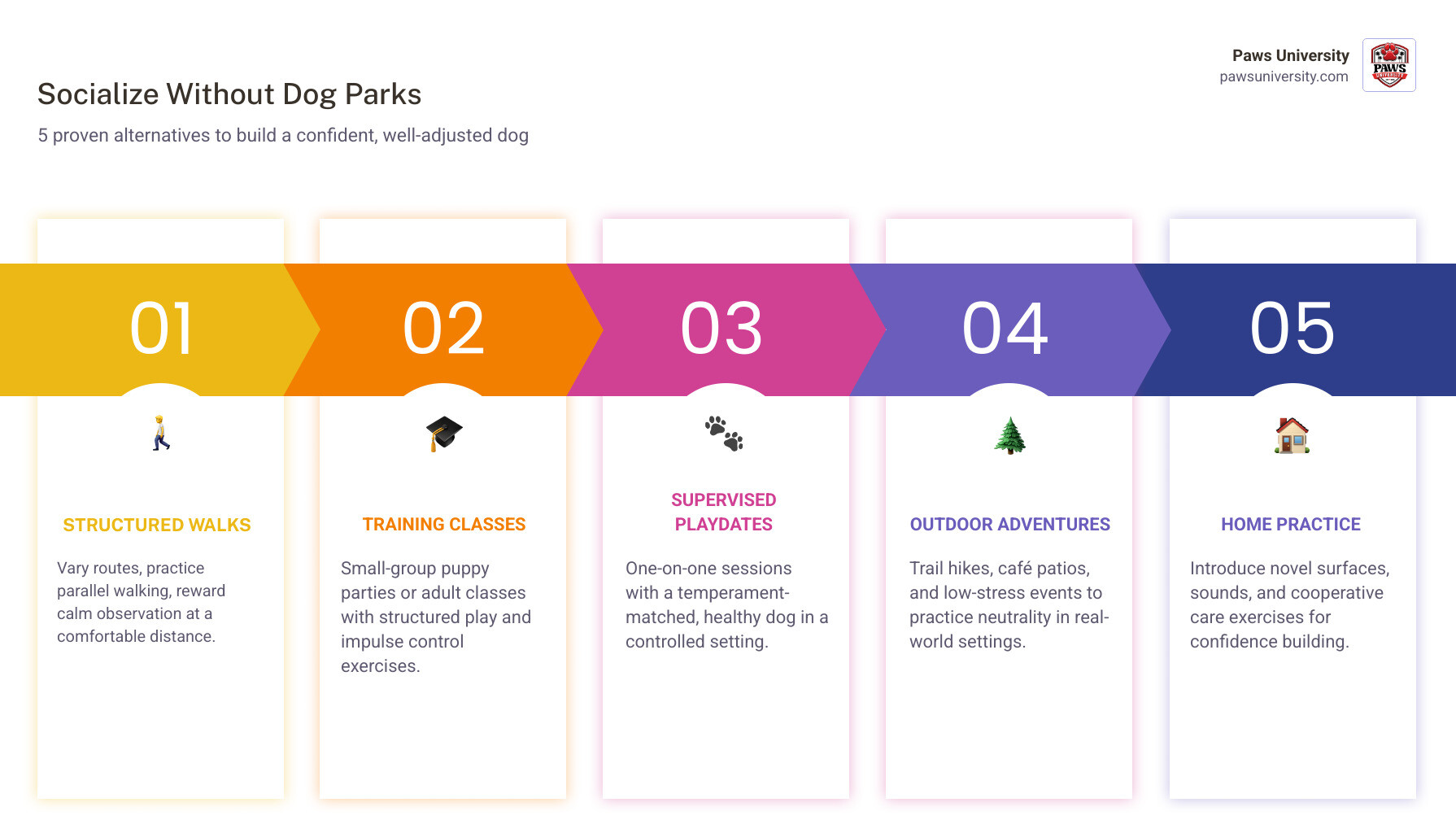
Structured neighborhood and trail walks are one of the most versatile tools for building environmental confidence. Rather than walking the exact same loop every morning, intentionally vary your walking routes, surfaces, and schedules. Introduce your dog to suburban cul-de-sacs, quiet downtown sidewalks, beach paths, and grassy parks during low-traffic hours.
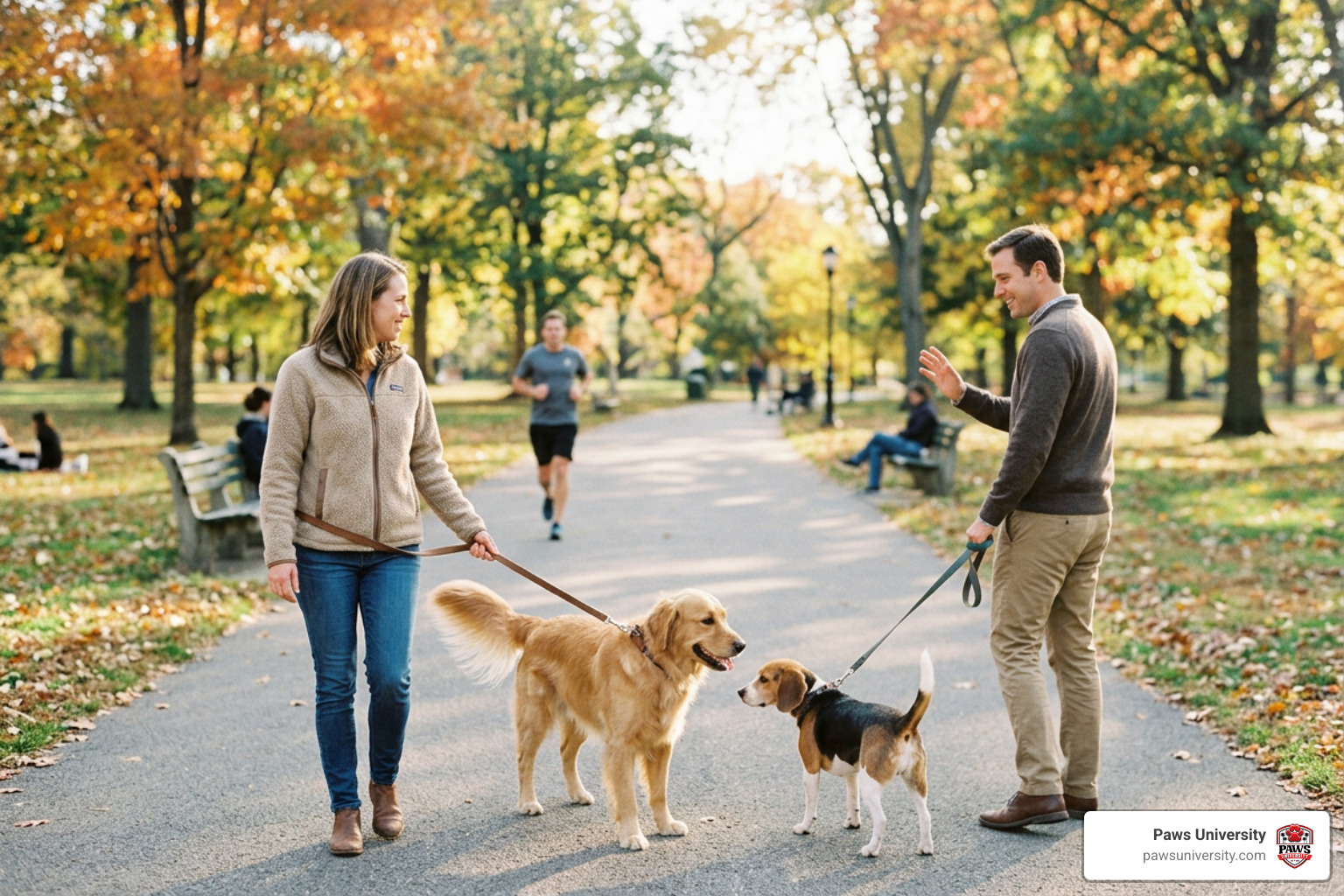
One powerful technique is parallel walking. Instead of allowing tense head-on greetings—which often trigger fear or frustration on a tight leash—walk alongside a calm, trusted canine companion at a safe distance (such as across the street or ten feet apart). Moving in the same direction allows dogs to absorb each other's scent and body language naturally without face-to-face social pressure.
During these walks, focus heavily on rewarding your dog for checking in with you and ignoring distractions. Consistently practicing loose leash walking builds strong leash manners and helps your dog associate outdoor stimuli with calm cooperation rather than pulling or frantic excitement.
Small-Group Training Classes and Puppy Parties
Enrolling in a structured group class or early puppy kindergarten provides social exposure under the watchful eye of a qualified instructor. Unlike the free-for-all nature of a dog park, a good training class teaches your dog how to focus on you and practice impulse control while other dogs work just a few feet away.
For young pups, specialized puppy parties with six or fewer participants offer an ideal setup. In these controlled settings, play is broken up into brief, monitored intervals paired with rest periods, ensuring no puppy gets bullied or overstimulated. Understanding the dynamics of social groups for dogs helps owners select age-appropriate classes that follow established puppy socialization methods centered entirely on positive reinforcement.
Supervised Dog Daycare and One-on-One Playdates
If your dog genuinely enjoys playing with other dogs, you do not have to rely on public parks to fulfill that social need. Private, one-on-one playdates in a securely fenced yard with a known, vaccinated dog allow you to hand-pick compatible companions based on play style, size, and energy level.
Another alternative is a professionally supervised dog daycare. High-quality daycare facilities screen every dog's temperament, enforce strict vaccination policies, group dogs by size and play style, and maintain low dog-to-staff ratios. Supervised daycare provides physical exercise and social enrichment while preventing the bullying behaviors common in unregulated parks. Reviewing a comprehensive checklist for socializing dogs with other dogs will help you evaluate whether a potential playmate or group setting matches your dog's temperament.
Outdoor Adventures and Low-Stress Dog-Friendly Events
Taking your dog on outdoor adventures—such as hiking shaded trails, visiting quiet outdoor garden centers, or relaxing near an open-air café patio—exposes them to varied sights, unusual smells, and novel sounds.

These outings provide an opportunity to practice the do nothing exercise for dogs. Find a comfortable bench or open grassy spot well away from main pedestrian paths, sit down, and simply reward your dog with high-value treats whenever they lie down, watch the world go by, and stay relaxed.
Pairing passive environmental exposure with solid obedience foundations, like mastering outdoor recall and leash manners, ensures your dog learns to navigate novel public spaces calmly and safely.
How to Socialize a Dog Without a Dog Park at Home
Socialization begins within your own home and yard. Pups and adult dogs need exposure to hundreds of non-canine stimuli to become truly resilient companions.
Create simple confidence-building courses using everyday household objects:
- Novel Surfaces: Encourage your dog to step across bubble wrap, textured rubber mats, crinkly tarps, metal grates, and wooden planks, rewarding each step with praise and treats.
- Auditory Enrichment: Play sound recordings of fireworks, thunderstorms, sirens, crying infants, and traffic at a barely audible volume while feeding meals, gradually increasing the volume over several weeks.
- Costumes and Gear: Wear hats, sunglasses, bulky raincoats, or carry open umbrellas, oversized boxes, and backpacks around the living room to normalize unusual human silhouettes.
- Cooperative Care: Gently handle your dog's paws, ears, tail, and muzzle, immediately pairing each touch with a delicious treat to prepare them for vet exams and grooming.
When introducing your dog to visitors and neighbors, keep greetings controlled and low-stress. Following proven steps for introducing dogs to new neighbors ensures your pet learns to greet novel humans politely on neutral ground without jumping or feeling cornered.
Adapting Socialization by Age and Reactivity Level
A dog's social needs and emotional thresholds change dramatically across their lifespan. Tailoring your approach to their specific developmental stage or behavioral history ensures lasting progress without setbacks.
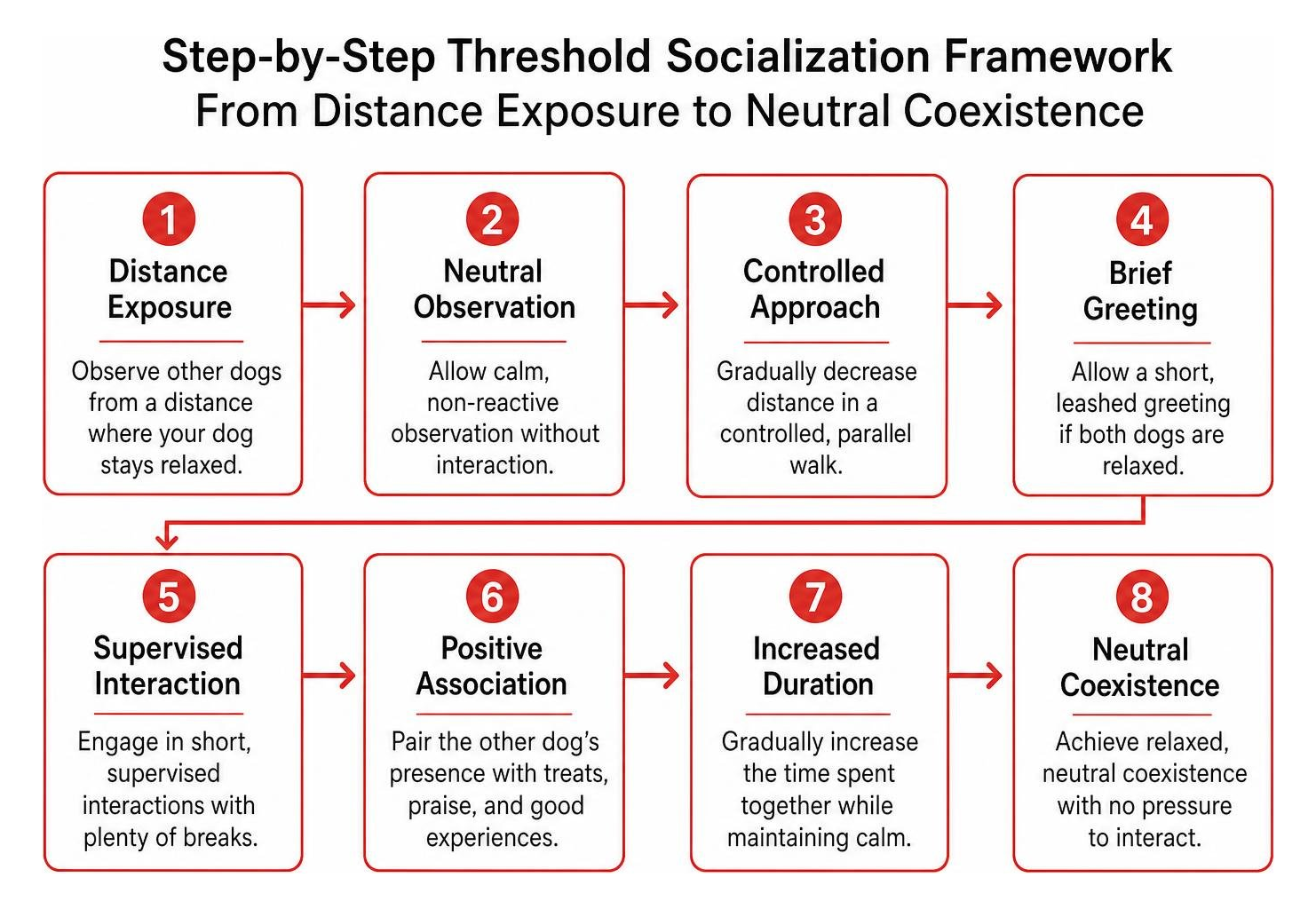
Following reputable puppy socialization guidance during early development, or referencing a practical guide to socializing adult dogs for mature rescues, keeps your training aligned with your dog's emotional capabilities.
Socializing Puppies vs. Adult Dogs
Puppies experience a critical, rapid socialization window between approximately 2.5 and 14 weeks of age (with the broader window closing between 16 and 20 weeks). During these early months, the brain is primed to accept novel experiences as safe. Early exposure must be gentle, varied, and positive. Experiencing a single traumatic event during this time—such as being attacked at a dog park—can result in lifelong fear.
Adult dogs, by contrast, reach social maturity between one and three years of age. Much like adult humans, socially mature dogs naturally become more selective about their social circles. Many adult dogs no longer desire rough play with unfamiliar dogs, preferring the company of a few trusted canine friends or simply coexisting peacefully. Understanding these differences through a dedicated puppy socialization guide for other dogs helps prevent unrealistic expectations for adult canine behavior.
Managing Leash Reactivity and Fearful Triggers
If your dog barks, lunges, or cowers when seeing other dogs on leash, dog parks are completely off the table. Reactivity is almost always driven by underlying fear, frustration, or past trauma.
Implementing a plan for safe socialization for reactive dogs relies on threshold management and classical counter-conditioning. A dog's "threshold" is the distance at which they can observe a trigger while remaining calm, accepting treats, and responding to basic cues.
By proactively calming fear reactivity before escalation and engaging your dog in games like the Look at That game, you teach them to look at a trigger, look back at you, and receive a high-value reward. Over time, their underlying emotional response shifts from panic or frustration to calm anticipation.
Essential Health, Safety, and Threshold Guidelines
When practicing socialization in public or semi-public spaces, keeping your dog physically healthy and emotionally safe is paramount.
Before introducing direct interactions with other dogs, consult your veterinarian to verify that core vaccinations (including rabies, distemper, parvovirus, and kennel cough) and parasite preventatives are up to date. Avoid socializing any dog that has shown recent signs of illness, lethargy, or gastrointestinal distress.
When supporting dogs with missed early socialization, learning to read subtle canine body language prevents accidental flooding and distress.
Subtle Canine Stress Signals to Monitor:
- Displacement Behaviors: Yawning when not tired, sudden scratching, intensive ground sniffing, or full-body "shake-offs" when no water is present.
- Early Visual Cues: Lip licking, looking away, showing the whites of the eyes ("whale eye"), a raised paw, or a stiffened tail held high or tucked tightly.
- Postural Shifts: A closed mouth with tightly held facial muscles, sudden freezing, pinned-back ears, or panting when the ambient temperature is cool.
- Escalated Distress: Barking, lunging, trembling, pacing, hiding behind your legs, or refusing high-value treats that the dog normally loves.
If you spot these early stress cues, do not correct or scold your dog. Simply create more distance from the trigger, allow their heart rate to settle, and resume your training at an easier intensity.
Frequently Asked Questions About Dog Socialization
What is the most effective way to socialize an unvaccinated puppy?
You do not have to wait until your puppy is fully vaccinated to begin socialization. Use minimal-contact exposure: carry your puppy in a sling or backpack, sit in your car with the windows cracked to observe traffic, sit on your front porch to watch neighbors walk by, and practice walking on various clean household surfaces. You can also host private playdates in your sanitized backyard with healthy, fully vaccinated adult dogs belonging to close friends.
Can an adult dog become well-adjusted without interacting with large groups of dogs?
Yes. A well-adjusted adult dog does not need a massive circle of canine acquaintances. Canine health and happiness stem from mental enrichment, physical exercise, secure attachment with their human family, and the ability to navigate public environments calmly. Neutral coexistence—where your dog can walk past other dogs without pulling, lunging, or freezing—is the gold standard of adult socialization.
How do I know if my dog is over threshold during a social outing?
Your dog is over threshold when their emotional arousal overrides their cognitive thinking. Common indicators include refusing high-value treats, completely ignoring familiar cues, exhibiting rigid body posture, trembling, frantically scanning the environment, or barking and lunging. If this occurs, calmly turn around, increase the distance between your dog and the stimulus, and give them time to reset.
Conclusion
Building a confident, well-adjusted canine companion does not require chaotic dog parks. By embracing structured neighborhood walks, positive-reinforcement classes, calm observation exercises, and carefully curated playdates, you protect your dog from physical illness and emotional trauma while teaching true environmental neutrality.
At Paws University, we have served as West Hawaii’s premier facility since 2002 on our seven-acre campus. As the first facility in the state for Doggie Daycare, our team provides supervised play that reduces behavior issues, premium pet boarding, and positive, reward-based training. Ready to build an unbreakable bond with your dog? Review our ultimate checklist for socializing dogs and start your journey toward calm, confident socialization today.