
Stop Separation Anxiety Barking With Three Calm, Consistent Changes
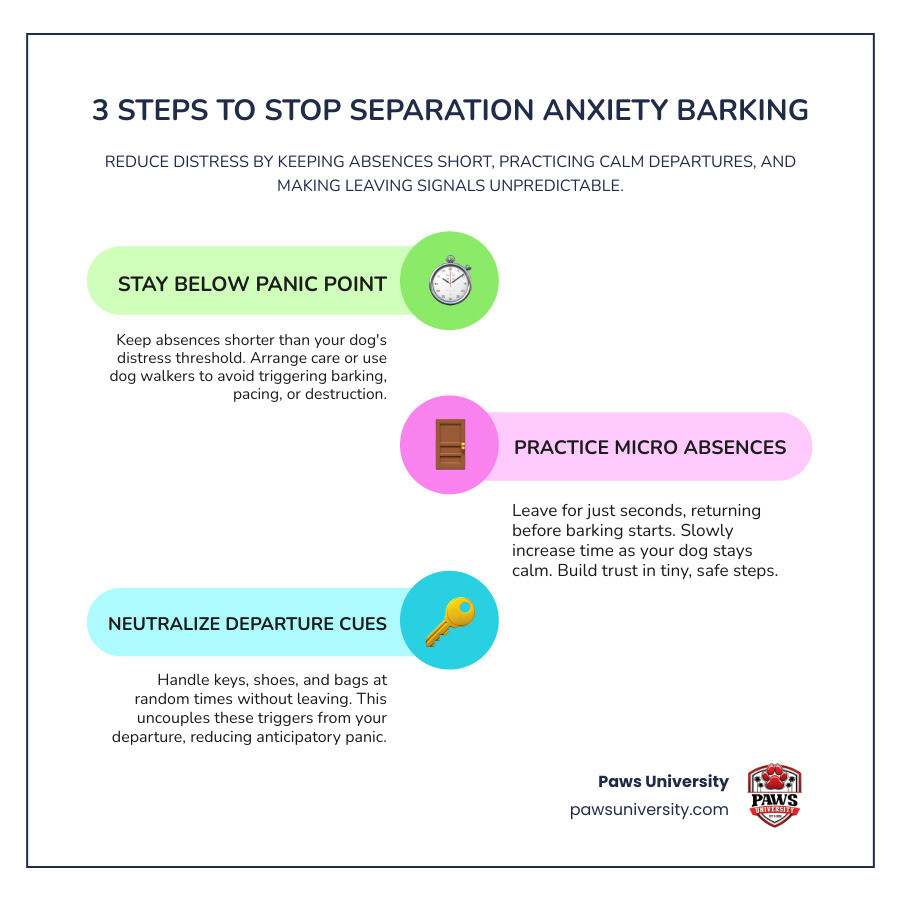
To reduce dog barking separation anxiety, do not try to silence the barking. Treat the fear behind it. Start with these three changes:
- Keep absences below your dog's panic point by arranging care when possible.
- Practice tiny, calm departures and return before barking, pacing, or scratching begins.
- Make leaving less predictable by handling keys, shoes, and bags without going anywhere.
Separation-related barking often begins soon after a dog is left alone and may continue with pacing, drooling, door scratching, destruction, or accidents. This is different from normal alert barking at a passing person or boredom that fades after a dog settles. Your dog is not being stubborn. They may be experiencing real distress.
The goal is not a quick fix. It is to help your dog learn, in safe small steps, that alone time is not dangerous. The three changes in this guide focus on lowering stress, removing scary departure signals, and building calm independence without punishment or a "cry it out" approach.
I’m Allen Daniels, a Hawaiʻi Island native and co-founder of Paws University. After more than 25 years training dogs with reward-based methods, including dogs struggling with dog barking separation anxiety, I have seen that steady, humane practice can make a meaningful difference.
Glossary for dog barking separation anxiety:
Understanding Dog Barking Separation Anxiety vs. Boredom
When a dog vocalizes while alone, it is essential to identify the underlying emotional state driving the behavior. Barking is communication, but the neurobiological state behind a bored bark is completely different from true isolation panic.
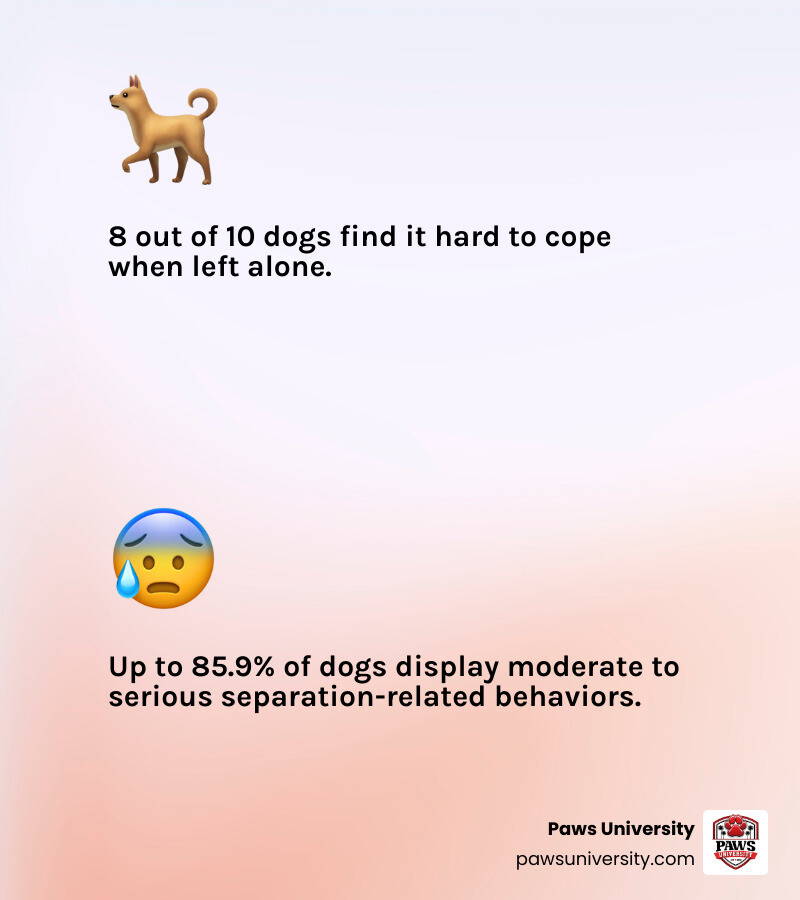
Research suggests that 8 out of 10 dogs find it hard to cope when left alone, and up to 85.9% of dogs display moderate to serious separation-related behaviors. When left without direction, bored dogs look for opportunistic fun—chewing a stray slipper, rummaging through a trash bin, or barking intermittently when a neighbor walks past the window.
In contrast, separation distress is an involuntary physiological panic response. When an attachment figure leaves, the dog’s sympathetic nervous system activates, flooding their bloodstream with stress hormones like cortisol and adrenaline. Vocalization becomes persistent, repetitive, and frantic, often characterized by a repetitive cycle of high-pitched yelps, sustained barking, and mournful howling.
The table below outlines the core behavioral differences between these two states:
| Observable Trait | Boredom Barking | Separation Anxiety Barking |
|---|---|---|
| Onset Time | Occurs intermittently throughout the day | Begins within 1 to 30 minutes of departure |
| Vocal Pattern | Pauses, investigates surroundings, barks again | Monotonous, frantic, continuous barking or howling |
| Appetite Response | Readily eats treats and finishes food puzzles | Ignores high-value food or refuses to eat entirely |
| Accompanying Body Language | Relaxed between barks, exploratory posture | Dilated pupils, trembling, pacing, sweaty paw prints |
| Exit Behaviors | Dispersed play, opportunistic chewing | Scratching, clawing, or chewing at entry doors/windows |
| Post-Arrival State | Happy greeting, easily settles after a few minutes | Extreme, frantic greeting lasting 15+ minutes |
For a formal evaluation of chronic distress, reviewing the clinical diagnosis of separation anxiety can help you determine whether your dog is experiencing medical or severe psychological barriers.
How to Identify Dog Barking Separation Anxiety Triggers
Recognizing true separation distress requires looking beyond vocalization. Because dogs are social animals, the loss of an attachment figure triggers an array of autonomic stress responses.
Key signs that point to separation anxiety include:
- Pre-departure agitation: Whining, pacing, panting, or shadowing you room-to-room as you prepare to leave.
- Exit-point destruction: Clawing at door frames, chewing windowsill trims, or digging into carpets near exterior entrances.
- Anorexia during isolation: Leaving high-value meats, cheeses, or stuffed chews completely untouched until you return home.
- Autonomic stress indicators: Heavy drooling (ptyalism), sweaty paw pads leaving damp tracks on hard floors, and stress yawning.
- Prolonged hyper-arousal on return: Greeting you with overwhelming frenzy that takes an extended period to settle.
Reviewing practical Dog Anxious When Leave Tips can give you immediate, day-to-day management ideas to help soothe early distress signals.
Medical and Behavioral Differential Diagnoses
Before starting a behavior modification program, rule out underlying medical issues and separate behavioral problems:
- Medical Incontinence and Gastrointestinal Distress: A dog experiencing a urinary tract infection (UTI), bladder stones, or age-related incontinence may soil the house indoors, causing secondary distress. Severe anxiety can also lead to acute stress-related colitis.
- Cognitive Dysfunction Syndrome (CDS): In senior dogs, disorientation, night waking, and vocalization may stem from canine cognitive decline rather than primary separation distress.
- Environmental Alert Barking: Dogs reactive to visual or auditory outside triggers (such as delivery trucks, street traffic, or wildlife) bark in response to external events rather than the isolation itself.
- Barrier Frustration: Some dogs tolerate solitary confinement in an open living space but panic when enclosed behind a solid door, gate, or crate.
Consult standard veterinary behavior guidelines to confirm that physical health conditions are ruled out before addressing behavioral distress.
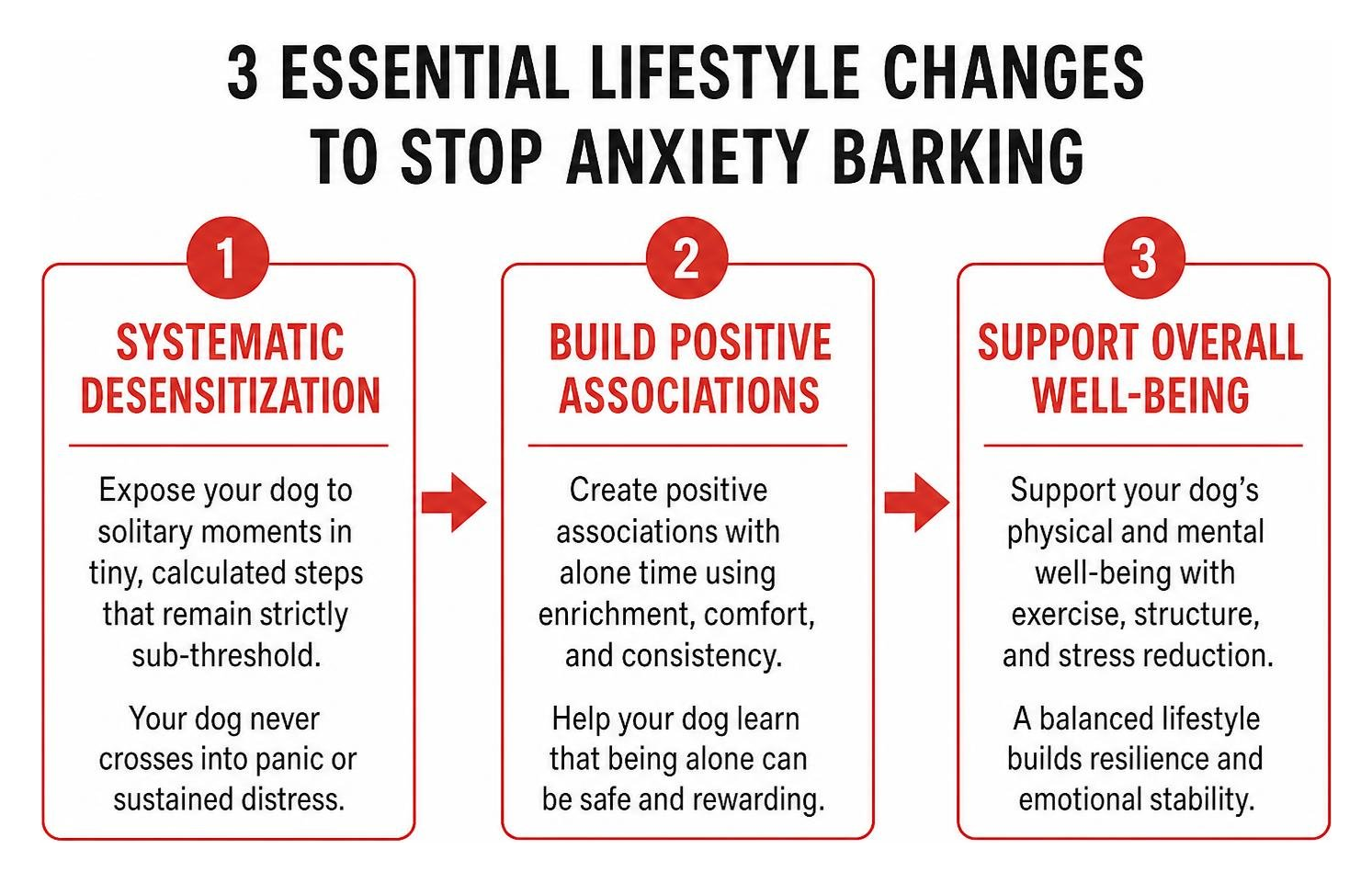
3 Essential Lifestyle Changes to Stop Anxiety Barking
Resolving anxiety-induced barking requires addressing the underlying emotional panic rather than merely trying to stop the noise. By systematically adjusting how your dog experiences isolation, you can rewire their emotional response from dread to calm neutrality.
Change 1: Systematic Desensitization for Dog Barking Separation Anxiety
Systematic desensitization is the gold standard for treating separation distress. This process exposes your dog to solitary moments in tiny, calculated steps that remain strictly sub-threshold—meaning your dog never crosses into panic or sustained distress.

The desensitization process follows these core steps:
- Establish a Baseline: Determine exactly how long your dog can remain calm alone before showing subtle stress signs (lip licking, pacing, vigilant staring at the door). If distress begins at 30 seconds, your starting training duration is 5 to 10 seconds.
- Practice Micro-Absences: Step out of sight behind an interior door or exterior door for a brief, safe duration. Return calmly while your dog is still completely relaxed.
- Vary Departure Times: Rather than increasing the time in a straight line, mix short durations with slightly longer ones (e.g., 10 seconds, 15 seconds, 5 seconds, 20 seconds). This prevents anticipatory anxiety.
- Tackle the Critical Milestone: Most anxious responses peak during the initial period of solitude. The 40-minute mark represents a significant milestone in behavior modification. Once a dog comfortably tolerates 40 to 90 minutes of calm isolation, scaling up to normal half-day routines is generally much smoother.
For dogs experiencing severe over-arousal, using The Ultimate Guide to High Anxiety Dog Training provides foundational exercises for emotional regulation.
Change 2: Pre-Departure Routine and Cue Neutralization
Dogs are keen observers. They quickly learn the sequence of actions leading up to your departure: picking up keys, putting on work shoes, gathering a purse or backpack, and turning off lights. These pre-departure cues serve as conditioned triggers that cause cortisol to spike before you even step outside.
To neutralize these triggers:
- Uncouple the Cues: Perform departure rituals throughout the day without actually leaving. Pick up your car keys and sit on the couch. Put on your heavy jacket, walk into the kitchen to grab a glass of water, and take the jacket off.
- Maintain Neutral Departures and Arrivals: Emotional goodbyes and enthusiastic greetings reinforce the idea that leaving and returning are high-stakes events. Keep departures calm and quiet. Upon returning home, greet your dog with low-key affection only after their arousal level has settled.
- Teach an Independent Settle: Train your dog to settle quietly on a designated mat or bed while you move around the room, rewarding sustained calm with gentle praise and rewards.
For clinical guidance on breaking anticipatory stress loops, review treatment protocols for separation distress.
Change 3: Threshold Management and Daily Enrichment
Behavior modification cannot succeed if a dog experiences full-blown panic episodes between training sessions. Every time a dog enters a state of panic, elevated stress hormones can remain in the body for days, resetting behavioral progress.

Threshold management relies on two primary pillars:
- Absence Suspension: In the early stages of training, suspend unmanaged solitary time. Use dog sitters, family members, or dog daycare so your dog is not pushed past their coping limit while learning.
- Sensory and Physical Enrichment: Physical exercise helps expend excess energy, but it should be paired with mental enrichment. Chewing and licking stimulate the vagus nerve and promote calming neurochemicals. Provide frozen lick mats or safe food puzzles before departures to encourage calm settling.
For broader routine frameworks, consult our Ultimate Guide to Managing Separation Anxiety in Dogs.
Additional Interventions: Confinement, Medication, and Professional Care
Complex separation distress often requires a multimodal approach that pairs environmental design with veterinary support.
Evaluating Crating and Safe Spaces
While crate training is valuable for general management, confinement can worsen panic for dogs with true separation anxiety. Barrier frustration and claustrophobia frequently co-occur with separation-related disorders.
If your dog pants frantically, claws at the crate door, drools excessively, or attempts to bite the wire mesh, strict crate confinement is contraindicated. Forcing confinement on an anxious dog can lead to broken teeth and torn pads.
Instead:
- Set up a dog-proofed safe room partitioned with a tall, secure baby gate.
- Use exercise pens to create an open, low-stress boundary.
- If your dog finds natural comfort in a den-like space, refer to Crate Training Teaching Your Dog to Love Their Space to build positive associations using strictly rewards-based methods, and avoid long confinement periods.
Veterinary Behavioral Support and Medication
For moderate to severe cases, behavioral modification alone may not be enough if a dog remains in a continuous state of high arousal. In a state of sheer panic, the brain cannot process new associations or learn that solitude is safe.
A veterinarian can prescribe behavioral medications to help:
- Daily Maintenance Medications: Selective serotonin reuptake inhibitors (SSRIs) like fluoxetine or tricyclic antidepressants (TCAs) like clomipramine help balance neurochemistry over several weeks, establishing a calm baseline.
- Fast-Acting Situational Aids: Short-term medications can be administered prior to planned departures to reduce acute panic while long-term training takes root.
Medication is not a sedative or a substitute for training; it is a compassionate tool that lowers panic so true learning can occur.
What to Avoid When Treating Separation Distress
Treating separation anxiety requires patience and empathy. Using the wrong techniques can heighten fear and prolong recovery.
Avoid these common approaches:
- Punishment or Scolding: Never scold, shout at, or punish a dog for barking, accidents, or destructive behavior upon your return. The dog cannot connect your anger with an action that happened earlier. Punishment makes your return unpredictable and frightening, worsening departure panic.
- Aversive Anti-Bark Collars: Shock, citronella, or vibration collars may suppress barking temporarily through fear, but they do not resolve the underlying terror. Suppressing vocal warnings often redirects panic into severe self-harm or gastrointestinal distress.
- The "Cry It Out" Method: Forcing a dog to panic until they stop barking causes profound physiological distress and can lead to learned helplessness—a state where the dog shuts down emotionally while remaining in severe internal turmoil.
- Dramatic Goodbyes: Lengthy, emotional departures alert your dog that something stressful is about to happen, priming their nervous system for distress.
Frequently Asked Questions About Separation Distress
How can I tell if barking is caused by boredom or separation anxiety?
Separation anxiety barking typically starts within minutes of departure, remains persistent and monotonous, and is accompanied by distress signals such as pacing, panting, refusal to eat high-value treats, and scratching at exit doors. Boredom barking is usually intermittent, triggered by external sounds or sights, and pauses when the dog finds another activity or settles down to sleep.
Should I let my dog cry it out when left alone?
No. Dogs do not naturally outgrow separation panic by being left to cry. Prolonged distress spikes cortisol levels, increases heart rate, and reinforces the belief that being alone is dangerous. Effective progress requires gradual desensitization that keeps the dog calm and sub-threshold.
How long does it take to resolve separation anxiety vocalization?
Because separation anxiety is an emotional disorder rather than a simple obedience issue, recovery timelines vary depending on severity, genetics, and consistency. Mild cases may show marked improvement within several weeks of consistent sub-threshold practice, while moderate to severe cases often require several months of systematic desensitization paired with veterinary guidance.
Conclusion
Helping a dog overcome separation anxiety barking requires compassion, patience, and consistency. By managing absence thresholds, neutralizing departure triggers, and building solitary confidence in small increments, you can help your dog learn that being alone is safe.
If you live in West Hawaii, our seven-acre campus in Hawaii County provides premium, reward-based environments designed to support your dog's social development. Explore our supervised dog daycare programs to help maintain threshold management while giving your companion engaging, safe socialization in a warm island setting.