Essential Foundations: When to Start and What to Teach First
To teach puppy obedience effectively, use short 3 to 5 minute positive reinforcement sessions that pair marker words with immediate food rewards to guide core behaviors. Puppies can start learning simple cues as early as 7 to 8 weeks old by luring them into position, marking the exact moment of success within 1 to 2 seconds, and practicing foundational habits like name recognition, sit, down, and recall in quiet environments before adding distractions.
The primary socialization window for puppies begins early and starts closing around 12 to 16 weeks of age. During this period, their brains are uniquely wired to absorb novel experiences, adapt to unfamiliar stimuli, and form positive associations that shape lifelong behavior. Engaging in early puppy training builds reliable habits without causing the fear, stress, or avoidance associated with aversive corrections.
Because young puppies have short attention spans, practicing before meals ensures high motivation. As outlined in the VCA Animal Hospitals guide on puppy behavior and training, using a marker word like "yes!" pinpoints the exact moment of success so your puppy understands precisely which action earned the reward.
Key First Priorities and Order of Learning
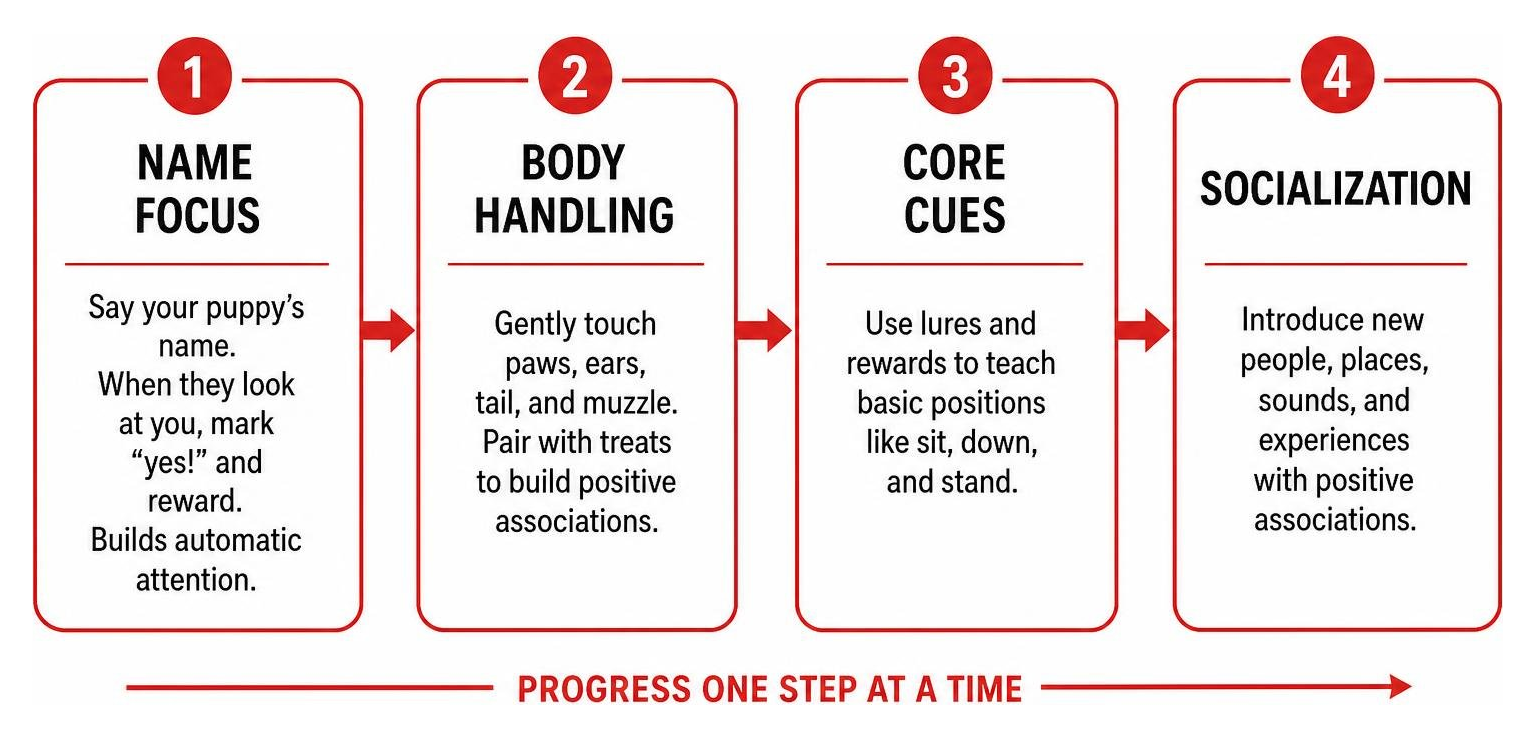
Before teaching formal cues, focus on core communication, body awareness, and routine management. The best learning order prioritizes foundational life skills:
- Name Recognition and Eye Contact: Say your puppy's name in a cheerful tone. The moment they turn their head to look at you, mark with "yes!" and deliver a treat. This builds automatic attention.
- Lure and Reward Fundamentals: Teach your puppy to follow a treat held in your fingers. This guiding movement makes teaching positions like sit, down, and stand seamless.
- Gentle Body Handling: Pair gentle touches to their paws, ears, tail, and muzzle with high-value treats so future veterinary exams and grooming sessions are stress-free.
- Alone Time Conditioning: Teach your puppy that being separated by a barrier or resting in a playpen is safe and relaxing, preventing distress and separation anxiety.
- House Boundaries and Potty Rhythms: Set up a designated relief zone outdoors and establish regular bathroom trips around waking, eating, and playing.
When teaching basic manners, keeping sessions structured and stress-free helps you make rapid progress, as detailed in our quick puppy obedience training overview.
The Step-by-Step Blueprint: How to Teach Puppy Obedience with Core Cues
Teaching obedience skills relies on three primary techniques:
- Luring: Guiding your puppy into position using a small treat held directly in front of their nose.
- Capturing: Waiting for your puppy to offer a natural behavior (such as lying down), marking it instantly, and delivering a treat.
- Shaping: Rewarding small, progressive approximations toward a complete behavior until the final action is achieved.
When luring, fade the food lure quickly. After five to eight successful repetitions, use an empty hand with the same motion to prompt the posture, rewarding from your treat pouch or opposite hand once they comply. This prevents the puppy from responding only when food is visibly present. For a deeper breakdown of these fundamentals, explore teaching puppy obedience basics.
| Positive Reinforcement Practice | Common Training Pitfall to Avoid |
|---|---|
| Marking and treating within 1–2 seconds of the behavior | Repeating verbal cues multiple times before the dog acts |
| Keeping sessions to 3–5 minutes multiple times a day | Training for 20+ minutes until the puppy becomes overtired |
| Using high-value, pea-sized rewards to maintain interest | Relying on physical force, leash pops, or verbal intimidation |
| Fading food lures into simple hand signals within a few reps | Only practicing in quiet rooms without proofing distractions |
Building Focus: How to Teach Puppy Obedience Foundation Cues at Home
Start practicing these core foundation cues in a quiet room with minimal distractions:
1. Sit
Hold a small treat near your puppy's nose. Slowly raise the treat up and slightly back over their head. As their nose follows the treat upward, their rear naturally lowers to the floor. The instant their bottom touches the ground, mark with "yes!" and give the treat. Once they follow the hand motion reliably, add the verbal cue "sit" right before moving your hand.
2. Default Down
From a seated or standing position, hold a treat at your puppy's nose, then lower your hand straight down between their front paws and pull it slowly outward along the floor in an "L" shape. When their elbows touch the floor, mark and reward. A default down teaches puppies to settle automatically rather than jumping up when waiting.
3. Stay
Ask your puppy to sit or lie down. Hold a flat hand toward them and say "stay." Wait just two seconds, mark, reward while they are still in position, and give a clear release word such as "free!" or "break!" Gradually increase the duration by a few seconds at a time before adding small steps of physical distance.
4. Recall ("Come")
Start indoors just a few feet away. In an upbeat voice, say your puppy's name followed by "come!" Open your arms wide. As they rush toward you, mark the moment they reach your legs and reward them with multiple small treats while gently holding their collar. Never call your puppy to you for unpleasant tasks like nail trims or baths; go to them instead so recall remains purely positive.
5. Leave It
Hold a treat in a closed fist. Your puppy will sniff, lick, or paw at your fingers. Remain still and patient. The moment your puppy pulls their nose back even an inch, mark and give a different high-value treat from your other hand. They quickly learn that looking away from an item is the key that unlocks rewards.
Real-World Practice: How to Teach Puppy Obedience in Distracting Environments
Once your puppy responds reliably in a quiet living room, it is time to "proof" their behaviors using the 3 Ds: Duration, Distance, and Distraction.
Work on only one parameter at a time. If you increase the physical distance between you and your puppy, reduce the required stay duration. If you introduce a distracting environment—such as an open grassy lawn—step closer and use higher-value rewards to keep their focus.
Prior to the completion of all puppy vaccinations, safe environmental exposure is essential. You can carry your puppy in a sling or wagon, sit on an outdoor blanket, or park near a busy area to observe sights and sounds safely from the back of your car. Exposing your pup to varied surfaces like grass, gravel, concrete, and wood helps build environmental confidence. For a structured approach to early exposure, follow our puppy socialization methods.
Daily Management: Potty Routines, Crate Training, and Bite Inhibition
A predictable daily schedule prevents unwanted behaviors before they start. Most puppies become reliably house-trained between 4 and 6 months of age when provided with consistent routines and active supervision.
House-Training Mechanics
Young puppies need bathroom breaks immediately after waking up, within 15 minutes of eating or drinking, and after every energetic play session. Take your puppy outside on a leash directly to a designated spot. Stand quietly, give them a few minutes to eliminate, and reward them immediately with praise and a treat outside the moment they finish. Never punish indoor accidents; clean the spot thoroughly with an enzymatic cleaner to remove lingering scent cues.
Positive Crate Conditioning
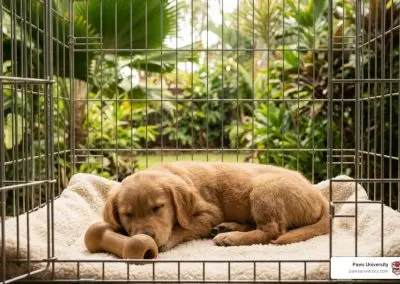
A crate functions as a secure resting den when introduced properly. Begin by leaving the crate door open, tossing high-value treats inside, and feeding meals near the back of the crate. Provide safe enrichment items, such as rubber chew toys stuffed with frozen kibble, to build positive associations with downtime.
Always ensure your puppy has had a bathroom break, exercise, and hydration before settling into their crate, and avoid overly long confinement periods during daytime hours. Learn more about positive crate setups in our dedicated crate training guide.
Teaching Bite Inhibition and Soft Mouth
Puppies explore the world with their mouths, and play nipping is entirely normal puppy behavior. However, they must learn bite inhibition—how to control the force of their jaws—before adult teeth and stronger muscles develop.
When your puppy bites skin or clothing too hard:
- Make a calm, high-pitched "ouch!" sound and pause all interaction for 5 to 10 seconds.
- If they continue to mouth excitedly, calmly stand up and step out of reach.
- Once they calm down, redirect their energy toward an appropriate rubber chew toy or rope.
- If mouthing becomes frantic, it often signals the puppy is overtired; guide them to a quiet space for a nap.
For step-by-step guidance on nipping, see our article on how to stop puppy mouthing and biting.
Navigating Common Challenges: Adolescence, Walking, and Choosing Classes

Loose-Leash Walking
Puppies naturally pull when on a leash because humans walk slower than a dog's normal pace. To teach loose-leash walking, reward your puppy frequently for keeping the leash slack and walking alongside you.
The moment the leash goes taut, stop in your tracks and become a stationary post. Wait for your puppy to turn back or loosen tension, mark that check-in, and resume moving forward. Practicing in low-distraction areas first sets your puppy up for success, as explained in our guide to mastering leash walking.
Managing Adolescent Regressions
Between 5 and 12 months of age, hormonal surges and developmental shifts lead to the adolescent phase. You may notice temporary regressions where your puppy seems to ignore familiar cues or tests boundaries.
Do not get frustrated. Return to basics: shorten training intervals, increase reward value, practice on a long line outdoors, and provide plenty of mental stimulation through food puzzles and sniffing walks. You can track age-appropriate growth milestones by reviewing Petful's developmental puppy training timeline.
Dog Trainer vs. Behaviorist: Choosing the Right Path
Understanding the difference between canine professionals helps you make the best choice for your dog:
- Dog Trainers: Focus on teaching observable skills, foundation obedience cues, leash manners, and polite household habits using reward-based methods.
- Veterinary Behaviorists: Specialize in diagnosing and treating complex emotional disorders, such as severe separation anxiety, phobias, or pathological aggression.
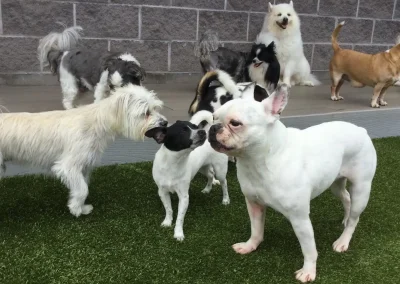
When evaluating puppy obedience classes, look for small group sizes, clean facilities, and instructors who use strictly positive, reward-based techniques. Well-run group classes provide controlled peer socialization where puppies learn bite inhibition and appropriate body language under expert supervision.
Frequently Asked Questions About Puppy Training
When is the best age to start teaching basic obedience to a puppy?
You can start teaching basic obedience the day you bring your puppy home, typically around 8 weeks of age. Early learning focuses on foundational skills like name response, gentle handling, crate comfort, and potty schedules. Puppies learn best between 6 and 16 weeks old, making this window the ideal time to establish lifelong good habits.
How do I stop my puppy from biting hands and clothes during play?
Teach bite inhibition by interrupting hard bites with a soft "ouch," immediately freezing your movement, and redirecting your puppy's attention to an approved chew toy. If your puppy remains overly mouthy, they may be overtired or overstimulated. Place them in their quiet rest area with a safe chew item for a nap.
Should I train my puppy on my own at home or attend group classes?
A combination of both delivers the best results. Home training allows your puppy to master basic cues in a calm, low-distraction environment. Group classes provide professional guidance, proofing around real-world distractions, and safe, supervised social interactions with other puppies that home training alone cannot replicate.
Conclusion
Teaching puppy obedience is an ongoing journey built on patience, positive reinforcement, and consistent daily practice. By keeping training sessions short, rewarding wanted behaviors instantly, and prioritizing early socialization, you establish clear communication and a lifelong bond of trust with your dog.
Whether working on foundation cues at home or enrolling in structured comprehensive puppy training programs, following reward-based guidance ensures your puppy develops into a confident, well-mannered companion.