What Is Dog Aggression Training — And Does It Actually Work?
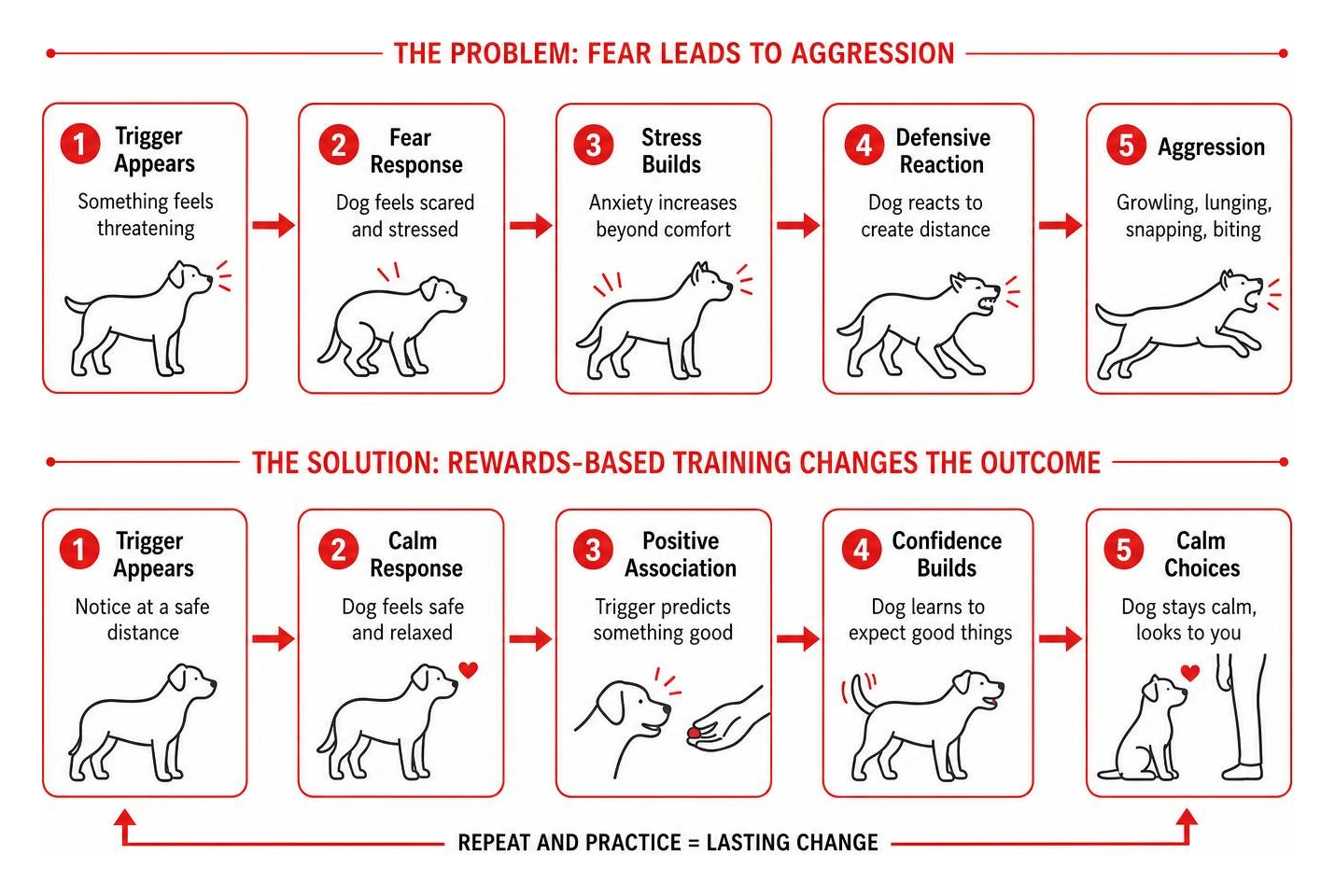
Dog aggression training is the process of identifying why your dog reacts aggressively and using structured, rewards-based methods to change that behavior safely and humanely. The short answer to whether it works? Yes — for most dogs, it does.
Here's a quick overview of what effective dog aggression training involves:
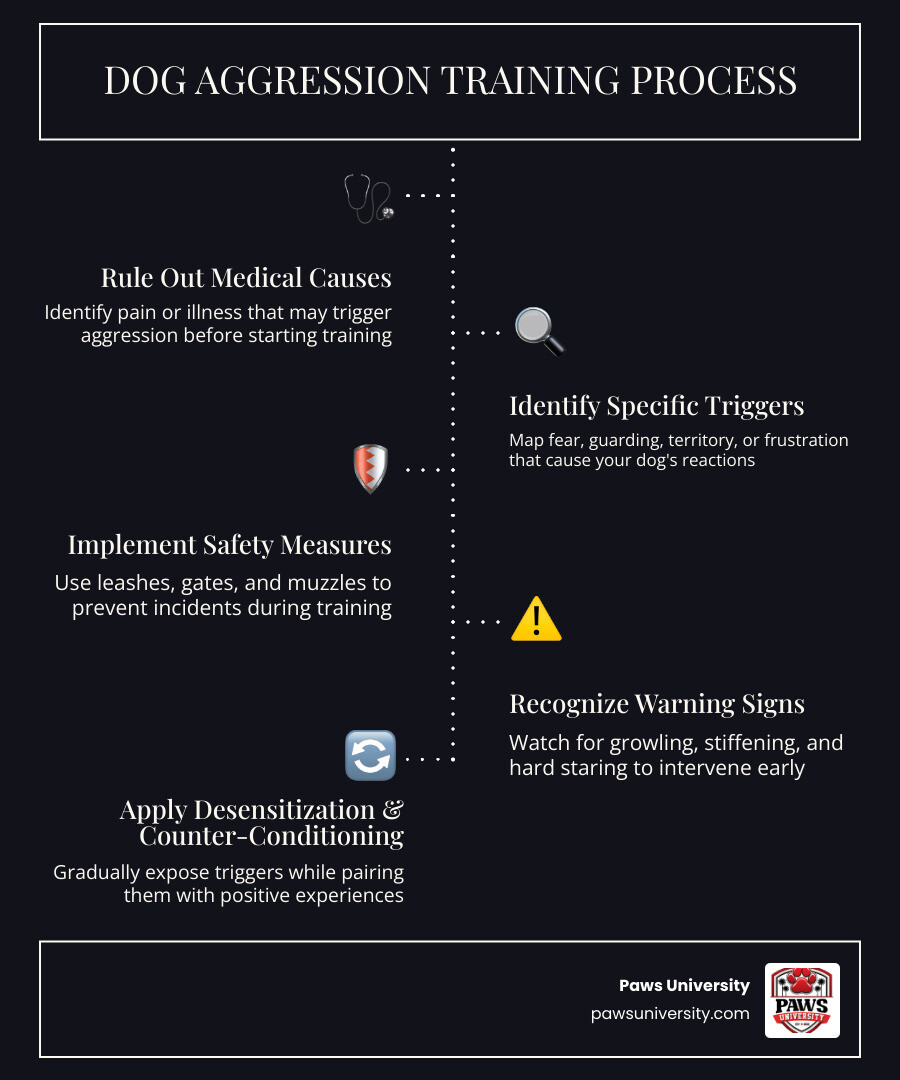
- Rule out medical causes — pain and illness can trigger aggression
- Identify your dog's specific triggers — fear, resource guarding, territory, or frustration
- Put safety measures in place — management tools like leashes, gates, and muzzles
- Learn your dog's early warning signs — growling, stiffening, hard staring
- Use desensitization — gradual, controlled exposure to triggers at a safe distance
- Apply counter-conditioning — pair triggers with positive experiences to change the emotional response
- Work with a professional — for moderate to severe cases, expert guidance matters
Aggression is not a personality flaw. It's a behavior — one that dogs develop when they feel threatened, confused, or unsafe. And behaviors can be changed.
I'm Allen Daniels, co-founder of Paws University in Kailua-Kona, and I've spent over 25 years applying the same operant conditioning principles I first learned as a professional dolphin trainer to dog aggression training and other behavioral challenges. Whether you're dealing with a dog that snaps at guests or lunges on the leash, the steps ahead will give you a clear, science-backed path forward.
Dog aggression training terms simplified:
- how can i stop my dog attacking other dogs
- how do i stop my dog growling at other dogs
- how to correct leash reactivity
Understanding Canine Aggression vs. Reactivity

When your dog is barking hysterically, lunging at the end of the leash, or baring their teeth, it is easy to assume they are "aggressive." However, as professional behavior consultants, we must distinguish between true aggression and reactivity. Confusing these two terms can lead to incorrect training strategies, which can make the problem worse.
A reactive dog overreacts to normal, everyday stimuli that other dogs would ignore. This hyper-arousal is often rooted in a lack of socialization, past traumatic experiences, or frustration (such as being restricted by a leash). A reactive dog might bark, lunge, and growl, but their primary goal is usually to create distance or express frustration, rather than to cause physical harm.
An aggressive dog, on the other hand, displays behaviors with an intent to threaten or cause physical harm. True aggression is a serious behavioral issue, but it is rarely a fixed personality trait. Instead, it is a functional behavior used to resolve a perceived threat when a dog feels their safety, territory, or valued resources are in jeopardy. According to the Dogs and Canines behaviour | RSPCA - RSPCA - rspca.org.uk , aggression is an outward expression of an internal emotional state—typically fear, anxiety, or pain.
To help you understand where your dog falls, let's look at a quick comparison:
| Feature | Reactive Behavior | Aggressive Behavior |
|---|---|---|
| Primary Emotion | Frustration, over-excitement, or mild fear | Deep fear, self-defense, or resource protection |
| Intent | Wants to move away, make the trigger leave, or access a stimulus | Intends to bite, pin, or physically deter the trigger |
| Off-Leash Behavior | Often friendly or tolerant when free of barriers | Continues to show warning signs or threat behaviors |
| Body Language | High arousal, bouncy lunging, vocalizing | Stiff posture, hard staring, lip curling, snapping |
To prevent these behaviors from escalating, we must recognize the signs of a struggling dog early. Many dogs labeled "unpredictable" are actually giving off subtle warning signs that their owners miss. For instance, a dog might freeze, stare intensely, show the whites of their eyes (whale eye), tuck their tail, or lick their lips. If we ignore these warning signs, the dog learns that their quiet communication does not work, forcing them to escalate to growling, snapping, or biting.
If you are noticing these early signals, it is a clear sign your dog needs help. You can read more about these developmental warning signs in our Signs of a Poorly Socialized Dog: Essential Guide.
The 7-Step Guide to Dog Aggression Training

When addressing aggressive behavior, we must follow a structured, step-by-step framework. Trying to rush the process or skipping ahead will only stress your dog and compromise safety. Here is our proven 7-step guide to dog aggression training using 100% positive reinforcement and rewards-based techniques.
Step 1: Rule Out Medical Causes
Before starting any behavioral modification plan, you must schedule a comprehensive veterinary exam. Sudden aggression is frequently triggered by underlying physical discomfort, such as arthritis, dental disease, thyroid imbalances, or soft tissue injuries. A dog in pain has a much lower tolerance threshold and is far more likely to snap or growl to protect themselves. If your dog is hurting, no amount of training will resolve the behavior until the pain is managed.
Step 2: Establish Immediate Safety and Environmental Management
Safety is our absolute priority. You must prevent your dog from practicing the aggressive behavior. Every time your dog lunges, growls, or bites, the behavior is reinforced—either because the trigger retreats (negative reinforcement) or because of an adrenaline rush. Use physical barriers like baby gates, secure doors, or a well-fitted harness. For detailed advice on keeping your home secure, consult the guidance on Dog Behavior Problems - Aggression - Getting Started - Safety and Management | VCA Animal Hospitals .
Step 3: Identify Triggers and Thresholds
Keep a detailed log of every incident. Note what triggered the reaction (e.g., a stranger, another dog, a loud noise), how close the trigger was, and what your dog's body language looked like before they reacted. Your dog's "threshold" is the distance at which they notice the trigger but can still remain calm and accept treats. Our goal is to always train below this threshold.
Step 4: Stop Using Punishment and Aversive Tools
Using choke chains, prong collars, e-collars, or physical corrections to address aggression is incredibly dangerous. While punishment might temporarily suppress the outward behavior (like growling), it does not change how the dog feels about the trigger. In fact, it pairs the scary trigger with physical pain, making the dog even more fearful and aggressive. Punishing a growl is like removing the alarm on a smoke detector—eventually, the dog will bite without warning. To understand how to handle these vocal warnings safely, read our guide on How to Stop Dog Growling: 7 Methods That Guarantee Results.
Step 5: Implement Desensitization (Gradual Exposure)
Desensitization means exposing your dog to their trigger at a very low intensity—usually at a great distance—where they do not react. For example, if your dog is aggressive toward other dogs, you might start training at the far end of a large outdoor field where another dog is visible but poses no perceived threat. Gradually, over days or weeks, you will decrease the distance, always keeping your dog relaxed.
Step 6: Apply Counter-Conditioning (Changing Emotional Associations)
While desensitizing your dog, you will use counter-conditioning to change their emotional response from negative (fear/anger) to positive (joy/relaxation). The moment the trigger appears at a safe distance, feed your dog high-value treats (like roasted chicken or hot dogs). When the trigger disappears, the treats stop. Over time, your dog learns: "Other dogs appearing means I get delicious chicken!" This shifts their conditioned emotional response from fear to happy anticipation.
Step 7: Practice Daily Management and Build Structure
Consistency is key to reducing overall stress. Ensure your dog has a predictable daily routine with plenty of physical exercise and mental stimulation (such as puzzle toys and snuffle mats). A structured lifestyle reduces frustration and builds a strong bond of trust between you and your dog. For more tips on creating a peaceful home environment, check out our resource on Reducing Dog Behavior Issues Without Pulling Your Hair Out.
Managing Aggression in Specific Environments
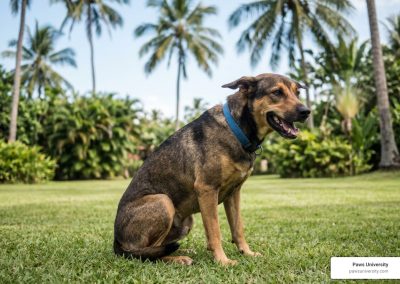
Aggressive behavior is highly context-specific. A dog who is perfectly relaxed lounging on a lanai in Hawaii County might become highly reactive when restricted by a leash or when a stranger enters their territory. To manage these situations, we must understand how environmental factors and "trigger stacking" (the accumulation of multiple stressors over a short period) contribute to outbursts.
Dog Aggression Training on Walks: Managing Leash Reactivity
Leash reactivity is one of the most common behavioral challenges dog owners face. When a dog is on a leash, they lose their natural "flight" option. If they feel threatened by an approaching dog or person, their only remaining option is "fight"—which manifests as barking, lunging, and snapping to force the trigger to stay away.
To manage leash reactivity on walks:
- Create Space: Always maintain a safe distance from triggers. If you see another dog approaching on the sidewalk, cross the street or turn around before your dog crosses their threshold.
- Use High-Value Rewards: Carry a pouch of premium treats that your dog only gets when they see a trigger on walks.
- Avoid Tight Leashes: Keeping a tight, tense leash transmits your anxiety directly to your dog and physically restricts them, increasing barrier frustration. Keep the leash loose but secure.
- Play the "Look at That" (LAT) Game: Reward your dog for looking at another dog calmly, then looking back at you for a treat.
For a complete, step-by-step roadmap to peaceful walks, refer to our In-Depth Guide to Leash Reactivity Correction.
In-Home Dog Aggression Training for Guests and Children
In-home aggression often stems from territorial instincts, fear of strangers, or resource guarding (protecting food, toys, or sleeping areas). Because children move quickly, make high-pitched noises, and do not always respect a dog's personal space, they can easily trigger a fear-based aggressive response.
To keep your home safe for guests and children:
- Establish a Safe Zone: Give your dog a dedicated, quiet space (like a separate room or a gated area) where they can retreat when guests or children are present. This area must be strictly off-limits to visitors.
- Manage Guest Arrivals: Never force your dog to greet visitors. Have guests ignore the dog completely—no direct eye contact, no reaching out to pet them, and no loud voices.
- Toss Treats from a Distance: Instead of having guests feed your dog from their hand (which forces an anxious dog to approach closer than they are comfortable with), have guests toss high-value treats behind the dog. This rewards the dog while encouraging them to move away to a safe distance.
- Address Resource Guarding Early: If your dog growls when you approach their food bowl or toys, do not punish them. This is a clear warning sign. For safety protocols on handling in-home growling, read our guide on How to Stop Your Dog from Growling at You.
For more advice on recognizing and managing these early warning behaviors in the home, you can review the Signs of Aggression in Dogs & What To Do | Dogs Trust resource.
Legal, Safety, and Professional Considerations
Living with an aggressive dog carries significant legal and safety responsibilities. In Hawaii County, dog owners can be held legally liable for any injuries or damage caused by their pets. Taking proactive safety measures is not just about protecting the community—it is about protecting your dog from severe legal consequences.
One of the most valuable, humane, and misunderstood safety tools is the basket muzzle. A properly fitted basket muzzle allows your dog to pant, drink water, and take treats while preventing them from biting. Introducing a muzzle should always be a positive, gradual process. Smear peanut butter or wet food on the inside of the muzzle and let your dog voluntarily put their nose in it, rewarding them consistently so they associate the muzzle with wonderful things.
While daily management and positive reinforcement can work wonders, moderate to severe aggression requires professional intervention. You should seek the help of a certified professional animal behaviorist if:
- Your dog has a history of biting and breaking skin.
- The aggressive behavior is unpredictable or occurs without clear triggers.
- The behavior is escalating in frequency or severity.
- You feel anxious, overwhelmed, or unsafe managing your dog on your own.
When looking for professional help, make sure to choose a certified, rewards-based behavior consultant who understands the emotional roots of aggression. To help you find the right support in our local community, read our guide on Barking Up the Right Tree to Find Aggression Training in Your Area.
Frequently Asked Questions about Dog Aggression
Can a dog be cured of aggression?
While we can significantly improve a dog's behavior, reduce their reactivity, and teach them reliable coping mechanisms, ethical behaviorists do not use the word "cured." Aggression is a natural canine behavior used for self-defense. A dog with a history of aggression can be managed to a very high standard of safety, but they will always require ongoing vigilance, environmental management, and a lifelong commitment to keeping them below threshold.
Why should I avoid punishment-based training for aggression?
Aversive training methods (like shock collars, prong collars, or physical corrections) rely on pain and fear to suppress behaviors. While they might stop a dog from barking or growling in the short term, they do not address the underlying emotional state. This creates behavioral "fallout." The dog remains highly fearful or angry but has been punished for showing warning signs, which significantly increases the risk of a sudden, severe bite without warning.
How do I stop my puppy from growling and biting?
Puppies naturally explore the world with their mouths, and play-biting or growling during a game of tug is completely normal behavior. However, we must teach them bite inhibition and appropriate play boundaries early on. If your puppy growls or bites too hard, immediately stop the interaction and walk away for a brief moment to teach them that biting makes the fun stop. Ensure your puppy is thoroughly socialized to different sights, sounds, and surfaces in a positive, controlled manner during their critical developmental window. For a detailed guide on navigating this stage, check out our article: How Do I Stop My Puppy from Growling and Biting.
Conclusion
Addressing dog aggression can feel overwhelming, but you do not have to walk this path alone. By understanding your dog's triggers, respecting their personal space, and using consistent, rewards-based training, you can build a safe, peaceful life together.
At Paws University, our premium seven-acre campus in West Hawaii has been supporting local families since 2002. We specialize in providing a safe, structured environment where dogs can thrive. Through our supervised play programs and expert, rewards-based training services, we focus on reducing behavioral issues and building confidence in dogs of all backgrounds.
If you are ready to take the next step in your dog's behavioral journey, we are here to help. Reach out to us today to learn more about our premium Paws University Training Services.