Understanding Canine Aggression: Types, Root Causes, and Risk Factors
Correcting aggressive behavior in dogs requires identifying specific emotional triggers, establishing strict physical safety management, and using reward-based desensitization and counter-conditioning. Rather than suppressing outward warnings, effective modification focuses on changing the underlying emotional state that drives the behavior, ruling out medical causes, and reinforcing calm alternative responses below the dog's reactivity threshold.
Canine aggression is a complex behavioral response rather than a fixed personality flaw. When dogs exhibit aggressive behaviors, they are using species-specific communication to negotiate their environment, defend resources, or create immediate space when feeling overwhelmed. The clinical definitions of canine aggression and warning signals outline several primary categories:
- Fear and Defensive Aggression: Triggered when an animal feels threatened, trapped, or cornered. The canine believes it has no option to retreat.
- Territorial Aggression: Manifests as barking, lunging, or charging to defend an area the dog considers its domain, such as a yard, home, or vehicle.
- Possessive Aggression (Resource Guarding): Occurs when a dog attempts to control access to high-value items, including food bowls, chews, sleeping spots, or favorite humans.
- Frustration-Elicited or Barrier Aggression: Happens when high emotional arousal cannot be resolved due to restraint, such as a leash, fence, or window.
- Redirected Aggression: Takes place when a dog is prevented from reaching its primary target and turns its arousal onto the closest person, animal, or object.
- Pain-Elicited Aggression: Arises when an underlying injury, joint disease, or internal illness lowers a dog’s stress tolerance, causing a defensive reaction to touch or movement.
- Predatory Behavior: Driven by innate prey drive rather than an emotional defensive reaction; typically quiet, focused, and distinct from social conflict.
Understanding why your dog reacts requires analyzing the function of the behavior. In most cases, aggression serves to increase distance from an uncomfortable stimulus.
Recognizing Early Warning Signals and Distance Requests
Dogs rarely bite without prior communication. Canines convey their discomfort through a subtle ladder of escalating body language signals. Overlooking early cues can cause a dog to escalate up the ladder to preserve its safety.
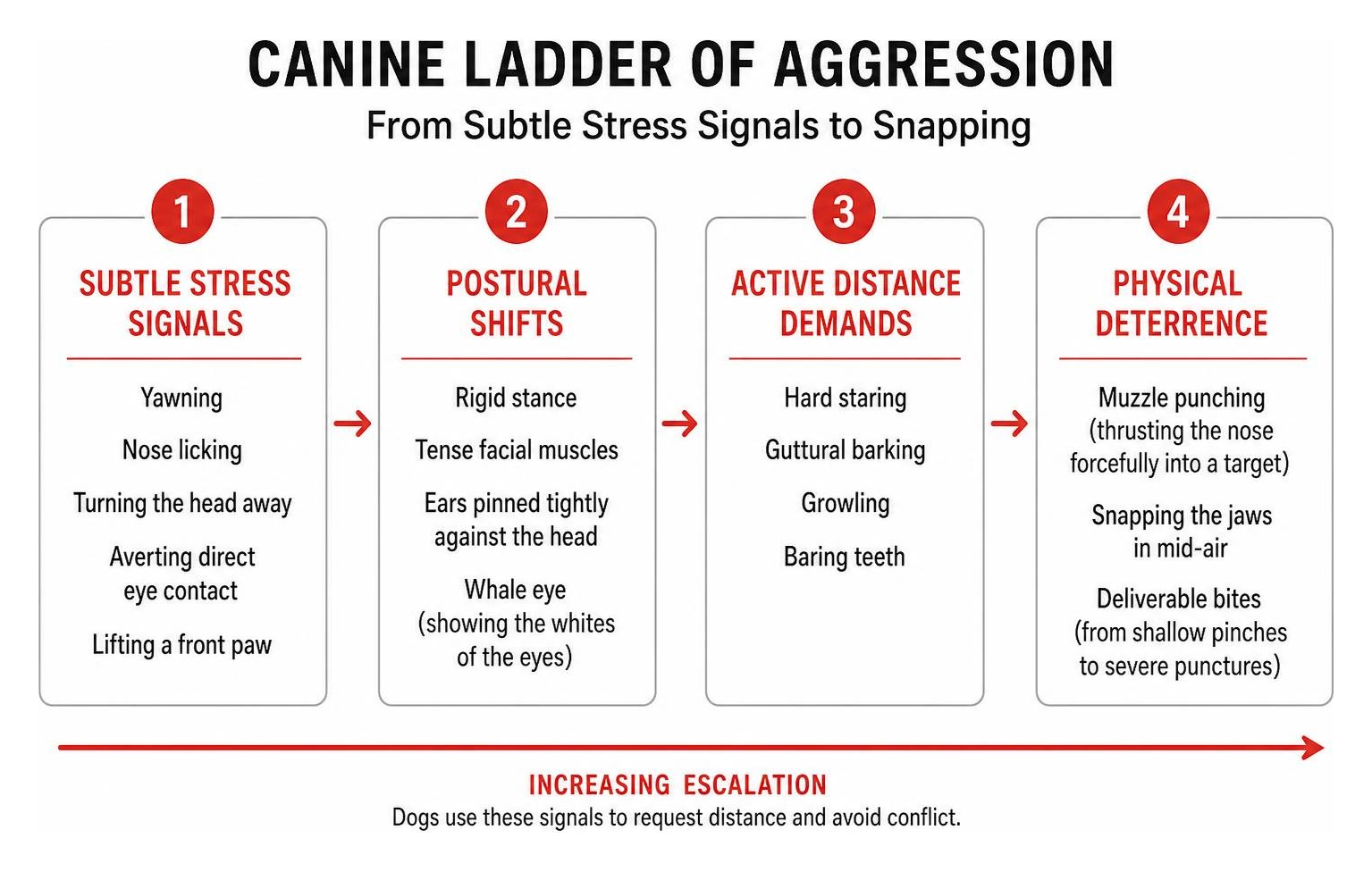
- Subtle Stress Signals: Yawning, nose licking, turning the head away, averting direct eye contact, or lifting a front paw.
- Postural Shifts: A rigid stance, tense facial muscles, ears pinned tightly against the head, or displaying "whale eye" (showing the whites of the eyes).
- Active Distance Demands: Hard staring, guttural barking, growling, and baring teeth. Exploring proven methods to address growling without punishment helps preserve these crucial warning signals.
- Physical Deterrence: Muzzle punching (thrusting the nose forcefully into a target), snapping the jaws in mid-air, and deliverable bites ranging from shallow pinches to severe punctures.
Addressing these warnings at the earliest tier prevents your dog from feeling that louder, dangerous behaviors are needed to be heard.
Evaluating Risk Factors and Reactivity Triggers
Every situation involving behavioral instability presents distinct variables. When planning a modification strategy, consider the core risk factors that affect long-term management:
- Physical Size and Strength: A 75-pound dog lunging at strangers carries a higher physical liability than an 8-pound companion displaying the same underlying emotional trigger.
- Bite History and Severity: Past incidents provide critical data. Dogs with an established history of delivering breaking-skin puncture bites require comprehensive environmental barriers and safety management.
- Predictability: Dogs displaying clear, predictable triggers are simpler to manage than those reacting to rapid, generalized environmental changes.
- Early Development: Missed developmental windows can lead to deficits. Reviewing guidelines on identifying signs of poor socialization clarifies how early isolation impacts adult behavior.
| Aggression Type | Primary Driver | Observable Body Language | Core Behavioral Function |
|---|---|---|---|
| Fear-Based Reactivity | Perceived threat, vulnerability, panic | Low body carriage, tucked tail, whale eye, lip retraction | Create physical distance from the trigger |
| Resource Guarding | Anxiety over losing a high-value item | Freezing over item, hard staring, tense jaw, guttural growl | Protect access to food, toys, resting areas, or people |
| Predatory Behavior | Innate hunting drive, motor patterns | Silent stalking, intense stillness, hyper-focused gaze | Capture and control rapid-moving objects or small animals |
Proven Techniques for Correcting Aggressive Behavior in Dogs
Sustainable behavioral improvement relies on changing the dog's internal emotional response rather than physically suppressing visible symptoms. Humane standards like those found in humane approaches to canine behavioral welfare emphasize positive, reward-centered methodologies that protect canine welfare while ensuring handler safety. Consistently reducing chronic behavioral issues requires systematic handling adjustments.
Veterinary Evaluation and Safety Steps Before Correcting Aggressive Behavior in Dogs
The first phase in addressing reactive or aggressive patterns is a comprehensive medical evaluation. Sudden shifts in temperament or escalations in touch sensitivity are frequently rooted in undiagnosed physical discomfort.
- Orthopedic Discomfort: Conditions such as hip dysplasia, cruciate ligament strains, and osteoarthritis can make routine interactions painful, prompting defensive snaps.
- Endocrine Imbalances: Hypothyroidism and adrenal fluctuations can increase irritability, noise sensitivity, and sudden reactivity.
- Sensory Decline: Age-related hearing or vision loss can cause a dog to startle easily when approached unpredictably.
Alongside medical diagnostics, standard veterinary management protocols for aggressive dogs recommend installing reliable physical safeguards:
- Environmental Management: Employ secure baby gates, solid privacy fencing, and closed window blinds to eliminate visual triggers.
- Double-Leash Setups: Use a secure flat collar alongside a comfortable front-clip harness to maintain physical control during outdoor outings.
- Humane Basket Muzzle Training: Introduce a well-ventilated basket muzzle as a neutral safety tool. Pair the muzzle with positive reinforcers (such as peanut butter or cream cheese) so your dog willingly places its nose inside, creating a reliable safety layer during public exposure or vet visits.
Core Protocols for Correcting Aggressive Behavior in Dogs at Home and on Walks
Reward-based behavior modification pairs classical counter-conditioning with systematic desensitization to build emotional resilience.

- Systematic Desensitization: Expose the dog to a known trigger at a controlled distance, low volume, or low intensity where the dog notices the stimulus but remains entirely relaxed (below threshold).
- Classical Counter-Conditioning: Pair the presentation of the trigger with continuous, ultra-high-value food rewards (such as real chicken, roast beef, or cheese). The stimulus becomes a reliable predictor of good things, changing the dog's emotional state from fear to positive anticipation.
- The "Look at That" (Click-for-Looks) Game: Mark the exact second your dog looks at a distant trigger without barking or stiffening, then immediately deliver a high-value treat. This teaches the dog to check back in with you instead of fixating.
- Emergency U-Turns: Train a cheerful, rapid 180-degree turn on cue indoors. When unexpected triggers appear on neighborhood walks, deploy this maneuver to move away smoothly before your dog reaches its stress threshold.
For detailed walk-management strategies, review our in-depth guide to leash reactivity correction. Proactively addressing spatial frustration is vital for preventing dog-on-dog attacks in common walking spaces.
Managing Aggression in Everyday Scenarios
Tailoring your safety protocols to daily routines minimizes trigger stacking and helps keep your household safe.

- Managing Household Visitors:
- Do not allow an anxious or territorial dog to greet guests at the front door.
- Set up a comfortable resting room equipped with a white-noise machine, chew puzzles, and a secure door or baby gate away from entry points.
- Once guests are seated and calm, the dog can be kept on a fixed leash or behind a barrier, receiving rewards for calm settle behaviors.
- Multi-Dog Household Dynamics:
- Feed dogs in separate rooms with closed doors to prevent possessive friction.
- Pick up high-value resources, such as marrow bones or plush toys, when multiple dogs share common spaces.
- Avoid tight bottlenecks in hallways or doorways where physical proximity can escalate arousal.
- Managing Leash Encounters on Walks:
- Cross the street or use parked vehicles as visual screens when approaching unfamiliar dogs.
- Avoid tight, head-on greetings on narrow sidewalks, as direct approaches are perceived as confrontational in canine communication.
- Integrate structured high-anxiety dog training strategies to keep arousal levels low during outdoor exercise.
- Adult Re-Socialization Frameworks:
- Provide parallel walking opportunities alongside neutral, steady dogs at generous distances rather than unstructured dog-park interactions.
- Refer to our guidelines on socializing adult dogs safely for steady exposure techniques that respect individual comfort zones.
Frequently Asked Questions About Dog Aggression
Can aggressive behavior in dogs be completely cured?
Aggressive behavior is rarely "cured" like an infection; rather, it is modified and managed. Through structured desensitization and counter-conditioning, you can significantly reduce reactivity and teach reliable alternative behaviors. However, environmental awareness, trigger management, and consistent safety routines remain lifelong responsibilities to prevent regression.
Why does punishing a dog make aggressive behavior worse?
Punishing a dog for growling, barking, or lunging suppresses its warning system without fixing the underlying fear or stress. If a dog learns that growling results in physical corrections, it may skip vocal warnings in future stressful situations and proceed directly to biting. Aversive tools also add physical discomfort to an already scary situation, intensifying the dog's negative association with the trigger.
What should I do immediately if my dog snaps or lunges?
Do not yell, jerk the leash, or physically discipline your dog. Focus on creating immediate distance:
- Turn smoothly and move away from the trigger.
- Use a calm, upbeat voice to redirect your dog's attention onto you.
- Place a visual barrier (such as a parked car, doorway, or gate) between your dog and the stimulus.
- Allow your dog's stress hormones to settle before attempting further training.
If your dog displays unexpected conflict at home, review protocols for handling sudden owner-directed growling to navigate the situation safely.
Conclusion
Managing and modifying canine aggression requires patience, realistic expectations, and consistent positive reinforcement. By prioritizing physical safety, ruling out underlying medical problems, recognizing early body language, and using reward-based counter-conditioning, you help your dog build genuine emotional stability.
At Paws University, our team is dedicated to supporting pet parents across Hawaii County with compassionate, science-based behavioral guidance on our spacious outdoor campus. Whether you need structured behavioral support, supervised socialization, or foundational manners, explore our comprehensive dog training programs to help your dog thrive.